


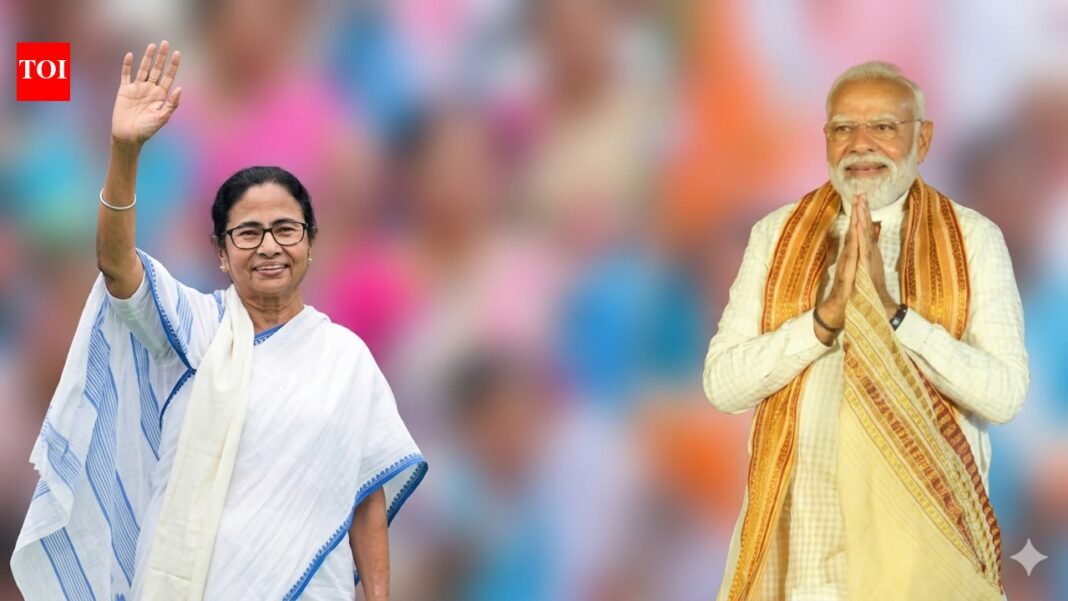
Keira Hobe…This has been the slogan for the past five years Mamata Banerjee used to mock her opponents. But this time, “khela hoye geche” is not what the Trinamool Congress (TMC) imagined. The unthinkable happened, “The lotus blossomed in West Bengal.“The result has redrawn Bengal’s political map, ending the TMC’s 15-year dominance and putting the BJP on the path to forming the state’s first government. It also marks another decisive turn in Bengal’s political history: from decades of left-wing rule, to the rise of Mamata Banerjee in 2011, and now to the breakthrough of the BJP.But how did a party that won 77 seats in 2021 jump to a landslide majority in 2026? This is not a wave built on luck. This is the result of a calibrated strategy to systematically target and undermine the political machinery of the TMC.Here are 10 initiatives that are changing Bangladesh’s electoral landscape:No “Didi…O…Didi” this timeIf the BJP has learned one clear lesson from 2021, it is this: Tone matters in Bengal.At a rally during the 2021 Lok Sabha elections, Prime Minister Narendra Modi shouted out “Didi… didi!” in a mockery of Mamata Banerjee. The TMC seized on this and termed it as an “insult to the daughters of Bengal”.Mamata Banerjee sharply hit back at the time: “They don’t even know how to respect women. It is a disgrace to the president that the Prime Minister mocks a female chief minister like this.” The TMC highlighted this during the campaign, arguing that the remark was not only personal but an insult to Bengali identity, a statement that resonated in a state where women voters have always been a decisive group.The BJP’s aggressive, personality-driven propaganda strategy in 2021 has hit a brick wall. Despite an intensive campaign, the results were unsatisfactory.In 2026, the shift is evident.There was no direct personal attack on Mamata Banerjee. The campaign is no longer focused on personality clashes but on what party leaders say are “systemic issues”, governance, corruption, delivery and law and order. It also enables the BJP to broaden its appeal beyond its core voters, especially among women voters. Follow local leadersThis event is not just happening in Delhi. Union Home Minister Amit Shah has been in the state for a long time and even said he will stay in Bengal “as long as needed” to oversee the campaign. But unlike previous elections, the focus this time has shifted to a national face backed by national leaders. In particular, Suvendu Adhikari, once a close aide of Mamata Banerjee, emerged as the party’s key strategist.The Home Minister chaired around 40 events and extensive organizational meetings to review preparations in all 294 constituencies. Meanwhile, federal ministers and chief ministers from BJP-ruled states fanned out across Bengal to make their presence felt through hundreds of rallies and roadshows.For the BJP, this creates a twin engine: central push and local execution. Adhikari himself emerged as a symbol of this strategy turning into results by defeating Nandigram by more than 10,000 votes.Refuting TMC’s “fish” narrativeAmid the heat of the campaign, Mamata Banerjee sought to stoke cultural panic, warning voters that the BJP would take away something central to Bengali identity: fish. “If they come to power, they will prevent you from eating fish, meat and eggs. They want to turn Bengal into a vegetarian country and destroy our identity,” she said at several rallies.The BJP moved quickly to fight back with optics. Leaders including Union Minister Anurag Thakur were seen openly eating fish during the election campaign, making the allegation a talking point. Thakur was photographed enjoying a traditional fish curry at a restaurant in Kolkata and quipped: “Didi said we will ban fish? I’m eating it now!”The response isn’t limited to senior leaders. In Bidhannagar, BJP candidate Sharadwat Mukherjee campaigned holding a huge hilsa (ilish) to appease fishmongers and vendors.In Jhargram, Prime Minister Narendra Modi made an impromptu stop to buy jamuri at a roadside stall, chatting with the vendors and paying for it out of his own pocket.The message from the BJP is that it is not trying to change the taste of Bengal but just wants to show that it can be a part of it.Countering TMC’s ‘vote chori’ accusationsWhen the massive voter list revision led to the deletion of nearly 9 million names, Mamata Banerjee and other TMC leaders launched a blistering attack, calling it “murder of democracy” and “backdoor NRC”. Speaking at a rally in Birbhum, she said, “What is happening now will go beyond what Super Hitler did. They removed hundreds of thousands of names belonging to a particular community to take away our rights.”However, the BJP stood its ground. Leaders such as Suvendu Adhikari and Amit Shah framed the exercise as a cleansing of “ghost voters” and a necessary correction to a “rigged system”. Taking a jibe at the TMC’s response, Suvendu said: “Pishima is crying because her ghost voter factory has been sealed.”“infiltration” narrativeThroughout the campaign, the BJP repeatedly highlighted the threat of illegal immigration at the border. They succeeded in portraying the TMC as the patron of infiltrators supporting vote bank politics. Amit Shah made clear promises during his 15-day stay in the state:Amit Shah made clear promises during his 15-day stay in the state: “Once the BJP forms the government, not even a bird will be able to cross the border illegally. We will build a security grid to make Bangladesh a bastion for citizens and not a haven for infiltrators. “corruption and governance The BJP’s most consistent attacks have been on day-to-day governance. From recruitment scams to a “chopping” culture, the campaign has turned corruption into a real problem. They have issued a sweeping “charge sheet” against the TMC’s 15-year rule, focusing on a teacher recruitment scam in which the court-ordered cancellation of 25,000 teachers’ appointments became a symbol of systemic corruption.BJP leaders highlighted specific governance failures: denial of Ayushmann Bharat benefits, blockade of central water projects and refusal to implement the Seventh Pay Commission for state employees. Defining the election as a choice between “mafia rule” and “transparent government”. The results show that the party has succeeded in convincing the middle class and the youth that the country’s economic decline is a direct result of the TMC’s model of governance.law and orderLaw and order became a constant talking point for the BJP, which framed the election as a choice between “bhoy” (fear) and “nirapotta” (security). Incidents such as the RG Kar case have been cited repeatedly to question the country’s approach to crime and accountability.In a symbolic move, the BJP even fielded the mother of RG Kar victim Ratna Debnath. Her candidacy transformed the election from a political contest to a pursuit of justice. Prime Minister Modi, who shared the stage with her at a huge rally in Panihati, declared:“This is more than an election; this is a fight for the dignity of our daughters. The soul of Bengal is crying out for justice that Didi failed to deliver. Mother’s tears will now become the foundation of a new, secure Bengal. “The BJP ensured that law and order remained a core issue for voters throughout the campaign.female votersOver the years, Mamata Banerjee’s Lakshmir Bhandar was considered an impenetrable political shield, providing Rs 1,000 to Rs 1,200 to over 2.4 crore women. In 2026, the BJP not only challenged this plan but actually doubled down on the stakes. Under the ‘Matri Shakti Vandan Yojana’, the BJP has promised to provide direct cash transfers of Rs 3,000 per month to every woman in the state.The BJP even sent workers to help women fill up ‘Matrishakti Bhorsa Cards’ (trust cards) even before the polls began. This form-filling exercise created a sense of certainty among rural voters. By combining this financial commitment with 33 per cent reservation for women in state government jobs and the creation of 7.5 million “Lakhpati Didis”, the BJP succeeded in breaking the TMC’s monopoly on women voters, turning a “silent support base” into a saffron wave.Get rid of the “outsider” labelIn 2021, TMC succeeded in branding the BJP as Bohiragoto (outsider). This time, the BJP responded with a clear localization push.Rather than relying too heavily on central leaders, the party highlighted Bengali faces like Suvendu Adhikari, projecting him as a “mati’r chele” (son of the soil). This shift was reinforced by campaign slogans, “Ebar bodol chai” (This time, we want change), “Asol poriborton” (Real change) and “Bangla nijer meyeke chay, kintu shashon poriborton-o chay” (Bangla wants its daughters, but also wants change in governance).Even as Prime Minister Modi and Amit Shah lead the rallies, the message remains rooted in Bengal: language, culture and local issues.“United” FrontOne of the biggest lessons the BJP has learned from its defeat in 2021 is that a divided house cannot be tolerated. In 2026, the Communist Party resolved the internal friction between the “old school and the new school” through a strong united front. The return of veteran Dilip Ghosh to the center stage was a turning point. The BJP’s deployment of the former state president from his old stronghold of Kharagpur Sadar marks a return of command to grassroots workers.By bringing Ghosh back to the core leadership, the BJP ensured that the “original” workers did not feel alienated by the influx of TMC defectors.For the first time, the BJP looks less like a collection of factions and more like a disciplined alternative to the Congress.