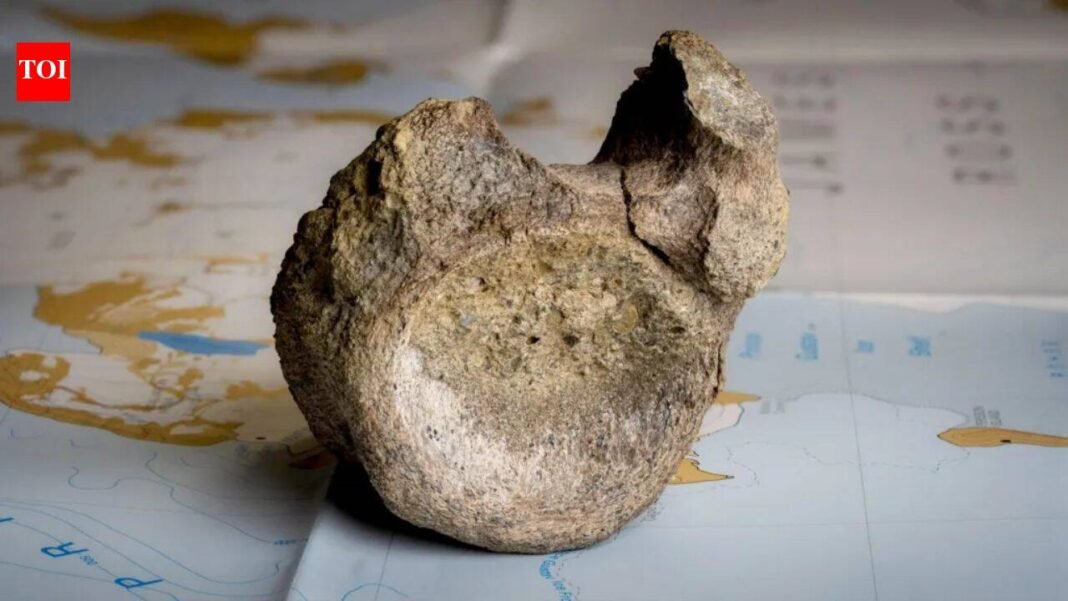
For years it languished in obscurity among thousands of geological specimens, cataloged and stored without much attention. The fossil was collected during an expedition to Antarctica in the mid-1980s and then quietly placed in a museum collection, where it remained for nearly four decades.Until recently, closer inspection revealed that this seemingly inconspicuous specimen had far greater significance than anyone imagined. According to the British Broadcasting Corporation, The fossil, now confirmed as the earliest dinosaur bone found on the Antarctic continent, was found in a drawer. The discovery sheds new light on a landscape that was completely different from the frozen wilderness known today and provides another perspective on a prehistoric ecosystem that is currently only partially understood.
How the earliest dinosaur bones found in Antarctica were hidden for decades
The fossil was originally discovered in 1985 during a field trip to James Ross Island. At the time, those who collected it could not confidently identify it. The specimen, thought to belong to an ancient reptile, was later placed in the geological collection of the British Antarctic Survey in Cambridge. Had it not been revisited years later, its story might have ended there.While reviewing archival material, collection managers reportedly noticed the fossil’s unusual shape. Surrounded by countless specimens collected by Antarctic expeditions over decades, the bone is striking enough to warrant further investigation. Field notes recorded at the time of the discovery provide important clues. A sketch created by geologist Mike Thomson describes the object as the vertebrae of a large reptile. However, drawings and measurements suggest the fossil may represent something more important than initially assumed.
Scientists identify Antarctic fossil as titanosaur dinosaur
To confirm the identity, experts turned to paleontologist Professor Paul Barrett of London’s Natural History Museum. Examination of the fossils revealed features related to titanosaurs, a group of long-necked herbivorous dinosaurs that flourished in the late Cretaceous period. The vertebrae’s special features, including its ball-and-socket structure, match those found in this family of dinosaurs.Titanosaurs occupied many areas of the ancient world and included some of the largest land animals known to science. Some species are unusually large, exceeding 30 meters in length and weighing tens of tons.The Antarctic specimen appears to belong to a much smaller individual. Based on the size of the tail vertebrae, scientists estimate that the animal measured about seven meters from head to tail. Whether it was a young dinosaur still growing or a naturally smaller species remains uncertain.
Dinosaur fossils reveal Antarctica’s ancient forest ecosystem
The discovery is yet another reminder that Antarctica once existed in a very different form.About 82 million years ago, during the late Cretaceous period, the continent was not covered by huge ice sheets. Instead, forests spread across the landscape, creating habitats that could support a variety of animals, including large plant-eating dinosaurs. Although Antarctica was located far south at the time, the global climate was warmer than today. Dense vegetation provides a food source for numerous herbivores, while river, wetland and woodland environments form part of a complex ecosystem.Evidence from this period remains difficult to obtain. Much of Antarctica’s geological history is hidden beneath the ice, and fieldwork is often limited by weather, transportation and logistics. Therefore, each fossil discovery has the potential to fill gaps in an otherwise fragmented record.