


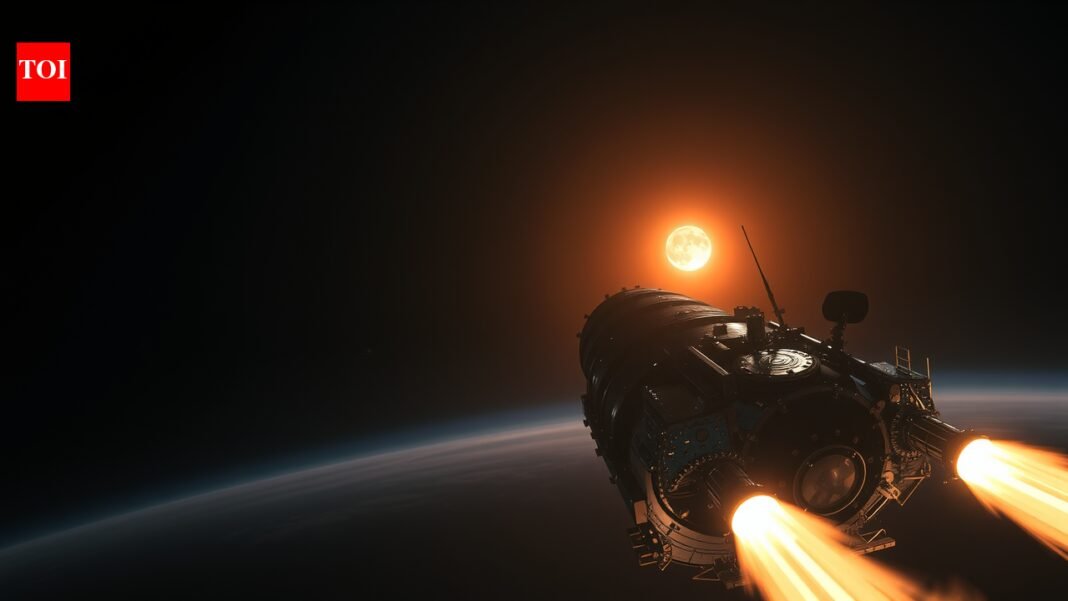
In 1988, the Soviet Union launched two of the most ambitious spacecraft ever launched, not toward Mars itself but toward one of its moons, a tiny, oddly shaped rock called Phobos. This mission was unlike any that had been attempted before. One of the probes carries a hopping robot, literally designed to jump across the surface of an alien moon. Scientists from 14 different countries participated. NASA is helping track spacecraft from Earth. If all went according to plan, the Soviet Union would make history. Instead, one spacecraft was killed by a faulty command from Earth, while another fell silent days before its most important moment. Neither probe has made contact with Phobos.
What is Phobos and why the Soviet Union wanted to explore Mars’ mysterious moon
Phobos is one of two moons of Mars, and it’s a strange one. It is small, only 22 kilometers in diameter, and its origins have long puzzled scientists. Some believe it is an asteroid captured by Mars in its gravity. Others believe it formed along with the planet itself. Regardless, studying Phobos up close can reveal important clues about how the solar system formed.By the mid-1980s, Soviet space planners were aiming for more than simple Mars orbiters and flybys. They want to study Mars from orbit, see how the solar wind interacts with Mars, and, most ambitiously, actually land something on Phobos. according to NASA’s HEASARC mission archivesThe Phobos mission aims to study Mars and its moons simultaneously, a mission that has never been done before.
The Phobos spacecraft was the largest interplanetary probe built by the Soviet Union
Both spacecraft weighed more than 6,200 kilograms when fully fueled, making them among the largest interplanetary probes launched at the time. They’re packed with scientific instruments, cameras, spectrometers, X-ray and gamma ray detectors, plasma analyzers, magnetometers, dust detectors and more. These are not simple photography boats. They are essentially flying laboratories.What’s really special about this mission, however, is what the probe is carrying to the surface of Phobos. One of the landers is a standard fixed science platform. The other one called PROP-F is something completely new. Because Phobos’ gravity is so weak (about 2,000 times weaker than Earth’s), the wheeled rover could float away. So engineers designed a robot that can move by jumping from place to place, analyzing rocks, magnetic fields and surface chemistry as it goes. This will be the first jumping robot to operate in another world.
How a faulty software command killed Phobos before it reached Mars
Phobos 1 launched in July 1988, and everything seemed fine until a routine software upload went wrong. An erroneous command accidentally shut down the spacecraft’s attitude control system. The system keeps the spacecraft oriented correctly in space, ensuring its solar panels are always pointed toward the sun.Without it, Phobos 1 would slowly drift off course. Its solar panels stopped receiving sunlight. The battery is exhausted. In this way, the spacecraft remained silent forever billions of kilometers away from the earth, and was never heard from again. It never even reached Mars. It remains one of the most famous software errors in all of space history, a reminder that in space, one errant line of code can end a billion-dollar mission in minutes.
How Phobos 2 reached Mars and spent two months sending back valuable science
The second spacecraft, launched a few days after the first, had much better luck, at least initially. After a seven-month journey, Phobos 2 successfully entered Mars orbit in January 1989. For nearly two months, it conducted truly impressive scientific research. It studies the dust on Mars, the interaction of the solar wind with the planet, the magnetic field around Mars, and sends back 37 close-up images of Phobos Many are clear enough to show surface features as small as 40 meters across. These are some of humanity’s best images of the moon in years.The mission also used infrared data to map Mars’ early mineralogy and improve scientists’ understanding of how the solar wind stripped particles from the Martian atmosphere over time, a process linked to why Mars, which once had a thicker atmosphere, became the barren planet it is today.
Phobos 2’s final days and how the mission ended before its greatest moment
The goal of the entire mission is one thing: get close enough to Phobos to release two landers. The plan is to bring Deimos close to the lunar surface about 50 meters before letting the lander depart. On March 27, 1989, just days before this happened, the spacecraft fell into complete silence.An investigation later concluded that the onboard computer was the most likely cause of the failure, although problems with the radio transmitter may also have played a role. When Deimos reaches Mars, Several onboard computers have experienced problemsleaving very few backups. Neither lander has ever been deployed. The mission ended at the worst possible moment.
What the Phobos mission accomplished and why it remains important in the history of space exploration
Although both spacecraft failed before completing their primary goals, the Phobos program was not a complete failure. The scientific results of Phobos 2’s return resulted in the publication of dozens of research papers in the early 1990s and contributed to real-world knowledge about the Martian atmosphere, magnetic environment, and its lunar surface. Over the years, close-up images of Phobos remain some of the best available.The mission was also an outstanding example of international scientific cooperation during the Cold War, with researchers from 14 countries contributing and even NASA providing tracking support. It was one of the most extensive scientific collaborations of its time.But the Phobos program also reinforced a painful pattern in Soviet and later Russian planetary exploration: Technically impressive spacecraft crashed repeatedly due to software glitches, electronic glitches or bad luck. The Mars 96 mission and the Phobos-Gruot mission were unsuccessful over the next several decades, leaving Phobos as one of the most tantalizing and least explored destinations in the solar system. A hopping robot that never jumped and a moon that was never touched remain one of the most haunting what-ifs in space history.