


There’s a sound that accompanies growth in many Indian kitchens – the sound of silpata crushing coconut, chillies and spices into a coarse mixture. Modern mixer grinders long ago replaced this ritual, but they also replaced the texture that came with it, turning almost everything into a smooth paste.


Don’t delay upgrading
Explore personalized EMI offers on your next purchase
Atomberg believes its new Zenova Mixer Grinder can restore some of the texture. The company claims its coarse mode can recreate the consistency of stone-ground chutney while offering the convenience of a modern mixer grinder. It was enough to make me curious and skeptical. I took the time to test the Zenova’s performance, rough mode, build quality, and day-to-day usability to see if these claims hold up in a real kitchen.
what’s in the box
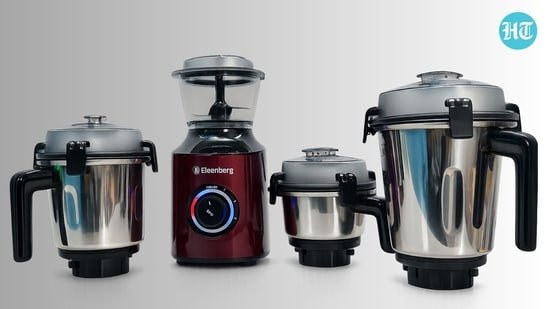
The Atomberg Zenova mixer grinder comes with a compact base and four stainless steel jars – a 1.5L liquidizer jar, a 1L multi-purpose jar, a 0.5L chutney and spice jar and a 0.5L chopper jar. It’s available in black, burgundy, pearl white, and several finishes with brass or copper trim, though the color doesn’t affect anything but its appearance.
One design choice worth noting: There are no vents in the motor housing. BLDC motors don’t require the airflow for cooling that standard AC motors rely on, so Atomberg sealed the body. The bonus is that over time, flour and chutney don’t get into the motor, which is a common failure point with traditional mixers. The trade-off is that the lack of a visible airflow path makes it more difficult to tell from the outside how hard the motor is working at any given moment; you’re relying on LED indicators rather than intuition.
Atomberg Zenova Mixer Grinder Review: Performance, Motor and Features
The Atomberg Zenova mixer grinder has 550W BLDC power, which is equivalent to a 1000W AC motor. Wattage and effective grinding power are not the same thing, so it’s not an unreasonable statement, but it’s also not something to accept just because a brand says so. The advantage of a BLDC motor is variable, efficient speed control rather than raw power; it can run 2,000 RPM tasks at much lower power than an AC motor would need to get down to that range. Whether this translates into “1000W equivalent” performance for real tough ingredients (dried turmeric, whole spices, hard legumes) is the real part to be tested, not the marketing line.
In practice, both turmeric sticks and dry masala are ground without audible motor straining sounds or a burnt smell, which is a reasonable standard for cleanup. This proves that the motor is more than capable of handling tough ingredients. By itself, this doesn’t prove it’s a match for a 1000W motor in every use case – short test cycles won’t validate heavier, longer-duration loads.
Coarse mode: what it actually does and doesn’t do
Coarse mode runs at about 5,000 RPM, well below the motor’s 18,000 RPM limit, and its purpose is to stop grinding before everything becomes even and smooth. Testing the same ingredients on the regular speed setting, the difference was measurable: The chutney made in coarse mode retained small pieces of coconut and chilli, rather than becoming a single blended paste. This part of the claim was tested.
What it does is not exactly replicate a stone grind. The silbatta works by squeezing and shearing in an irregular human rhythm. Coarse mode still has the blade spinning at a fixed lower speed, producing a rougher texture, but not quite the same. Calling it “sil-batta-like” is more accurate than most such marketing comparisons, but it’s an approximation, not a replacement. It’s worth knowing before paying extra specifically for this feature.
For everyday tasks like idli batter, wet grinding and dal for vada batter, the Zenova performed within the expected range of a mid-to-high-end blender. The batter is smooth and there is no significant heating, which is important for later fermentation. The pulse button jumps the motor up to 18,000 RPM for a short period of time, useful for thicker loads where standard speed settings are a little difficult. None of this is exceptional. It is qualified, which is a more relevant standard for kitchen appliances used daily.
More important features than expected
The more convincing aspects of this product are its security and usability. The jar lock system, fault alarm, and restart protection are not eye-catching features, but they solve common annoyances associated with traditional mixer grinders. These additional features make the device feel more modern without fundamentally changing the way it is used.
That said, electronic systems also introduce additional points of failure compared to purely mechanical designs. Long-term reliability will ultimately determine whether these features continue to be advantageous after years of use.
chopper tank
The 0.5-liter chopper tank automatically limits the motor to around 2,000 RPM when locked, eliminating the need for any manual speed selection. The result is chopped onions and tomatoes that retain their shape rather than turning into a wet, semi-blend mixture that would normally be accomplished using a grinding jar for the same task. This is a real functional difference, not a cosmetic one; the automatic speed limiter feature really makes a difference here. However, it’s a small jar, suitable for single-meal sizes rather than batch preparations, and it doesn’t replace a knife for anything other than basic dicing.
Build, Noise and Limitations
Noise levels are lower than older AC motor blenders, although “quiet” is a relative term; a hum is still audible at the highest speed setting. At full rpm, the base feels stable on the counter, without the vibration-induced movement that some lighter blenders exhibit.
These limitations are straightforward rather than dramatic. If your kitchen outlet isn’t close to your preferred counter space, the cord may be shorter than ideal. The smaller size of the 1 liter multi-purpose jar makes it suitable for batch cooking in large households, which means larger quantities need to be refilled more frequently. The overall feature set (apart from the rough mode) doesn’t significantly exceed what’s offered by competing mixers in the same price range.
final verdict
The Atomberg Zenova is one of the few mixer-grinders trying to rethink a product category that has remained largely unchanged for years. Not every innovation here will be equally useful for every home, and depending on cooking habits, some features may be more relevant than others.
Its strongest argument isn’t raw performance, but overall user experience. Kibble mode provides a real point of differentiation, while safety and convenience features add a layer of refinement not often seen in this category.
However, buyers should view this as a premium mixer grinder with a different philosophy rather than a direct replacement for traditional high-power models. Zenova succeeds in bringing fresh ideas to the market, but whether those ideas are reasonably priced ultimately comes down to how much users value convenience, control, and modern design.
Check out these products from Atomberg:
Disclaimer: At Hindustan Times, we help you stay updated with the latest trends and products. Hindustan Times has affiliate partnerships, so we may get a share of the revenue when you make a purchase. We are not responsible for any claims relating to the products under applicable law (including but not limited to the Consumer Protection Act 2019). The products listed in this article are in no particular order of preference.