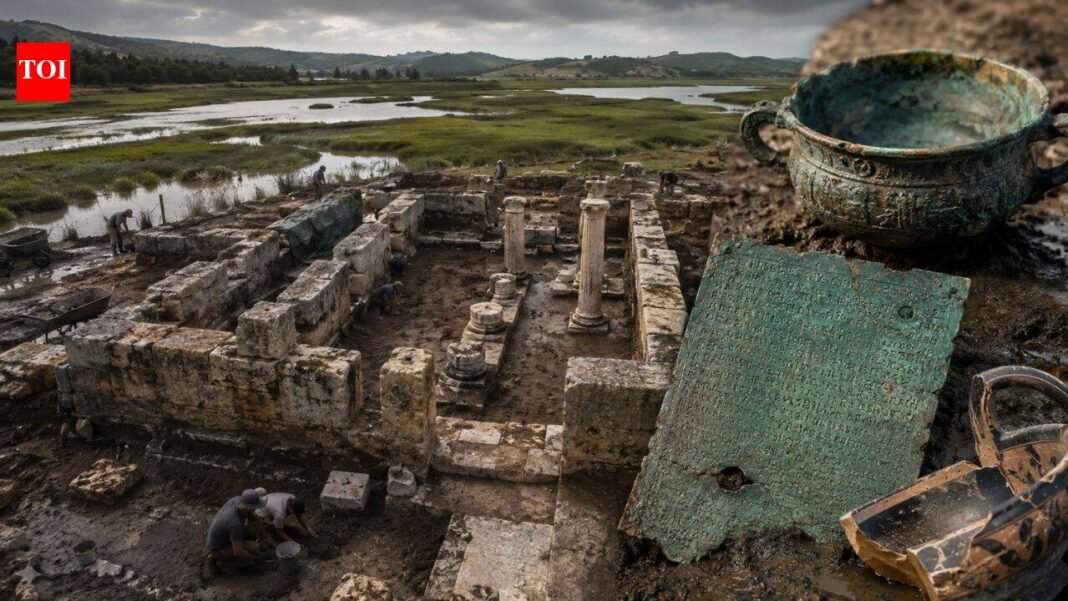
The landscape on the western edge of the Peloponnese is never completely still. The shoreline changes, wetlands expand and shrink, and what once stood next to open water is gradually trapped by layers of mud and reeds. Ancient writers recorded many of these sites with surprising confidence, but environmental changes over the centuries have often left descendants unsure whether these places ever existed in the form described. Among these lingering mysteries is a sanctuary linked to Poseidon, a god whose reach extended far beyond the ocean itself. The temple appears in extant geographical records, but its exact location remains uncertain. For a long time it seemed to fall somewhere between recorded history and local tradition. Now, after years of archaeological work near Samicon in southern Greece, traces of the temple have emerged from the ground where they had been hidden for more than two millennia.
forgotten origins Poseidon Sanctuary
In ancient times, the coast near Samicon was closer to the sea. Meanwhile, the low-lying land behind it is vulnerable to flooding and gradual environmental transformation, Greek City Times reports.Ancient descriptions place Poseidon’s sanctuary in the area, serving communities scattered across the Ilis region. It is not an isolated rural sanctuary. The site appears to have been of shared importance to neighboring settlements, providing a place where religious rituals and regional identity intersected. However, over centuries, water and sediment changed the terrain. Swamps cover various parts of the coast, obscuring buildings that once stood in more open surroundings.As the environment changed, the sanctuary also disappeared from view. In modern times, only written references hint at its former existence.
How archaeologists track Hidden Sanctuary of Poseidon
Interest in finding this temple is not new. For decades, archaeologists and historians have tried to connect ancient descriptions to real locations. Early surveys of the area revealed some interesting architectural remains, including a large number of stone buildings, indicating efforts to manage water resources in an area prone to flooding.These clues are never enough to solve the problem. The landscape itself complicates matters. Swamps, shifting soils and sediments accumulated over centuries make it difficult to determine where important structures still exist beneath the surface.A more systematic excavation campaign finally gathered momentum in the early 2020s. As the trenches expand and buried architectural elements come into view, a clearer picture begins to emerge. The first scattered remains began to reveal the outlines of a large shelter complex.
What the unusual design of the Temple of Poseidon reveals
Foundations found at the site indicate that the building differed from many familiar Greek temple layouts. Rather than being a simple arrangement centered around a sacred room, the structure contains two main rooms connected by a shared entrance area.This arrangement attracted special attention because it suggested a more complex function than mere worship. One part may have housed worship spaces related to Poseidon, while another part may have housed activities related to the neighboring communities who used the sanctuary.The building itself is solidly built. Thick masonry walls and deep columns demonstrate awareness of the local environmental challenges. The building appears to have been designed with durability in mind, an understandable choice in a terrain where wet and unstable ground has always been a concern.Roof fragments found during excavations indicate the use of styles related to Laconia tradition. Curved terracotta elements form part of the cladding system, adding another regional character to the sanctuary’s appearance.
What findings at Poseidon Reserve tell us
The most illuminating discoveries don’t just come from the walls and foundations. Some artifacts provide a glimpse into the activities that once took place within the sanctuary. These include a beautifully crafted marble basin that was used in purification rituals. These objects were common in ancient Greece and allowed people to ritually purify themselves before entering the sanctuary.Among them is a beautifully shaped marble perirranterion (ceremonial basin), carved to imitate a bronze cauldron and likely used for purification rituals before entering the sacred space, Greek City Times reported.There are also the remains of a Late Classic period painted cantalus, a double-handled drinking vessel from the 4th century BC, often associated with ritual or religious use.Another discovery included a bronze plaque that was once part of the temple’s wall decoration. Although further conservation efforts may help clarify its meaning, the inscription remains difficult to read.
How builders protected Poseidon Sanctuary from flooding
Evidence from the site suggests that its managers were forced to respond repeatedly to environmental pressures. Rising groundwater appears to have posed ongoing challenges, particularly in the later stages of the temple’s use.Reportedly, extensive renovations were carried out at some stage between the 4th and 3rd centuries BC. Roofing materials were replaced, but derelict elements were not simply thrown away. Instead, builders repurposed them under new floor surfaces, creating a stabilizing layer designed to improve conditions inside the structure.The solution involves less major engineering and more about practical adaptation. Those responsible for maintaining protected areas appear to have recognized the difficulties posed by the surrounding landscape and responded with an approach that balanced available resources and local knowledge.
Poseidon Sanctuary’s connection to ancient waterways
Modern descriptions often see Poseidon as the ruler of seas and storms, but ancient worship linked him to a wider body of water. Springs, rivers, lakes, and wetlands are all within his scope.This broader connection helps explain the location of the sanctuary. Temples located near marshes and coastal lagoons were not surprising to ancient visitors. Rather, this setting may have reinforced the god’s relationship with various forms of waterways.