

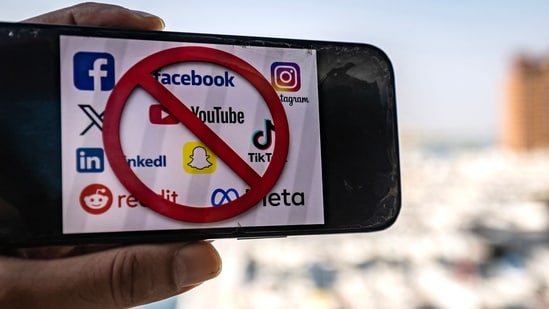
British Prime Minister Keir Starmer announced on June 15 that the country would ban everyone under the age of 16 from accessing a range of social media sites, including TikTok, Instagram, YouTube, Facebook, Snapchat and X. The UK Parliament is due to approve legislation before the end of this year, with the ban expected to come into force in spring 2027.

The government says enforcement will target technology companies, not children. Social media companies that fail to prove they have taken “reasonable steps” to prevent children from using their services will face hefty fines.
“Every parent can see for themselves. Social media makes children unhappy,” Starmer said when announcing the policy.
Starmer said the ban was influenced by Australia’s experience and the UK would go further. He did not deny that some teenagers would find ways to get around the limit, but argued that enforcement difficulties had never been seen as a reason to abandon the drinking age limit.
A few days later, on June 18, UAE announced A resolution banning social media use by children under 15, among other restrictions on youth access to such apps.
Also read: Defining social media addiction
global wave
The UK and the UAE are the latest in a series of countries to have legislated or are moving ahead with restricting children’s access to social media.
Australia has set the template. The Cybersecurity Amendment (Minimum Age for Social Media) Bill 2024 came into effect on December 10 last year, making Australia the first country to impose nationwide restrictions. Under their laws, Instagram, Facebook, Threads, Snapchat, YouTube, TikTok, Reddit, Twitch, X and Kick must take reasonable steps to prevent users under 16 from holding accounts.
Companies that fail to comply face fines of up to A$49.5 million (approximately US$32 million). The Australian government said that within weeks of the ban, nearly 5 million accounts identified as belonging to children were closed, and it would take action to delete another 300,000 accounts by March 2026.
Indonesia implemented similar age restrictions in March 2026, covering platforms that could expose young people to addiction, pornography, online fraud and cyberbullying. Brazil has enacted a law requiring people under 16 to link social media accounts to a legal guardian, while also banning addictive platform features such as infinite scrolling.
Canada legislated this year to establish a Digital Safety Commission, which would have the power to ban children under 16 from using social media unless social media companies prove they have removed harmful content. Malaysia has also asked social media apps in the country, which has more than 8 million users, to prevent users under the age of 16 from holding accounts. France, Spain, Denmark, Greece, South Korea and Thailand are studying or advancing similar measures.
HT reports In February this year, the Indian government was considering age-related restrictions on social media usage.
Social media companies are expected to oppose the restrictions. Meta, which owns Instagram and Facebook, warned that such restrictions would put children at greater risk. In response to the UK statement, a Meta spokesperson said: “As we have seen in Australia, bans have the potential to isolate teenagers from online communities and information and force them to turn to unregulated alternatives that lack built-in protections and parental controls.” Alphabet’s YouTube similarly warned that “blanket bans can turn children away from carefully curated, supervised and rewarding experiences and towards anonymous, less secure services.”
How Australia implemented the ban
Because most restrictions are only in place for a few months in other countries, Australia’s example remains the most comprehensive to date. A key enforcement issue is ensuring that social media companies reliably determine whether a user is under 16.
Prior to imposing restrictions, the Australian government commissioned an independent Age Assurance Technology Trial (AATT) to assess the accuracy, usability, privacy concerns and accessibility of verification methods. Its findings influenced subsequent guidance issued by Australia’s online safety regulator, the Electronic Safety Commissioner.
The guidance recommends against a single mandatory approach and urges companies to allow for a layered system to detect when underage users attempt to open or operate an account. Social media companies cannot rely solely on a user’s declared age (the age a user submits when registering an account) to comply with the ban.
For example, one such method is age inference. Social media applications can leverage existing behavioral data such as IP address geolocation, device history, usage patterns, vocabulary in posts, and interest groups the user follows to flag accounts that may belong to people under the age of 16.
The other is facial age estimation. Companies can work with third parties to verify age through artificial intelligence technology. In simple terms, users submit a selfie or video selfie, which is analyzed by the software to come up with an estimated age range. To mitigate privacy concerns, companies that verify age do not store images after generating age estimates.
The third method is authentication. Social media companies can ask for identification documents or check a user’s age through a bank or email service. In these cases, the user can provide credit card details and the company can contact the bank to confirm only the user’s age.
Compliance is not a one-time check. Social media companies should continually monitor behavioral signals and take action if they suspect a user may be underage.
Also read: A global reassessment of social media for youth
Bypass restrictions
Even with government restrictions, teenagers have found ways to break through.
Within days of Australia’s restrictions, social media was flooded with posts from young people claiming they were still online.
Journalists also documented the many ways children circumvented the ban. The Washington Post reported in December 2025 that a 14-year-old girl from New South Wales said she could bypass facial inspections by having her mother scan her face on her behalf.
One Reddit user suggested using masks sold on Chinese e-commerce platforms to confuse age recognition systems, Fortune reported.
More commonly, teens turn to VPNs (virtual private networks, software that routes internet traffic through servers in other countries) to mask the user’s actual location and bypass geo-restrictions.
But VPN issues are expected in Australia. Information Age, a publication that covers the country’s technology policy, reported that eSafety told companies they could use the service to detect VPN usage and cross-reference IP intelligence data to spot users trying to circumvent restrictions.
According to Time magazine in April this year, Australian Communications Minister Anika Wells expressed confidence that the large amount of user behavior data held on the platform will eventually catch those who use borrowed credentials or location blocking tools.
Also read: Anti-social: Why young people are quietly quitting social media
Has the ban worked?
Between January 19 and February 2 this year, eSafety Australia conducted a survey of 898 parents and guardians of children aged 8 to 15 years old. The survey found that nearly half (49.7%) of parents surveyed said their children had an account on at least one social media platform before the restrictions. After the ban came into effect, this proportion dropped to 31.3%.
“Reductions in account ownership were observed across 10 platforms,” the company said in a report in March.
But the regulator also noted that despite the reduction, “a significant proportion of under-16s maintain accounts on age-restricted platforms”.
Another survey of 1,050 Australians aged 12 to 15, conducted in April 2026 by suicide prevention organization the Molly Rose Foundation, found that more than 60 per cent of children who had social media accounts before the ban still had access to at least one account.
About two-thirds of respondents also said the companies had taken no action to restrict their accounts. Fortune reported in April 2026 that the foundation’s CEO described the results as “significant questions about the effectiveness of Australia’s social media ban.”
(Based on input from each agency)