


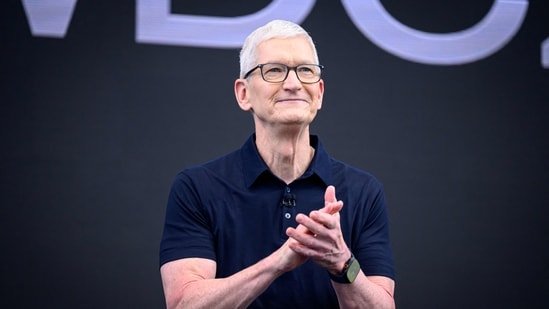
In Tim Cook’s final keynote as CEO before handing over the reins of Apple to John Ternus, the tech giant highlighted an updated long-term strategy for artificial intelligence (AI) at the Worldwide Developers Conference (WWDC). At the same time, next-generation versions of all product operating systems are poised to evolve the personalities and collective ecosystems of iPhone, iPad, Mac, Apple Watch, and Apple TV.

“I’m so grateful to be on this journey with you,” an excited Cook said, thanking developers and the Apple community. “Developers are building more apps than ever before,” he said, pointing to the momentum that defines user app experience. Developers are now submitting 1,000 new apps to the App Store every hour.
Also read:
The focus areas are platform improvements, trust and security, and Craig Federighi, Apple’s senior vice president of software engineering, called Siri a huge leap forward. macOS Golden Gate, for example, is built with “attention to detail,” he said.
Following last year’s full rollout of its transparent-inspired Liquid Glass interface, Apple is making further improvements, such as better diffusion of content for legibility and depth effects. There is now a slider option for transparency and tint settings. Interface adjustments have been made across applications, including controls and how text is presented.
Apple insists parts of all operating systems have been redesigned to be more responsive, meaning iPhone and iPad apps now launch 30% faster. Content processing and data transfer between devices is also faster. The CPU scheduler on iPhone has been redesigned to improve compute allocation. This will support iPhones as early as iPhone 11, marking a new improvement in performance for older iPhones.
Apple is adding a suite of child safety features. After setting up a children’s account on an Apple device, parents will be able to control what content their children can see, who they can talk to, and broader guidance on digital content consumption. Parents will be able to unlock content and apps at any time, including which apps their kids can download from the App Store and which websites they can now access on their iPhone, iPad, or Safari browser on their Mac.
Parents still need to approve all downloads, or approve conversations with new contacts. Parents can also get daily child allowance suggestions for different app categories. Apple is providing developers with a full suite of tools.
Writing a new chapter in artificial intelligence
It’s long overdue for Apple’s AI puzzle. The smarter Siri, expected to rival popular AI chatbots, debuted in 2024, but has yet to reach the climax of its rollout so far. It’s likely that, with Gemini providing the basis for Apple’s base model that now emphasizes Siri’s AI companion capabilities, Apple has more confidence in Siri’s ability to perform a variety of tasks beyond conversation.
“Some people seem to be moving forward and seem to be pursuing AI for AI’s sake without explicitly thinking about the people,” Federighi said without mincing words when describing the current AI landscape.
Apple Intelligence is evolving with the Apple Foundation model and will now be integrated into Google’s Gemini model. These will be calculated on the device and online depending on the task. Reasoning, visual understanding, and generation are some of the key elements. Utilities remain key to Apple’s AI integration, including a new contextual system coordinator.
Before generating an answer, Spotlight search and powerful semantic indexing will find context and content while finding the latest information on the web.
Earlier this year, Apple and Google announced a multi-year partnership, saying the latter’s Gemini model and cloud technology would provide the foundation for Apple’s smart features. With the inclusion of powerful AI assistants in iOS 27 later this year, many users will see significantly less need for separate subscriptions, including OpenAI’s ChatGPT and Anthropic’s Claude.
For specific tasks and queries, there will be specific application actions, integration across applications, and screen awareness will have the context of what the user is watching or seeing. Siri AI will now integrate personal contextual understanding, application action, broader state awareness, image understanding, and access to extensive world knowledge.
Federighi noted that while most AI companies talk about privacy, by default most retain users’ conversations for model training. Apple does not store any user data and only uses it to perform tasks or generate requests. Apple is ready to call on experts to verify this claim.
For users, the ability to combine responses and tasks with information on Apple devices will unlock a deeper level of usefulness. You can start a chat with Siri AI on one device and continue on another. Some options will also be available on Apple Watch.
While Apple’s AI focus officially begins when iOS 27, iPadOS 27, macOS Golden Gate, watchOS 27, and tvOS 27 coincide with the launch of the next-generation iPhone later this year, Apple has clear intentions to make improvements and improvements with a focus on performance and battery conservation.
Last year’s operating systems, including iOS 26 and iPadOS 26, also ushered in naming scheme changes.