


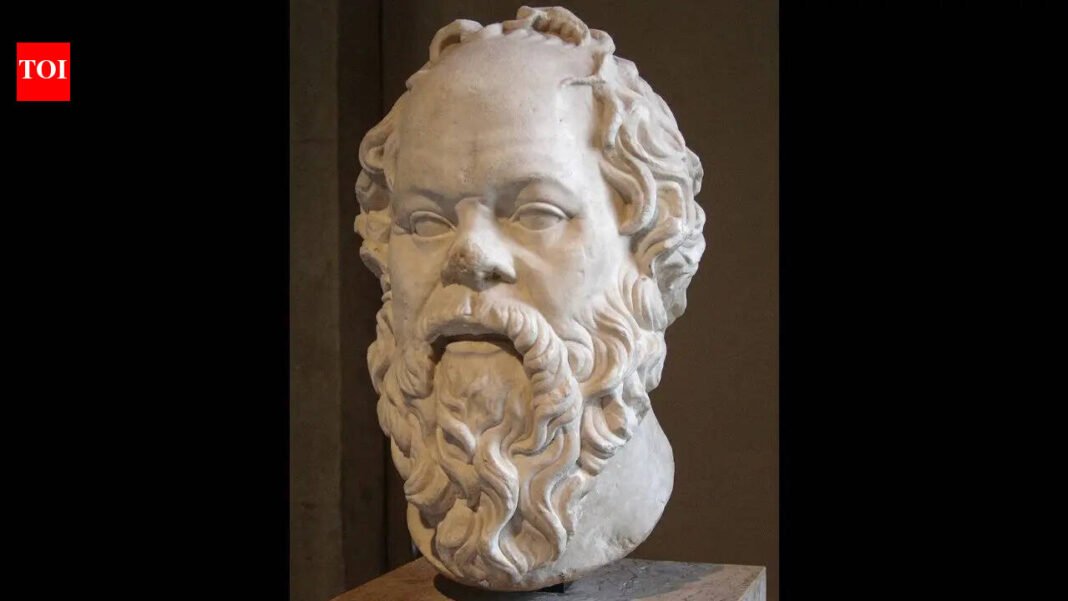
This quote is one of those quotes that never really leaves circulation. It appears in articles, social media posts, and casual conversations about relationships. It sounds ancient, a little humorous, and a little provocative at the same time.But there’s a layer behind it that people don’t always stop to think about. This is not just a joke about marriage. It reflects an ancient philosophical way of viewing life, relationships and personal growth through discomfort and experience.Whether Socrates actually said this in this exact form is another question. Still, the ideas attached to it have spread widely enough that it has taken on a life of its own.That alone is interesting.
Socrates’ quote of the day
“Marry no matter what; if you marry a good wife, you will become happy; if you marry a bad wife, you will become a philosopher.”
The meaning behind Socrates’ words
On the surface, this statement is simple. It sees marriage as a bifurcation of experience. One path leads to happiness, the other to intellectual development. It’s this contrast that makes it memorable.But the deeper meaning is not marriage itself. It’s more about how humans respond to life situations that they have no complete control over.In the framework of this sentence, “good wife” represents harmony, emotional stability and ease of daily life. Things are going well. Life feels settled. I feel very comfortable and don’t have much inner conflict.A “bad wife,” on the other hand, represents tension or difficulty. Not necessarily in a literal sense, but as a symbol of friction in an intimate relationship. According to the idea, this friction forces people to reflect. It forces people to question. It forces people to think.This is where philosophy comes into play.So this sentence isn’t really a ranking of spouse types. It points to two different human outcomes. Comfort can bring happiness. Difficulties can lead to introspection.Sometimes, the two occur simultaneously in real life, just not with such a clean separation.It also reflects the ancient philosophical belief that pain or discomfort often produces deeper thought. Many ancient thinkers believed that wisdom comes not from comfort but from challenge.Today’s tone may sound humorous, but the underlying structure is quite serious. It’s about how people are shaped by the conditions they experience.And relationships, especially intimate relationships like marriage, often exacerbate these conditions.
The background and origin of Socrates’ words
This quote is widely attributed to Socrates, but historians and scholars often point out that it did not appear directly in his original recorded dialogue.Much of what we know about Socrates comes from the writings of his students, especially Plato. Because of this, many of his statements are actually later explanations, summaries, or even cultural additions developed over time.This statement is often viewed as a traditional proverb rather than a verified historical statement. It has been repeated so often that it has become somewhat detached from its origins.That doesn’t mean it’s meaningless, but it does change the way it’s read. Rather than thinking of it as the strictly philosophical teachings of Socrates himself, it might be more accurate to think of it as a distillation of “Socratic” reflections on life and relationships.The humor is also more modern than classical Greek writing. This is another reason why scholars sometimes question its origins.Still, the connection to Socrates remains strong, as the idea fits into his broader philosophical approach. He often focuses on questioning assumptions, examining human behavior, and exploring how people thrive in discomfort.So even though the quote isn’t technically his, the spiritual feel of the quote is consistent with his way of thinking.
Life lessons hidden in thoughts
One way to read this quote is as a comment on unpredictability. Life doesn’t always give predictable results. Choices make for different experiences, and not all experiences are comfortable.In this framework, marriage often becomes a metaphor for long-term commitment. Not just romantic relationships, but any deep, shared human relationship with an uncertain outcome.Sometimes people go into a relationship expecting stability and end up getting it. Other times, they go in expecting stability, only to find complexity, disagreement, or emotional tension.This quote shows that both outcomes have value, just in different ways.Happiness is actually very simple. It feels good, it settles life, it brings ease.In this sense, philosophy is more than just academic thinking. This is a reflection that arises from difficulties. When life gets complicated, people tend to ask deeper questions. Why things are like this. What should be changed? How meaning is constructed.The tone of this statement is slightly sarcastic, but also quietly accepting of the unpredictability of life.It does not promise control. It just goes to show that no matter what happens, something will be gained.
Why this quote still attracts attention today
One of the reasons this quote continues to circulate is its blend of humor and discomfort. People saw the joke on the surface, but also sensed something more serious underneath.Modern relationships are discussed much more openly these days. People talk about compatibility, emotional labor, communication styles and expectations. In this context, the quote feels oddly relevant, if somewhat hyperbolic.It captures a feeling that many people understand but rarely speak outright. Close relationships can shape personality in unexpected ways.Not always extreme, but gradually. quietly.Some people think this is cynical. Others see it as playful wisdom. Some saw this as a warning. Most people just share it because it sounds smart and a little provocative.This is often how these ancient quotes survive in modern culture. Not because they are completely accurate, but because they are flexible enough to accommodate multiple interpretations.And this one is very flexible.
Misconceptions and modern frameworks
It is important to note that reading this sentence too literally can be misleading. This does not mean that marriage is destined to produce happiness or suffering in fixed ways. Nor does it suggest that partners can be classified in any meaningful sense into “good” or “bad” categories.Real relationships are much more complex. They change over time. They develop based on communication, shared experiences and external pressure.What this sentence really does is compress a wide range of human experience into a simple binary structure. This makes it memorable, but also incomplete.In modern psychology, relationship dynamics are often discussed in terms of compatibility, emotion regulation, attachment styles, and communication patterns. None of this fits neatly into a simple framework of happiness and philosophy.Still, this quote is shared because simplicity often spreads faster than accuracy.Sometimes people don’t look for accuracy. They are looking for something that reflects a certain feeling.
A closer look at Socratic thought
Even if the wording is controversial, the idea is loosely tied to the spirit of Socratic philosophy. Socrates was famous for questioning assumptions rather than accepting simple answers.His approach to life often involves conversation, reflection, and intellectual discomfort. He believed that wisdom comes from recognizing what you don’t know.In this sense, the “becoming a philosopher” part of the sentence is symbolically consistent with his legacy, even if not historically accurate.For Socrates, philosophy was not a profession or an identity. It’s a way to fit into life. Constant questioning. Keep checking.So when the quote says that difficulty leads to philosophy, it’s loosely consistent with that worldview, even if it reduces it to a humorous contrast.
Other quotes from Socrates
“The unexamined life is not worth living.”“I know I don’t know anything.”“To find yourself, you have to think for yourself.”“Strong people discuss ideas, mediocre people discuss events, and weak people discuss people.”“Education lights the fire, not fills the container.”“Be kind because everyone you meet is fighting an uphill battle.”
final reflection
This quote has survived because it is somewhere between humor and philosophy. It is not meant to be hard and fast rules about marriage, nor is it a literal prediction of life outcomes. It’s more like an interesting look at how experience shapes people in different ways.Pleasures and difficulties are all part of relationships. Sometimes they overlap, sometimes they alternate, and sometimes they arrive unexpectedly.Perhaps that’s the real reason this quote still resonates today. It simplifies a very complex reality into something simple and easy to remember, yet open enough for debate.This balance is why it keeps coming back.


