


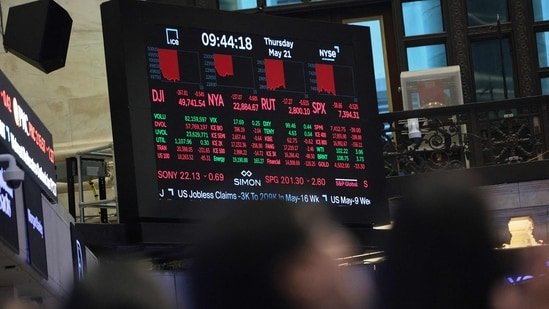
U.S. stocks were lower on Thursday as rising oil prices, worries about the conflict with Iran and renewed inflation worries weighed on investors in the S&P 500, Dow Jones Industrial Average and New York Stock Exchange.

The S&P 500 fell 0.3%, heading for its fourth loss in five sessions after hitting a record high recently. The Dow Jones fell about 110 points and the Nasdaq Composite fell 0.4%.
The market was largely driven by another rise in crude oil prices, with uncertainty over Iran and the Strait of Hormuz continuing to fuel concerns about disruptions to global energy supplies.
Oil prices rise as tensions rise with Iran
Crude oil prices rose sharply again on Thursday amid reports that Iran may continue to control maritime traffic in the Strait of Hormuz. Brent crude rose 2.6% to $107.76 a barrel, while U.S. West Texas Intermediate crude topped $100.
“While geopolitical risks are still likely to intensify, the more pressing issues appear to be macro-related,” eToro’s Bret Kenwell told Bloomberg. “Rising energy prices continue to fuel concerns about longer-term inflation. Markets will have a lot to digest in the coming weeks and months.”
concerns about inflation
Rising oil prices have pushed U.S. Treasury yields higher again, reviving concerns that the Federal Reserve may be forced to keep interest rates high or even raise them further. The 10-year Treasury yield climbed to 4.61% from 4.57% the previous day.
Higher yields typically weigh on stocks because they increase borrowing costs for businesses and consumers while making safer investments like bonds more attractive.
Investors are also concerned that higher financing costs could slow spending on artificial intelligence infrastructure projects, which have been largely underpinning the market’s recent momentum.
According to Bloomberg, Ulrike Hoffmann-Burchardi of UBS’s chief investment office said: “Inflation concerns are unlikely to ease significantly until a clearer path to end the conflict in the Middle East emerges, and we expect yield volatility to persist in the short term.”
Jamie Dimon warns interest rates could be higher
Jamie Dimon added to market anxiety with a stark warning about the future of interest rates.
“They could be much higher than they are now,” JPMorgan Chase’s CEO told Bloomberg Television. “We may have gone from a savings glut to a savings deficit.”
Nvidia earnings report fails to spark rebound
Despite another strong earnings report from Nvidia, artificial intelligence-related stocks struggled to lift the broader market. Nvidia beat Wall Street estimates on both profit and revenue, while also issuing stronger-than-expected guidance for the quarter.
“Construction of AI factories—the largest infrastructure expansion in human history—is accelerating at an alarming rate,” said CEO Jensen Huang.
Still, Nvidia shares fell nearly 2% as investors appeared to lock in profits after the stock surged last year.
Walmart shares fall after profit warning
Retail giant Walmart was one of the market’s biggest losers on Thursday. The company posted solid revenue growth but issued a lower-than-expected profit forecast and warned that higher fuel costs and inflationary pressures were starting to hurt margins.
Walmart shares fell nearly 8%.
Meanwhile, Ralph Lauren’s earnings and revenue came in stronger than expected, sending shares up more than 11%.
Economic data sends mixed signals
New labor market data initially pushed yields higher after an unexpected drop in weekly jobless claims, suggesting layoffs remained relatively limited.
However, business activity data alone paint a more complex picture.
An S&P Global survey showed weaker-than-expected growth at U.S. services companies, while manufacturing activity improved.
“Business surveys show the devastating economic impact of war in the Middle East is increasingly clear,” said Chris Williamson, chief business economist at S&P Global Market Intelligence.
Asian shares rise, global markets mixed
International markets were mixed on Thursday. Technology stocks rose after Samsung Electronics reached a labor agreement to avoid a strike, pushing the Kospi soaring 8.4%.
Samsung shares rose 8.5%, and chipmaker SK Hynix shares soared 11.2%. Japan’s Nikkei 225 index rose 3.1%, but the Chinese market performed poorly, with Hong Kong falling 1% and Shanghai falling 2%.