



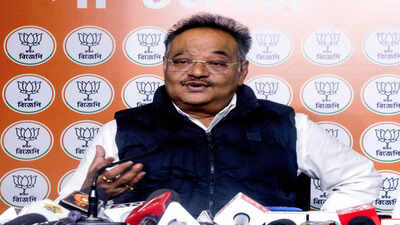
Are you a movie fan? The question seemed to catch Samik Bhattacharya a bit off guard. He made a list of celebrities ready to run bjp In West Bengal. But he eventually gave an answer that was clearly Bengali. He said he was more comfortable in the theater and was an active participant when the demands were less demanding.For someone who claims to appreciate poetry and admits to having a weakness for poetry Shakti Chattopadhyaya love of theater feels like a natural corollary. In this sense, the West Bengal BJP president seems to have an easier time dealing with intellectuals of opposite political persuasions in the bylanes of Kolkata than some of his party colleagues.His attempt to imagine the future starting from Bengal’s past is evident in the way he talks about the Bengal development model rather than the bulldozer model, which is rooted in the legacies of Syama Prasad Mookerjee and Bidhan Chandra Roy. The latter was the first chief minister of the state after independence and one of the highest Congress leaders ever produced in Bengal. This instinct to show courtesy to his opponents continues even when he talks about his current opponents. He described Abhishek Banerjee as intelligent and articulate, an assessment that was respected even across political lines.But when it comes to the political base, Samik pulls no punches. In a modest apartment in Salt Lake City, where he is currently campaigning, he patiently listens to party workers as they adjust strategy, call for reinforcements or seek solutions. When asked to compare the BJP’s ground game with the Trinamool Congress party’s battle-hardened electoral machinery, he paused. He then said plans were in place, pointing out that in 2011, the TMC ousted the Left from power despite its own organizational disadvantages.He relied on the BJP’s slogan that this election was a BJP-Mamatha election and claimed that the TMC would be wiped out in North Bengal from Darjeeling to Malda. However, when asked how the BJP shares political space with figures such as Bimal Gurung, who has openly supported Gorkhaland, a cautious political image comes to the fore. He said mountain people have historically been deprived, deceived and culturally ridiculed. Their grievances must be addressed, he said, but he ruled out any partition of West Bengal.Bhattacharya admitted that the BJP has historically performed poorly in the old Kolkata Presidency, with 109 seats in the area at stake. But he insists the party will do better this time and, in his words, even Mamata’s Bhowanipore will face a tough contest. He even hinted that Mamata Banerjee might have filed her last nomination. Regarding Junglemahal, another bright spot for the BJP in 2021, he said the party has learned lessons from the setback in the 2024 Lok Sabha elections. He predicted that the BJP would get a majority and claimed that the party might get 175 seats. He said the mood for change is brewing across the state.Behind this confidence lies a larger debate about Bangladesh itself. He believes the election could change the political narrative in the state. Talking about Ashoknagar, where oil was discovered but development was slow, he alleged that such projects were stalled due to political feuds. This is a common accusation leveled against the Trinamool by the BJP, but he uses it to make a broader point that Bengal is being deprived not only of better governance but also of momentum itself.Bhattacharya sounded dissatisfied, even aggrieved, with the particularly intensive revision of the electoral roll. He said he was unhappy with the process by which the names were removed. He alleged that the TMC exerted pressure on poll officials and even judicial officials. He also alleged that at some places, Form 7 application forms were burned while the police remained silent. By criticizing the process, the leader also appeared to be creating an outlet for the anger of some BJP supporters, including Matuas, over the mass deletions. For him, the top priority of a future BJP government is simple: improving law and order, restoring democracy and re-establishing constitutional norms. In terms of penetration, he has entered territory more familiar to the BJP. Calling it an “international conspiracy”, he said when asked about the BSF’s role in the Union Home Ministry, public awareness was needed to stop it. But even so, he cautioned that the names of Indian Muslims should not be removed from the electoral rolls. It is an attempt to combine the BJP’s hard-line border politics with a degree of opposition to blanket exclusion.While he recognized the financial pressures faced by cash-strapped states like West Bengal, he was also pragmatic on welfare issues. He said that if the BJP comes to power, Rajesh Bandar will not be removed from office. Instead, it will be doubled in size and renamed Annapurna Bhandar.He was equally dismissive of suggestions that fish would disappear from Bengali tables under the BJP. He joked that if the BJP wins, they will send fish to the chief minister. Mamata Banerjee expressed similar views when asked about temple politics, including the Jagannath temple in Digha and similar announcements in Siliguri. When asked if Mamata was going after the BJP’s Hindu vote bank, Samik humorously replied that even the gods were angry with the chief minister.He is not worried about the change of candidates, the votes of tainted leaders like Rakesh Singh and the exclusion of Ashok Lahiri. He said these were internal decisions and they would not change the larger outcome.All in all, Bhattacharya’s speech was both stiff and layered. He made it clear that the BJP’s model of governance would be firmer, albeit still bound by the constitutional framework, and that sectors such as education and health would need to be rebuilt. He has been with the BJP for more than four decades and since then people have had to be told the difference between the Janata Party and the BJP. From there to what many consider the BJP’s best chance of coming to power in Bengal, it’s almost a complete moment for him. While many pollsters believe the BJP is likely to win about 120 seats in the 294-member parliament, Samik noted that the party’s performance in Haryana and Delhi exceeded pre-poll expectations and believes an eventual push from Modi and Shah will push it past the halfway mark.Samik is not a crowd-puller like Suvendu Adhikari or an organizing force like Dilip Ghosh. He did bring a polite language, as evidenced by the ease with which he quoted Tagore while dodging uncomfortable questions. In his writings, Samik does not admit that the literary and civilizational icons of Bengal belong to the liberal or leftist imagination. He wanted to enter this space and rearrange it, arguing that cultural legitimacy and nationalist politics did not need to exist in separate worlds. He portrays himself as a Bengali conservative who sounds cultured, grounded in history and socially acceptable.The Mamata Banerjee-led TMC has long sought to portray the BJP as “bohiragato zamindars”, outsiders seeking to reset Bengal’s politics and culture. With Samik at the helm, the BJP hopes that the attacking line will lose some strength. In Bengal, the party has often appeared culturally extroverted, politically influential but emotionally distant. Whether Samik can help soften that perception may ultimately determine how far the BJP goes in challenging Mamata Banerjee.