

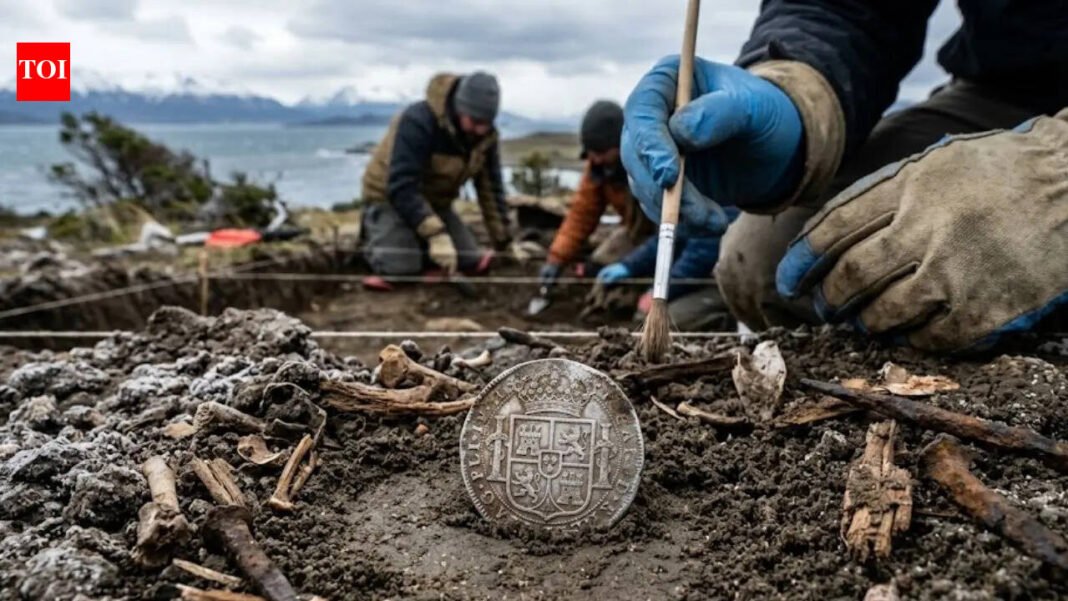
The coordinates of the doomed Spanish settlement Rey Don Felipe have remained a mystery to the marine world for more than four centuries. Recently, however, archaeologists in southern Chile discovered a 440-year-old silver coin that serves as a clear geographical anchor for the doomed colony. The coin, known as the “Real de a Ocho” (Eight Coins), was discovered through advanced metal detection technology at the exact location where 16th-century records show a church was built for the city. The discovery also represents a “basic sedimentation” process and proves the location of “Famine Harbor,” where nearly 300 settlers died of starvation and exposure. As such, it serves as a practical reminder of the incredibly tragic colonial failures in human history.
A 440-year-old silver coin found in lost Spanish colony
Researchers from the University of Bernardo O’Higgins (UBO) discovered a “Real de a Ocho” (eight) silver coin from Potosi (present-day Bolivia) in the Strait of Magellan. According to historical records, the coin is believed to have been deposited during the “foundation ceremony” of Rey Don Felipe’s settlement on March 25, 1584. Typically, Spanish explorers and colonists would consecrate a site by burying a coin under the cornerstone of a new church, which served as a “geographic anchor” for the entire site.
role king philip ii in the southern colonies
The coin bears the heraldic emblems of the Spanish Crown and the Jerusalem Cross, indicating that it was currency during the reign of King Philip II. Maritime archaeologists consider such coins crucial for dating the strata of an archaeological site and confirming its cultural identity. As a research paper published in ResearchGate points out, the existence of this precise Potosi minted silver also points to the fact that colonists establishing themselves in South America had access to high-value currencies that were created in order to establish a permanent economy at the end of the continent.
How harsh weather frustrated Spain’s defense against Sir Francis Drake
The coin’s origin has been confirmed to be in Port Hambrae. The colony was established to protect the Strait of Magellan from British privateers, particularly Sir Francis Drake. However, the colony was so remote and had harsh climatic conditions that the colonists faced a hostile environment that was difficult to overcome. Chilean government historical records show that only about five of the 300 settlers were still alive when English navigator Thomas Cavendish discovered the site in 1587 and found it occupied by a “city of the dead.” Mapping the site provides important information about early European attempts to colonize the sub-Antarctic region of the world.
The balance between discoveries and site integrity in southern Chile
The excavation is part of a project funded by Chile’s Ministry of Culture, Arts and Heritage. The team used high-precision geolocation and non-invasive scanning methods to spot soil anomalies before excavation, which allowed them to locate the small silver artifact without damaging the fragile permafrost or the structural remains of the 16th-century fortifications located on the site. As a result, the site remains intact to allow continued study of colonial logistics and survival strategies.