

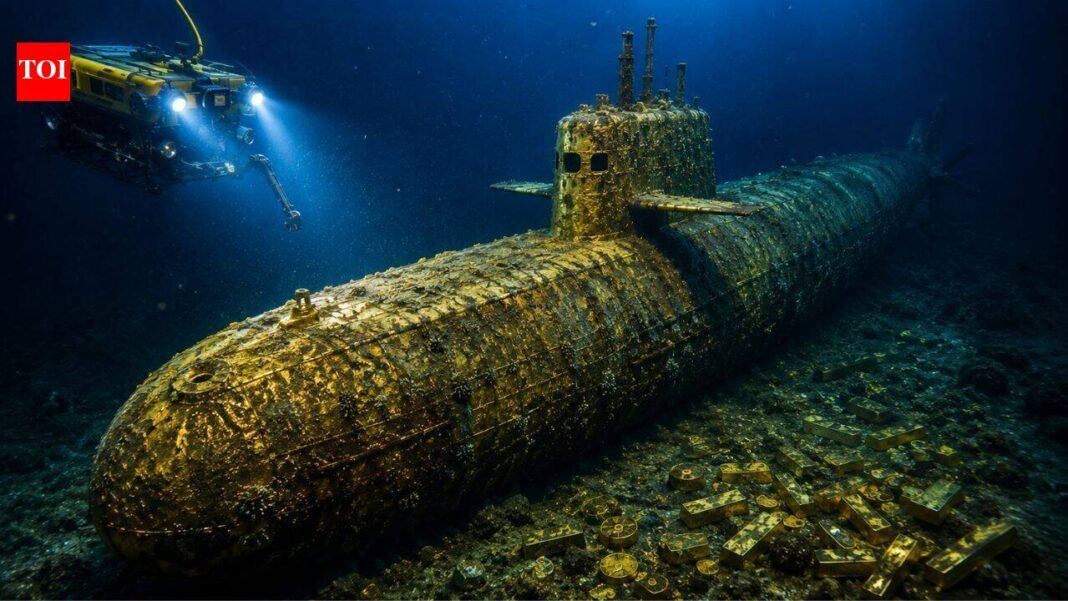
In the summer of 1944, the submarine sank in the Atlantic Ocean and disappeared from history. For decades, its exact resting place remained uncertain, despite wartime reports, scattered naval records and countless theories. Hidden under nearly three miles of water, the Japanese submarine I-52 could carry far more passengers than its crew. Hidden deep within its hull were precious wartime cargoes, including gold, strategic raw materials and medical supplies bound for Germany, reflecting the increasingly desperate partnership between the two Axis powers separated by oceans.It took more than fifty years of deep-sea technological advancements and painstaking historical detective work to finally locate the wreck. When explorers finally reached the site in 1995, they discovered a ship that had survived the intense pressure of the deep ocean. Most of the submarine remains upright, preserving one of the most unusual maritime stories of World War II and leaving unanswered questions about the riches left inside.
How the I-52 Became One of Japan’s Most Valuable Submarines
According to the New York Times, by 1944, ordinary merchant shipping between Japan and Germany had become almost impossible. The dominance of Allied navies means surface ships face a huge chance of being intercepted before they reach Europe. Both countries increasingly rely on long-range submarines capable of transporting compact but valuable cargo across thousands of miles of hostile waters.I-52 belongs to this small group. It was a large transport submarine, rather than a traditional attack craft, that left Japan and then docked in Singapore to complete loading. The cargoes included metals such as tin, tungsten and molybdenum, as well as natural rubber, quinine and opium for military purposes.Its most valuable cargo attracted attention long after the war ended. Approximately two tons of gold contained in 146 gold bars were used to pay for advanced German equipment and industrial technology that Japan was unable to produce domestically in sufficient quantities.
News of Betrayal on I-52
The submarine’s voyage may seem secretive, but much of it has been revealed before it enters the Atlantic Ocean.British and American codebreakers successfully deciphered vital German and Japanese naval communications, allowing Allied commanders to monitor planned submarine operations with astonishing accuracy. Nauticos revealed that information revealed where the I-52 was expected to rendezvous with the German submarine U-530, when the transfer would occur and the type of cargo it was carrying.With this intelligence, the U.S. Navy dispatched a hunter-killer team, centered on the escort aircraft carrier USS Borg. Instead of searching blindly across the Atlantic, its aircraft were sent to locations that had been identified through intercepted communications.
this I-52 at night disappear under the atlantic
According to reports, on the evening of June 23, 1944, I-52 surfaced and rendezvoused with U-530 in the mid-Atlantic. As soon as the exchange ended, Borg’s plane flew overhead.Lieutenant Jesse Taylor, piloting a TBM Avenger, made an initial attack with depth charges and then another attack with a Mark 24 sonic torpedo. Although officially described as a mine during the war, the weapon was actually an early homing torpedo that could track the sound produced by a submarine’s propeller underwater.Recordings collected via sonobuoys captured the sound of the submarine diving, followed by explosions and shattering sounds, indicating the vessel had sustained fatal damage. A second Avenger attacked after detecting additional underwater movement.The next day, American ships found floating debris and large amounts of rubber scattered on the sea, confirming that the submarine had been destroyed. U-530 escaped without being detected. All 109 personnel aboard I-52 were killed, the U.S. Naval Institute reported.
A mystery that lasted for decades
Although it was believed during the war that the submarine had been sunk, no one knew exactly where it was parked. The attack occurred at night, in bad weather, and far from the coastline. The navigation methods relied upon by the crew inevitably produced errors, while the submarine itself continued to move after being hit. As a result, for decades, official Navy coordinates pointed searchers to the wrong area of the Atlantic.The problem became clear when researcher Paul Tidwell began examining original records in the early 1990s. Rather than rely solely on published reports, he scoured archives in multiple countries, gathering operational logs, wartime diaries and original attack reports that are rarely studied together. These records paint a more complete picture of what happened in the final hours of the I-52 voyage.
How old records spark new searches
The resting place of the submarine cannot be determined based on historical documents alone. Tidwell’s team turned to a navigation reconstruction system called RENAV, which was originally designed to reconstruct the motion of modern submarines. Analysts combined information from multiple vessels involved in the operation, taking into account differences in ocean currents, course changes, weather conditions and recording locations.The results showed that the possible location of the sinking was more than ten miles away from the coordinates that had been accepted for decades.These revised data became the centerpiece of a deep-sea expedition launched in 1995. At the time, success was far from guaranteed. Weeks of sonar scans have turned up nothing, fuel reserves are dwindling and previous search attempts by others have failed.
The Atlantic finally reveals its secrets
The breakthrough came near the end of the expedition.On May 2, 1995, sonar reportedly detected an object parked near the newly calculated location. Closer inspection revealed a debris field and the clear outline of a large submarine standing on the ocean floor more than 17,000 feet below the surface.A remote-controlled camera then passed over the wreck and recorded details around the stern that matched the unique design of Japan’s C3 transport submarine. These features confirm the identity beyond a reasonable doubt.The condition of the vessel surprised investigators. The hull did not completely collapse under the immense pressure, but was gradually submerged after suffering torpedo damage, leaving most of its structure intact during the descent.
The gold may still be in there
No attempt was made to recover gold during the original expedition, although fragments of the wreckage recovered from the seafloor helped support legal salvage rights.Researchers believe the precious metal is stored in the front of the submarine, an area believed to have been largely undisturbed since 1944. The site is a rare combination of wartime archeology, intelligence history and deep-sea exploration. It is also the final resting place of the submarine’s crew, making any future salvage efforts subject to legal and ethical controversy.More than eighty years after I-52 disappeared beneath the Atlantic Ocean, the submarine continues to attract attention not only because of the treasure believed to be on board, but because its discovery demonstrates how wartime codebreaking, archival research and modern technology can solve a mystery that generations of investigators have resisted.