

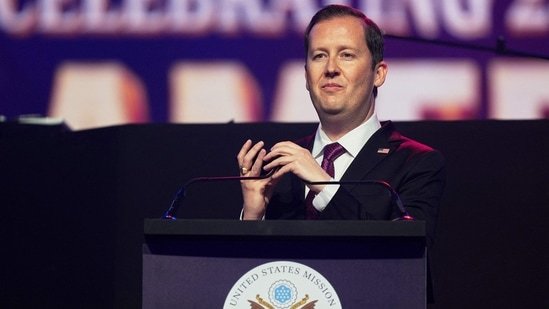
Concerns among Indian professionals over recent changes in the H-1B visa program have been clarified by US Ambassador to India Sergio Gor. In an interview with IANS, Gore said the Trump administration’s review of the H-1B system is part of a broader immigration reform effort and should not be seen as a move to target Indians.

His comments come as many students, tech workers and employers are closely watching changes that could affect one of the most important U.S. work visa pathways.
US envoy Sergio Gore addresses India’s H-1B issue
Addressing concerns over the new visa rules, Sergio Gore said the changes were linked to the government’s wider immigration agenda.
“The H-1B program is part of the government’s broader immigration reforms. It should not be construed as a program specifically targeting Indians,” Gore told IANS.
This issue is very important for India as Indian nationals get maximum share H-1B visa. Indians continue to make up the largest share of approved H-1B petitions, according to U.S. Citizenship and Immigration Services (USCIS) data.
The H-1B program allows us Companies hire foreign professionals for professional jobs, especially in fields such as technology, engineering and science. Therefore, any major policy shift will attract the attention of Indian workers looking to advance their careers in the United States.
New H-1B rules reshape visa options
The biggest change is how the restrictive H-1B visa is selected. For the fiscal year 2027 season, the United States abandoned a purely random lottery system and introduced a salary-based selection process.
Under the new system, applications related to higher-paying jobs will receive greater weight in the selection process. Low-wage and entry-level positions are less favored. The government says the goal is to prioritize high-skilled workers and high-paying jobs.
Another issue causing uncertainty is the $100,000 payment requirement for certain new H-1B petitions. Earlier this month, a federal district court in Massachusetts struck down the policy, calling it illegal. However, the legal dispute is not yet completely over and the matter is still under court review.
These changes are expected to have varying impacts on applicants. Experienced professionals with higher salaries, specialized skills, or advanced U.S. degrees may continue to have great opportunities. New graduates and workers applying for lower-wage jobs may face a tougher path.
USCIS data also shows a sharp decline in the number of correctly filed H-1B registrations, from 343,981 in FY26 to approximately 211,600 in FY27. The data further shows that there has been an increase in selections involving applicants with advanced U.S. degrees, while there has been a decrease in selections from the lowest wage categories.
Gore also told IANS about the proposed first phase of negotiations India-US Trade Agreement It’s progressing well and both parties are now focused on the legal details of the deal.