


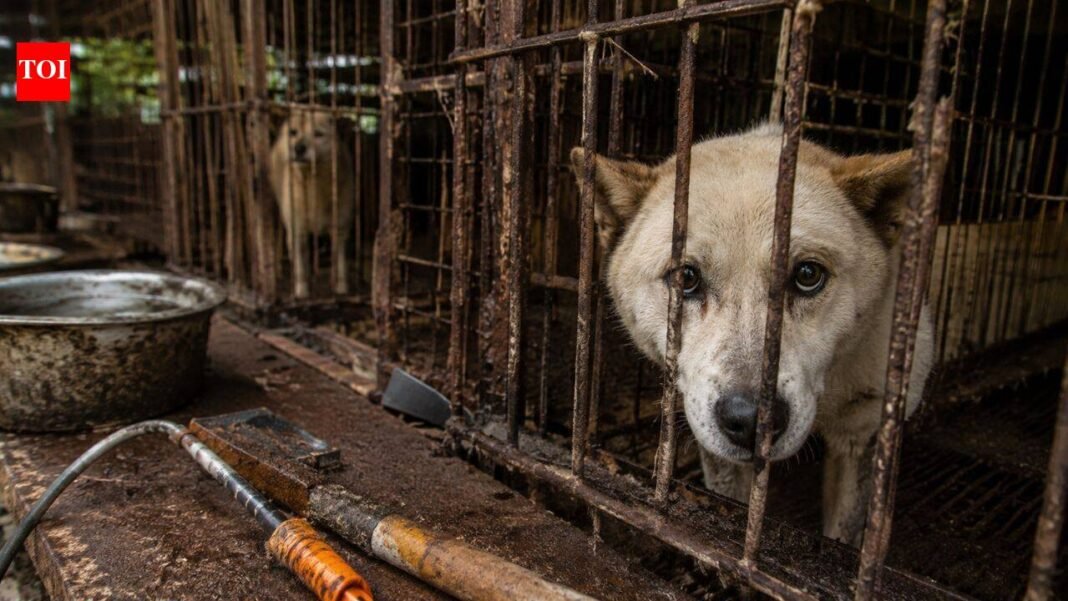
As South Korea prepares to impose a nationwide ban on raising, slaughtering and selling dogs for meat next year, a troubling question has arisen: Where have the hundreds of thousands of dogs that once supplied the country’s dog meat industry gone?According to government estimates, 400,000 to 450,000 dogs will be bred for meat by 2024. Today, that number has dropped to around 20,000 as farms close ahead of the ban taking effect in February 2027. But officials have no records showing where most of the animals went.“Our role is to verify that dogs are no longer present on farms or in slaughterhouses before providing compensation,” an inspector from South Korea’s Ministry of Agriculture told AFP on condition of anonymity.“We had no part in what was done to the dogs,” he said.The country passed landmark legislation in January 2024 banning the breeding, slaughtering and sale of dogs for human consumption. Offenders face up to three years in prison.To encourage farmers to exit the industry, the government is offering compensation of up to 600,000 won (about $390) for each dog removed from a farm.However, official figures obtained by an MP showed that as of February, only 623 dogs had been adopted and less than 500 had been transferred to shelters, leaving the fate of hundreds of thousands of animals unknown.Animal welfare groups believe many dogs were killed before the law came into effect.“If a large number of rescued dogs join the adoption program, animal organizations like ours will know about them,” said Kim Young-hwan, a representative of animal rights group CARE.“We have not seen any adoptions of dogs rescued from kennels,” he told AFP.CARE said it has rescued and rehomed about 2,500 dogs from farms over the past 20 years, with most sent overseas as Koreans generally prefer smaller pet breeds suitable for apartment living.Dogs raised for meat are usually large breeds such as the Nuremberg or the Korean Yellow Spitz.Former dog owner Ju Yeong-bong acknowledged what may have happened to many of the missing animals.“In South Korea, people have long made a distinction between dogs kept for food and dogs kept as pets,” Joo told AFP.Asked about the fate of thousands of unaccounted for dogs, he said they were likely “already eaten.”CARE’s Kim said the possibility was “infuriating,” adding that animal welfare groups lacked the capacity to save such a large number of dogs.According to the Ministry of Agriculture, as of May, 1,265 dog farms, accounting for about 82% of the country’s total, have applied for closure.Zhu, who is also a Christian pastor, said he entered the dog breeding industry in 1994 after struggling to make a living through ministry.“I feel like the dog meat ban is a betrayal,” he told AFP.“This was imposed for political reasons without meaningful dialogue or appropriate measures being taken to protect our livelihoods.”He said many former dog owners were trying to switch to other livestock industries, but the government’s licensing process slowed the transition.Animal rights advocates argue the ban closes a long-standing legal loophole surrounding the treatment of meat dogs.Unlike cattle or pigs, dogs have never been officially classified as livestock in South Korea, allowing the industry to operate for decades without regulated breeding or slaughtering practices.Animal rights groups say dogs are often electrocuted, hanged or beaten to death.At an abandoned slaughterhouse in the city of Pyeongtaek, AFP reporters found rusty cages containing dog skulls alongside equipment allegedly used to electrocute animals.“They often remain conscious when their internal organs are burned,” Shin Joo-woon, an activist with animal welfare group KARA, told AFP.“Other dogs will witness the process.”KARA said it rescued 29 dogs from the Pyeongtaek factory last month and had filed animal cruelty complaints with the farm owners.