


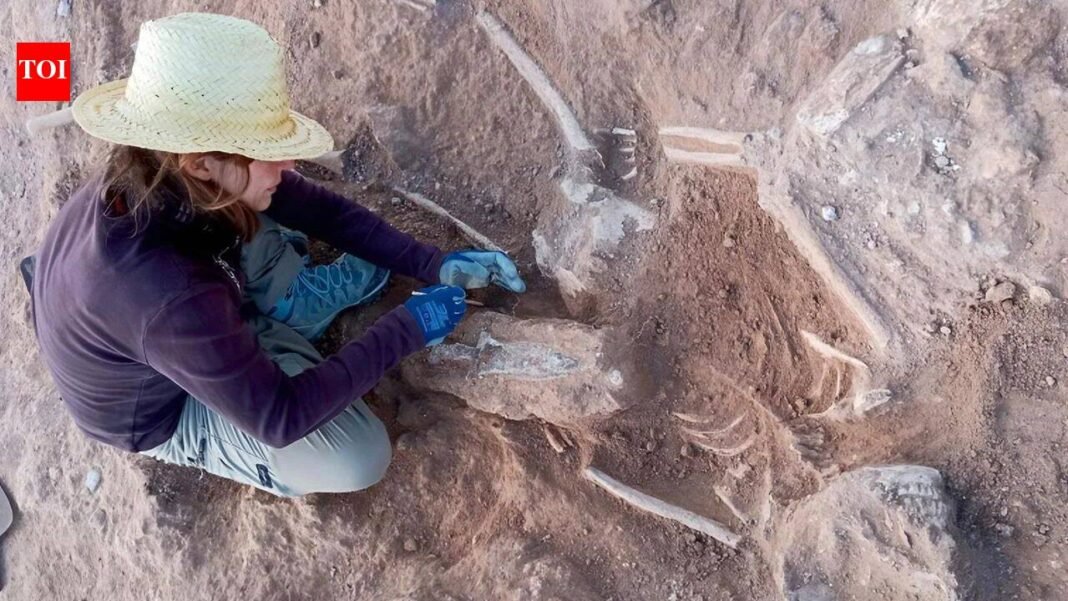
A prehistoric hilltop enclosure in southern Spain has revealed to archaeologists two distinct historical moments that occupied the same site. What initially appears to be the remains of an ancient fortified settlement dating back some five thousand years, soon reveals something far more unexpected beneath its weathered stonework. The abandoned complex contains the skeleton of a Roman-era man, some 2,500 years after the original builders of the fortress, UNN reports. The discovery raises a new set of questions, not because the burial itself is unusual, but because of where it occurred. Sites abandoned for thousands of years are sometimes repurposed by later societies, but each such case has its own story. Excavations in Spain offer a rare opportunity to examine how a site played a completely different role in a distant chapter of European history.
inside 5,000-year-old fortress Spain built in the Bronze Age
The remains came to light during archaeological investigations carried out ahead of construction related to the solar project. The site, located in the highlands near Almendralejo in the Extremadura region, has not attracted much attention despite its size.As the excavation expanded, the carefully planned outline of the wall began to emerge. Dating shows that the fortress was built around 3000 BC, during the Bronze Age, when communities in parts of Europe began to adopt metal and historic stone tools. The structure is not a simple defensive wall, but a thoughtful design that reflects organized architecture on a large scale.The fortifications reportedly stretch about 77 meters and follow a carefully designed geometric layout. Round fortress-like protrusions stood at each corner, allowing anyone defending the enclosure to monitor approaches from multiple directions.There are smaller protected sections within the facade, arranged around a central open space. Defensive ditches added another layer of security, indicating that the purpose of the settlement was to ward off threats rather than simply mark territory. Overall design points to a community capable of coordinating planning, labor organization, and engineering knowledge often associated with later periods. Prehistoric fortified settlements have been documented for decades throughout the Iberian Peninsula, but the Extremadura site stands out for its size and architectural complexity.
Roman-era tombs hidden inside 5,000-year-old fortress
The most puzzling discovery was made near the center of the abandoned paddock. Archaeologists have discovered the remains of an adult male who was buried thousands of years after the fortress ceased operations.Examination revealed that the person may have been between 25 and 35 years old at the time of death. Next to him lies a dagger associated with Roman military equipment, placing the tomb firmly in the Roman period, rather than the prehistoric occupation of the site. The difference in time is staggering. By the time the man was laid to rest, the fortress had been abandoned for about two thousand years.
Why were Roman soldiers buried there?
The man’s identity remains uncertain. Although the weapon suggests a connection to the Roman army, it does not answer whether he served as a legionnaire, traveled with an auxiliary unit, or simply carried military equipment.No obvious damage was found on the bones, suggesting a violent death. It is currently thought that illness or natural causes may have ended his life. If so, the abandoned hilltop paddock may simply have provided a convenient burial site during the journey through the region.Roman communities are known to repurpose older monuments for various purposes, including burials. Ancient buildings often remain visible in the landscape, becoming familiar landmarks to later generations, long after their original functions have faded from memory.
Forensic work may reveal more of his story
Experts are continuing to analyze the remains, hoping to learn where the man came from, his health and whether his diet reflected military service or civilian life.Scientific testing could also determine whether he spent his early years in another part of the Roman Empire before arriving in Spain. This evidence may help explain why his final resting place ended up in a fortress built nearly 3,000 years before his life.