


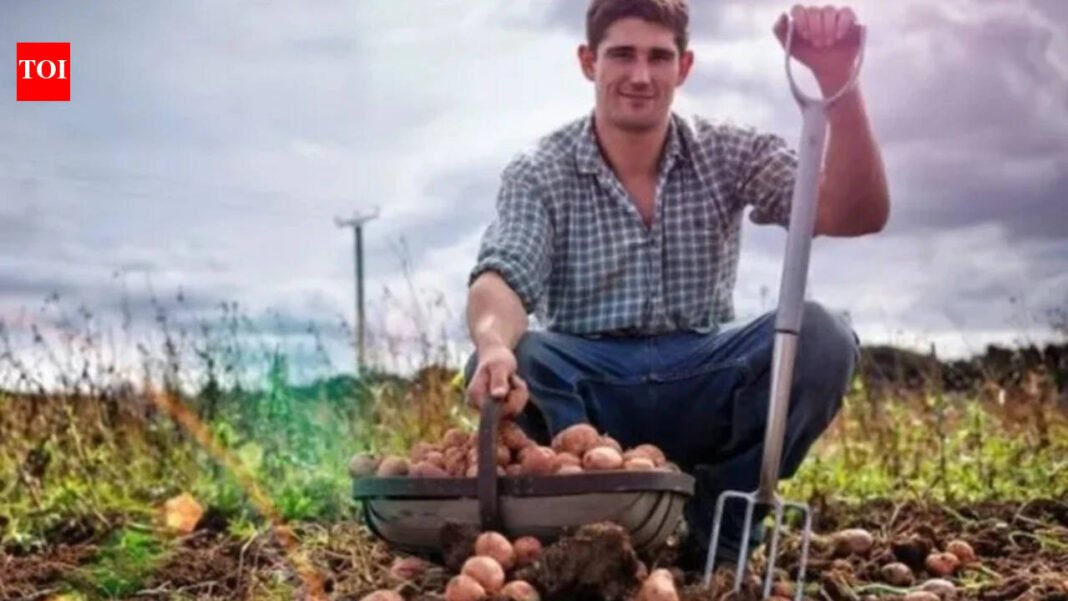
There’s a forthrightness to German folk proverbs that’s almost uncomfortable in its honesty. One of the most striking is: “The stupidest farmers own the biggest farmers Potato“. Literally translated, it goes like this: “The stupidest farmers have the biggest potatoes.”At first glance, this sounds like a humorous insult. But beneath its rough surface lies a layered look at opportunity, effort, and the unpredictability of success.This proverb endures not because it flatters intelligence but because it challenges a comforting belief: Success is always the reward of skill.
Meaning: When results do not match effort or intelligence
Essentially, this sentence points out the mismatch between the two Perception and visible results. This goes to show that sometimes seemingly careless, ignorant, or even stupid people can still end up with unexpectedly good results.This is not a celebration of ignorance. Instead it’s a comment randomness of life outcomes—Especially in areas like agriculture, where weather, soil conditions, pests and timing are often as important as human decision-making.Folklorists and proverb researchers such as Wolfgang Mead have noted that many traditional European proverbs reflect a pragmatic worldview shaped by agricultural uncertainty: No matter how experienced a farmer is, success is never entirely under human control.
Source: Modern folk proverbs rooted in rural life
Unlike classic proverbs that originated in the Middle Ages or the Bible, This sentence has no traceable historical origin. Linguists usually classify it as Modern German Folk Proverbsderived from rural rhetoric rather than formal literature.The phrase is recorded in the Dictionary of German Colloquial Proverbs and Proverbs, which includes the following references: Duden – Idiomwhich contains widely used idiomatic expressions in German, as well as scholarly proverb research tracing contemporary folk wisdom in German-speaking areas.Its imagery – farmers and potatoes – is also culturally specific. Potatoes became a major crop in Central Europe relatively late (after the 18th century), especially driven by figures such as Frederick the Great of Prussia. Over time, potatoes became deeply woven into rural life and humor, making them a natural symbol of everyday agricultural wealth.
Why potatoes? The role of opportunity in agriculture
The choice of potatoes was no accident. Potatoes grow underground and out of sight, making their yields more unpredictable before harvest. A farmer may put in the same effort in both areas but receive very different results for the following reasons:
- soil composition
- rainfall distribution
- pest infestation
- Seed variation
Modern agricultural science confirms this unpredictability. The Food and Agriculture Organization of the United Nations (FAO) has repeatedly emphasized that crop yields are affected by controllable inputs (fertilizers, labor, technology) and uncontrollable environmental variables.In this sense, this proverb reflects a very real agricultural truth: Efforts do not guarantee corresponding rewards.
Philosophical level: Is wisdom always visible in the results?
Philosophically, this proverb raises a disturbing question: Do the results reliably measure intelligence or ability?This idea is widely debated in philosophy and behavioral science. Humans tend to think that apparent success equals merit. Yet real-world systems are often noisy, meaning luck and structural conditions can skew results.This is echoed in modern discussions of decision theory and risk analysis, with scholars arguing that:
- Short-term results are often poor indicators of skill
- Randomness can enhance or inhibit performance
- ‘Survivor Bias’ Distorts Perceptions of Success
In short, someone may succeed not because they are “the best,” but because conditions are temporarily favorable to them.This proverb captured this intuition long before formal economics or psychology attempted to model it.
Contemporary relevance: From farm to start-up
Although this proverb has rural origins, its logic fits perfectly into the modern context.
1. Enterprises and Start-ups
When starting a business, it’s not uncommon for less experienced founders to succeed due to timing, market gaps, or investor trends, while it’s not uncommon for experienced founders to fail due to external constraints. This is often discussed in the venture capital community as “Surface area of luck.”
2. Social media and virality
On platforms like YouTube, Instagram or TikTok, the success of content is heavily influenced by algorithms and timing. A poorly curated video can go viral, while well-crafted content can go unnoticed. The logic of the proverb is visible here almost in real time.
3. Exercise
Even in professional sports, outcomes are determined by chance—deviations, weather conditions, referee decisions. Analysts often warn against over-interpreting a game as proof of superiority.
Warning against misunderstanding
Although this proverb is humorous, it should not be interpreted as an endorsement of incompetence or laziness. It does not believe that “foolishness leads to success.” Instead, it highlights a statistical reality: SSuccess is due to many reasons.German proverb scholar Wolfgang Middel pointed out that many traditional proverbs function as “compressed social observations” – not universal laws, but reminders formed by life experience.It would be a misunderstanding to misuse this proverb to negate skills or education. In most long-term systems, ability still dominates outcomes. Luck may create peaks, but consistency usually requires ability.
Why it’s still important today
The persistence of this proverb lies in its disturbing honesty. It works against a deep-seated human bias: the desire to believe the world is fair and predictable.We prefer the following narrative:
- Effort always wins
- Wisdom always pays off
- Success is always worth it
But the reality is more complex. This proverb forces us to accept that Life’s results are a combination of hard work, timing, and randomness.This doesn’t mean the effort becomes pointless. Rather, it makes humility necessary.
Conclusion: Between skill and opportunity
“The dumbest farmer has the biggest potatoes” isn’t really about farmers, potatoes, or even intelligence. It’s about the tenuous relationship between action and outcome.It reminds us that success can sometimes be misleading, failure can be undeserved, and appearances rarely tell the whole story.In a world increasingly driven by metrics, rankings, and visible performance, this old country proverb still provides a grounded perspective: rightResults are not always judgments of ability—they are often the product of circumstances over which we have only partial control.Perhaps that’s why it’s survived—not as a scientific truth, but as a cultural warning against overconfidence in what we think we can measure.