


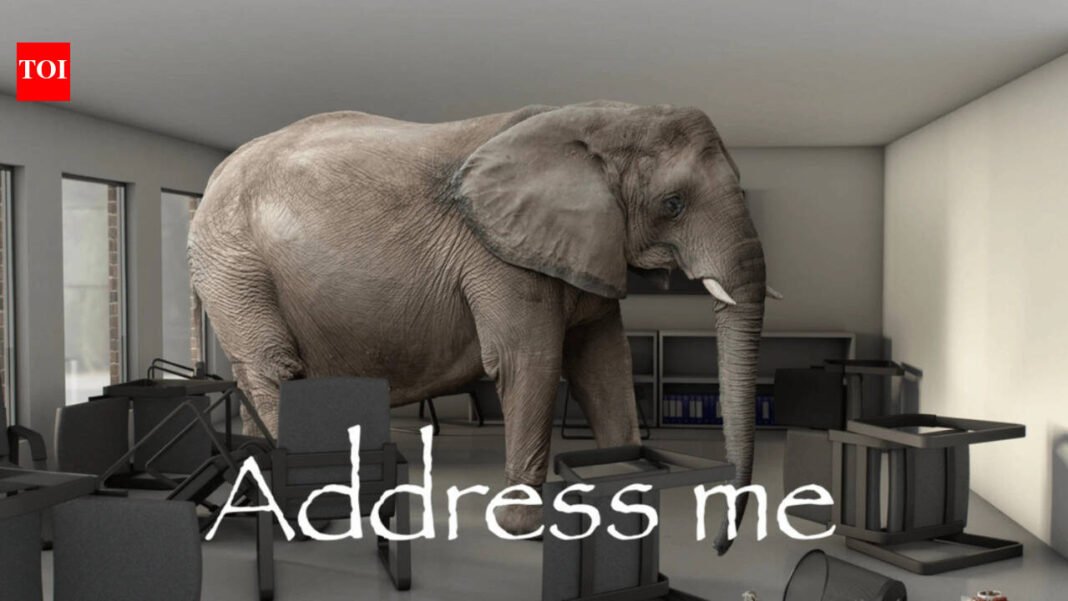

It’s the weird thing about being human: we can spot a small flaw in someone else’s life from afar, but be completely blind to the larger issue right in front of us.An old proverb from Indonesia and the wider Malay world perfectly captures this paradox: “You can’t see the elephant with your eyes, but you can see the ants across the sea.” An elephant is difficult to detect near one’s own eyes, but an ant can see clearly on the other side of the ocean.The image is deliberately absurd – that’s what makes it so memorable.
A lesson in self-awareness
At its core, this proverb highlights a psychological bias: Humans tend to be more critical of others than of themselves.
- this “The elephant is right in front of you” Represents one’s own major shortcomings – anger, hypocrisy, arrogance or bad habits.
- this “Ants Across the Ocean” Small mistakes that represent others – small mistakes that seem big because they are not our own.
The message is simple but uncomfortable: SSelf-awareness is harder than judgment.The idea appears in different cultures, but in Indonesian and Malay expressions it is expressed through startling visual exaggeration – elephants versus ants – to emphasize how distorted human perception is.
Oral tradition, not a single author
Unlike modern colloquialisms, which can be traced back to a specific author, this proverb comes from a long-standing Malay oral traditiondeveloping across the waters of Southeast Asia.Linguistic and folklorists note that many proverb (Malay proverbs) developed over centuries through storytelling, trade interactions, and public teaching practices. These expressions are not “written” in a moment, but are refined through repetition in everyday speech.Collection example Indonesian Big Dictionary (KBBI) A selection of Malay proverbs documents variations of this saying, confirming its widespread use in both formal and informal contexts of modern Indonesian language education.What makes it particularly powerful is that it does not require a well-known author to be passed down from generation to generation—suggesting that it reflects a deeply shared human observation rather than a personal philosophical invention.
psychology
Modern psychology provides structure to proverbs that have been observed centuries ago.A key concept is cognitive biasspecial:
- fundamental attribution error: People tend to interpret other people’s mistakes as personality flaws and their own mistakes as situations.
- blind spot bias: Most people think of themselves as less biased than others—even though everyone is affected by bias.
Simply put, we connect to:
- quick to criticize others
- forgive yourself easily
This proverb anticipated these ideas long before modern psychology formalized them.
cultural significance in daily life
In Indonesia and the wider Malay-speaking society, proverbs like this are often used as gentle correction in conversation. Elders or teachers can use statements like this to encourage reflection rather than outright confrontation.For example:
- Teachers may use it when students blame each other for a group mistake.
- This is what a parent might say when a child is quick to complain about a sibling but ignores their own behavior.
- In the workplace, this may surface when colleagues criticize management while ignoring their own inefficiencies.
The proverb is a social tool—it criticizes without shame.
Why does the image work so well?
The contrast between elephants and ants is not random. It has three functions:
- Scale distortion: It exaggerates the difference between one’s own faults and those of others.
- Visual memory: The brain remembers absurd images more easily than abstract suggestions.
- Emotional impact: It subtly challenges itself without outright accusations.
This is why proverbs tend to outlast formal lectures—they compress psychological complexity into vivid images.
contemporary significance
In today’s digital world, this proverb takes on even more meaning.Social media platforms amplify the exact behavior it describes:
- People are quick to notice the flaws of a public figure or stranger online.
- Comments sections often become spaces for intense judgment.
- At the same time, users may overlook their own inconsistencies or lack of context.
For example, a small mistake by a celebrity can trigger widespread criticism. However, similar or greater personal shortcomings often go unexamined in everyday life. In this sense, this proverb functions like a warning label for online behavior: yes Be careful what you magnify in others before looking at yourself.
Philosophical Importance: A Call to Self-Reflection
Philosophically, this proverb is consistent with ideas found in many traditions:
- exist Stoicismself-examination is the core of virtue.
- exist Buddhist thoughtunderstanding your own heart is the key to reducing pain.
- exist Confucian ethicsprioritizing self-correction over judging others.
The commonalities are clear: Moral clarity begins within.This proverb does not mean to completely ignore other people’s shortcomings. On the contrary, it emphasizes Prioritize attention–Fix the closest ones first.
Why it’s still important today
The power of this proverb lies in its simplicity. It requires no knowledge of philosophy or psychology to understand. However, it points to a lifelong challenge: seeing yourself accurately.It asks a quiet but persistent question:If you can clearly see the ants across the ocean, why can’t you see the elephant in front of you?The question remains unsettling over the centuries because the answer rarely changes – it’s easier to look outward than inward.
A mirror disguised as a sentence
This proverb is not only a cultural product of Indonesia; It is a behavioral mirror. It reflects the common human tendency to externalize blame and minimize self-censorship.Its longevity across generations shows that people always need the same reminder: before judging others, check what you might be lacking in yourself.Perhaps that’s why it’s survived so well – it doesn’t just describe human behavior. It quietly challenges it.