


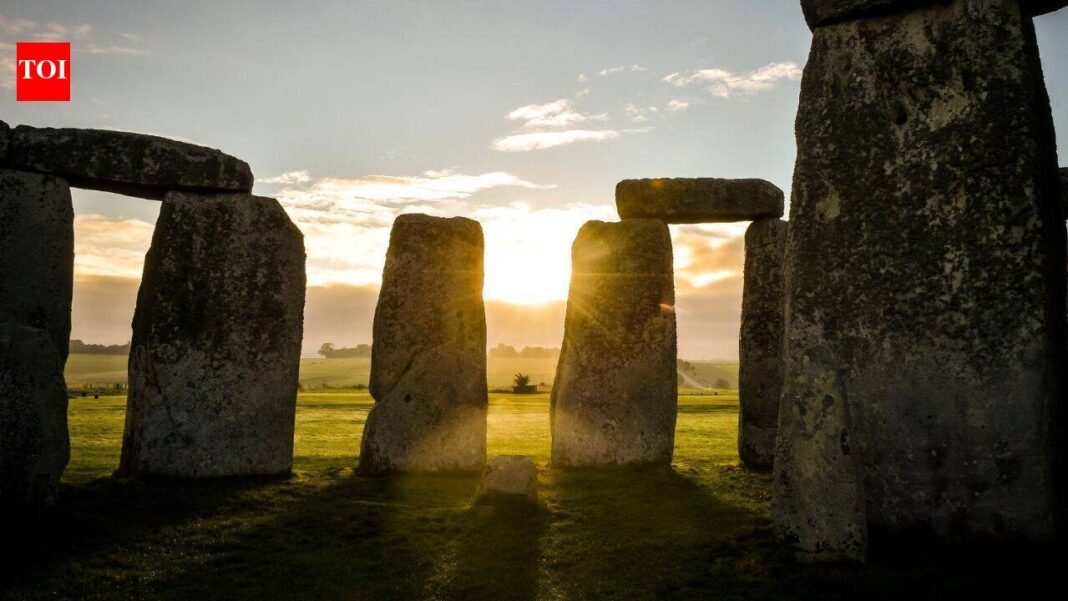
In a stretch of low-lying countryside not far from Stonehenge, where the road from Bulford cuts through open meadows, archaeologists have been piecing together something that has never quite formed a complete picture. Scattered post holes, pottery shards, bone fragments and charcoal appear ordinary until they are placed opposite each other. It is now suggested that this quiet stretch of land in Wiltshire may have once hosted a wooden structure aligned with the midsummer sunrise, built centuries before the first stones of Stonehenge were raised. It’s a tentative idea, drawn based on angles and soil stains, but it shows that the landscape was marked long before the stone entered the story.
hidden pattern Neolithic Occupation layer discovered during British excavation
The site itself is situated on a gentle hillside overlooking the kind of farmland that rarely attracts attention unless specifically planned. In this case, it was a housing development linked to the British Ministry of Defense that prompted the comprehensive archaeological scans, which were carried out in stages from 2015 to 2017, National Geographic reports. What rises from the ground is not a monument in any obvious sense, but more a fragmented impression of an activity long gone.The team, working with Wessex Archeology, reportedly documented dozens of pits spread over a wide area, many of which contained common household remains of late Neolithic life. Fluted pottery, animal bones, flint fragments, these materials often indicate repeated but unremarkable occupations. It does not initially suggest anything consistent or thoughtful in an architectural sense.However, the ground keeps showing up with some minor inconsistencies. Two of the deeper traits refuse to behave like the others.
Unusual postholes excavated that suggest intentional wooden arrangements
Most pits have straight outlines, as if they were dug quickly and filled haphazardly over time. These two outliers are different. Their sides narrow as they descend, giving them an almost funnel-like shape, and appear to be designed to grab something upright rather than simply store trash or rubble.It was stuffed tightly with chalk, and there was nothing else inside. One bears traces of ash charcoal, which is not unusual in itself, but its presence feels more deliberate than the lack of everyday debris. These are not dumping pits. They read more like sockets and are designed to hold weight.Taken together, they form a rough line on the hillside, although this line is not immediately noticeable if not measured. Only when drawing does the suggestion emerge: something once stood there, high enough to form a positional relationship with the horizon.
Possible Neolithic Reconstruction sun alignment In prehistoric Britain
Reconstruction is always half calculation, half guesswork. In this case, archaeologists imagined heavy wooden posts, about four meters high, firmly inserted into chalk-filled sockets. Nothing survives above ground, so the monument’s shape is inferred rather than seen.What catches people’s attention is the direction they seem to be pointing. When a line is drawn between them and extended outward, it intersects with a point on the horizon where the sun would rise in midsummer 2950 BC, thus affecting changes in the sky of the Neolithic world. Not a perfect match, but close enough to raise questions about intent.This orientation also echoes the sight lines associated with Stonehenge, which later became famous for its alignment with sunrise and sunset on the summer solstice. The wooden arrangement predates the earliest stone phase by about half a millennium, suggesting that an interest in sun positioning may have been ingrained in the region long before the monuments we now recognize were formed.
Stonehenge before Stonehenge feels like a stretch, but it’s still there
It’s easy to imagine continuity, a straight line from the wooden columns to the towering sarsen stone. Archaeologists are careful not to say it directly. The evidence is weaker than the narrative would like.Still, distance matters. The site is just a few miles from Stonehenge itself, close enough that movement between the two makes perfect sense. Some believe the wooden structure may have served a practical purpose or even served as a staging area for labor or ceremonial activities associated with large-scale construction projects nearby.Others resist this framing. Two postholes, no matter how carefully measured, would not easily qualify as monuments in the true sense of the word. The leap from consistency to intention is where interpretations begin to fall apart.What seems to be more widely accepted is that the people who lived on this land paid attention to the changing seasons. Whether this focus turned into architecture or whether it remained something more informal is difficult to determine.
What else is in the soil is uncertain
The carved wood feature has been dated to approximately 2950 BC, while Stonehenge’s earliest stonework phase began centuries later. The gap is both significant and embarrassing. It leaves room for influence, but also room for coincidence.Soil cannot hold power. It retains only traces of activity, flattened into layers that refuse to explain themselves. Faint geometric shapes of charcoal, pottery, chalk, dug earth. Interpretations came later, through notebooks and surveys rather than the ground itself.There is also the question of how representative this structure is. There are many wooden circles and column arrangements in Neolithic Britain, most of which are only partially understood. Some are clearly ceremonial, others are domestic or communal in nature. It may be more prudent to place this site within a broader pattern than to tie it too closely to Stonehenge.