



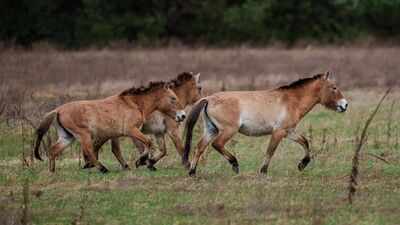
A new study of DNA fossils rewrites the evolutionary history of horses, suggesting that the extinct Dalian horse from northeast China was a genetic bridge between North America and Eurasia.For decades, the traditional narrative held that horses were brought to the Americas by Europeans from Spanish conquistadors, who shocked Native Americans with a creature they had never seen before. But the latest genomic research turns that story on its head.Horses actually originated in North America millions of years ago, and they only made it to Europe thanks to a surprising genetic middleman in China.
Dalian horse
The Dalian horse, once thought to be endemic to Northeast China, has unique American ancestry and was inherited from ancient horse populations in Siberia, according to researchers at the State Key Laboratory of Earth Microbiology and Environmental Change.This gene flow means that the bloodlines that later gave rise to the modern European horse acquired their American roots through this Chinese crossroads.“The Dalian horse may be a pathway for North American-related genetic lineages to enter the Northeast Eurasian horse population,” the researchers wrote in Proceedings of the Royal Society B: Biological Sciences.
A journey of fifty thousand years
Equids originated in North America during the early Eocene. The genus Equus first appeared about four to five million years ago and is the only surviving lineage that includes all modern horses, donkeys and zebras.According to fossil records, equids spread from North America to Eurasia via the Bering Land Bridge about 2.6 million years ago, and then experienced extensive evolutionary diversification.A 2025 study has confirmed that ancient horses migrated repeatedly between North America and Eurasia during the late Pleistocene, when sea levels fell and a land bridge connected the two continents.The new study analyzed 20 Dalian horse samples from the late Pleistocene, most of which were unearthed in Qinggang County and Harbin, Heilongjiang Province. The researchers recovered a complete mitochondrial genome and identified a “unique component” of the eastern Bering Strait lineage, primarily American DNA, that is not shared by other northeastern Asian equids.The researchers believe that gene flow across Beringia continued until after 50,000 years ago, although it was “intermittent and geographically restricted.”The Dalian horse was first discovered in fossils from Gulong Cave in Dalian and is believed to have been restricted to northeastern China during the late Pleistocene. New research broadens the scope, with two equid fossils from Yakutia in Russia’s Far East falling within the range of Dalian horse mitochondrial diversity.Researchers say this suggests the Dalian horse’s range “extends from northern China at least northwest to southern Siberia and northeast to Yakutia.”
Why did Dalian horses disappear?
Despite its role as a genetic conduit, the Dalian horse eventually disappeared. Researchers found that its extinction was not due to a lack of genetic diversity, but rather to its inability to adapt to a changing climate.Stable isotope analysis shows that the Dalian horse is a specialized herbivore. Around 40,000 years ago, the environment changed, becoming wetter and dry grasslands were replaced by peatlands and wetlands, which had a narrow diet that they could not adapt to.For the Dalian horse, its large size and “limited ecological plasticity” mean it cannot survive without high-quality forage.This extinction trajectory mirrors other large herbivores that disappeared from that era, such as North American horses and giant camels.