


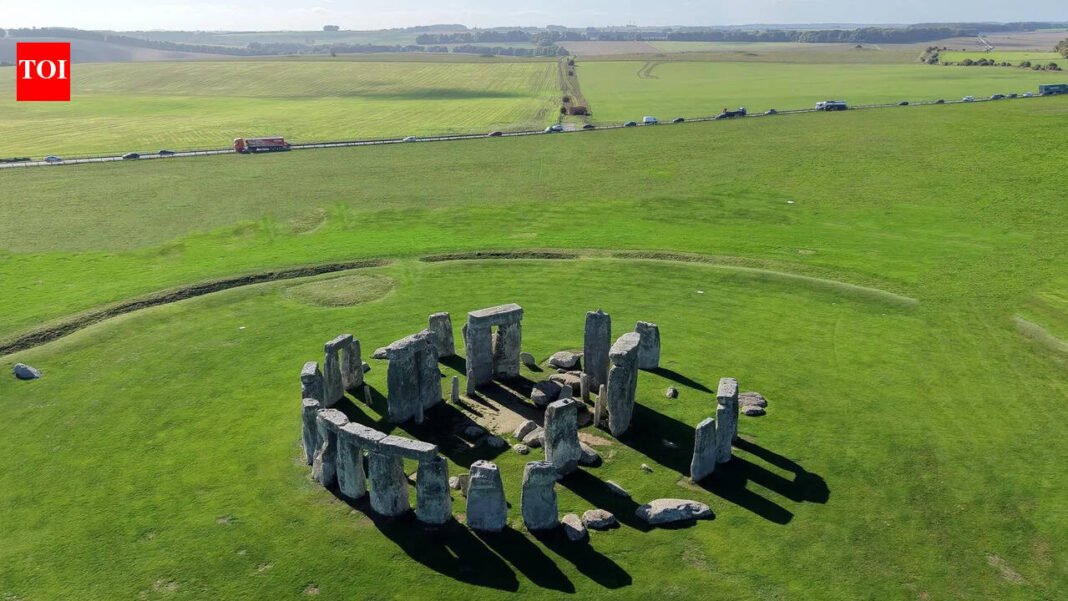
Archaeologists have discovered an early prototype of Stonehenge, a remarkable 5,000-year-old monument that predates Britain’s most famous prehistoric landmark by some 500 years.The discovery, made near Bulford in Wiltshire, about five kilometers from Stonehenge, has been described by researchers as a “once-in-a-lifetime” find. Experts believe the monument may provide new clues about how ancient communities first developed the solar alignment and ritual traditions that later became the core of Stonehenge.The timing of the announcement is particularly significant, just days before thousands of people are expected to gather at Stonehenge to watch the summer solstice sunrise, one of the most important events in the site’s annual calendar.Unlike the towering stone circles of Stonehenge, the newly discovered structure is much simpler in design.Archaeologists found evidence of two massive wooden pillars about 120 meters apart. Although the wood itself has long since disappeared, large post holes remain in the ground, allowing researchers to reconstruct the monument’s original layout.Radiocarbon dating shows that the monument was built between 3000 BC and 2950 BC, some five centuries older than the iconic stone circle that later stood on Salisbury Plain.Researchers believe the pillars may have been three to four meters high, forming a striking landmark in the prehistoric landscape.One of the most important aspects of this discovery is its precise alignment with the Sun.Analysis by Skyscape archaeologist Dr Fabio Silva confirmed that the monument was carefully positioned to face midsummer rise and midwinter sunset, an astronomical pattern that would later become a defining feature of Stonehenge.The discovery suggests that communities living in the area were observing and marking important solar events centuries before Stonehenge was built.Phil Harding of Wessex Archeology, who led the excavation, said the discovery gave us a rare glimpse into how prehistoric people understood the sky and organized their ritual lives around seasonal cycles. He described it as one of the most important discoveries of his long archaeological career.Experts say the monument adds to growing evidence that the wider Stonehenge landscape was a major ceremonial center long before the famous monoliths were erected.The site generates more than just mailboxes.Archaeologists have discovered dozens of pits containing pottery shards, flint tools, animal bones and charcoal, suggesting that people gathered there for significant communal activities.One of the most interesting finds was a rare disk-shaped flint knife. Researchers believe its circular design may have symbolized the sun, reinforcing the theory that the monument had religious or ritual importance.Animal remains were also found, including bones from aurochs (a now extinct bison species), providing further evidence that mass gatherings may have occurred at the site.Archaeologists believe the monument was not a permanent settlement, but rather a place where communities gathered regularly to commemorate key moments in the annual cycle.One of the most fascinating questions raised by this discovery is whether the monument’s builders later played a role in the creation of Stonehenge itself.Researchers say the newly discovered site bears striking similarities to the earliest stages of Stonehenge. Both are comparable in size and both focus on solar alignment.This has led some experts to believe that the community responsible for building the wooden monument may have passed down their knowledge and traditions, which ultimately inspired the construction of the stele, making it one of the most famous prehistoric sites in the world.The discovery is further evidence that Salisbury Plain was the site of a complex network of ritual monuments, ceremonial sites and gathering places that stretched over centuries.