

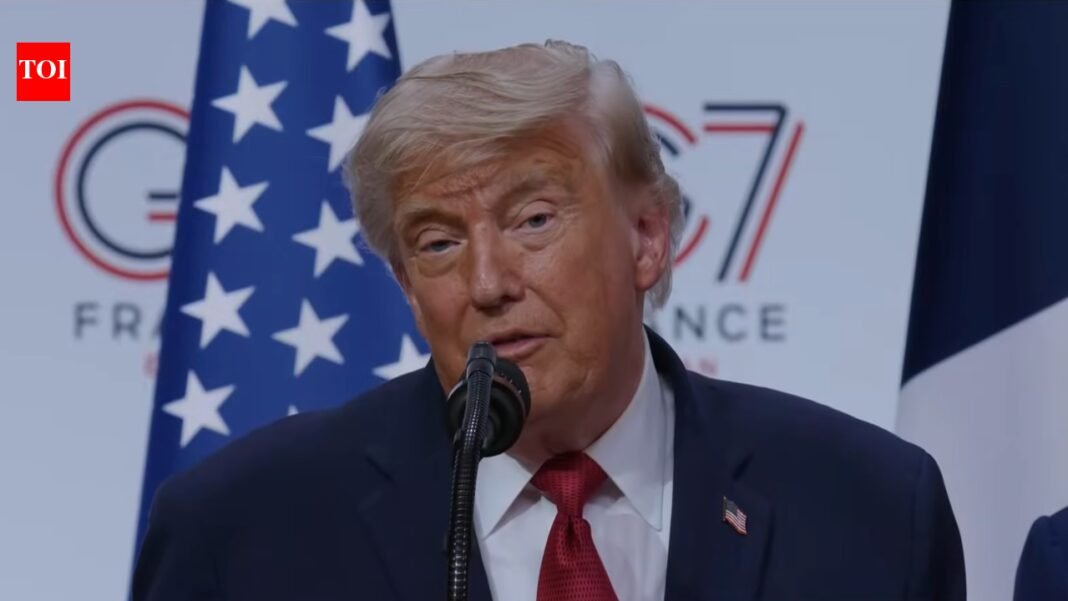
TOI reporter in Washington: U.S. President Donald Trump jokingly declared “I’m the boss” at a Group of Seven meeting in France on Wednesday, amid widespread criticism in Washington that he is being dominated by Iran in a potential deal that it says lays out several urgent U.S. obligations while allowing Tehran to push core nuclear issues into the future.Trump is determined to counter growing domestic opposition that the self-styled master negotiator will sign a memorandum of understanding that critics say is effectively a “surrender document” that would trade U.S. influence for vague guarantees from Tehran. Trump has said he is prepared to abandon the deal and resume attacks on Iran if it does not meet his expectations. “It’s a memorandum of understanding. If I don’t like it, we’ll go back to shooting them… If they don’t behave, we’re going to drop a bomb right in the middle of their head, okay? ” Trump said during a meeting with Egyptian leader Mohammed al-Sisi amid a heated debate in Washington over whether Tehran had the upper hand on Trump. According to Bloomberg and other media reports, the U.S.-Iran MOU provides Tehran with what many experts call “shocking concessions”: an immediate end to all U.S. and UN Security Council sanctions; the unfreezing of billions of dollars in Iranian assets around the world; the immediate resumption of Iranian oil exports to stabilize global energy markets; and, controversially, the establishment of a $300 billion “revival and economic development” fund for Iran with the support of U.S. Gulf partners. In return, it simply demands a “full settlement” of Iran’s stockpile of near-bomb-grade uranium, leaving the fate of enough highly enriched material largely up in the air. For a conflict ostensibly launched to permanently eliminate Tehran’s nuclear ambitions, failure to obtain such fuel calls into question the strategic success of the entire military venture, analysts say.The asymmetric arrangement has forced Trump to contend with a growing domestic perception that his deal is, at best, a “lite version of the Joint Comprehensive Plan of Action.” The president hates the comparison because of his deep-seated dislike of Barack Obama, whose original 2015 nuclear deal Trump famously tore up. “They took $1.7 billion… You know what the Iranians did? They laughed at Obama and called him a stupid bastard!”* Trump said at the G7 meeting, using vulgar and heartfelt language to denigrate his predecessor at the international forum and underline his disdain for Obama-era diplomacy.However, policy experts point out that Obama’s deal actually imposed strict, verifiable caps, limiting Iran’s low-enriched uranium to 300 kilograms, dismantling critical centrifuges and mandating rapid inspections by the International Atomic Energy Agency. Instead, Trump’s new MOU relies almost entirely on repeated, boilerplate promises that Tehran will “never produce a nuclear weapon,” balanced by immediate and massive economic concessions from the United States.The political crossfire has resurrected long-standing partisan myths, particularly Trump’s long-held rumor that the Obama administration simply “delivered a bunch of cash to Iran” as bribes. The January 2016 deal was actually more transactional: The $1.7 billion transfer consisted primarily of $400 million that Iran under the Shah paid into the U.S. Military Procurement Trust Fund before the 1979 Islamic Revolution; the remaining $1.3 billion was legal arbitration interest accumulated over nearly four decades of frozen litigation in The Hague.While the first $400 million was actually delivered on pallets in non-dollar currencies, including Swiss francs and euros, as the settlement law prohibited direct dollar transactions with Iran, it was a settlement of an old debt tied to the simultaneous release of U.S. prisoners. Critics of Trump’s current package point out the irony: While Obama returned Iran’s own historical funds, the new Trump memorandum of understanding outlines a path for a staggering $300 billion in new regional capital, albeit through Gulf partners. To counter growing claims that they were defeated by Iran and “selling Israel to the sewer” by pulling U.S. forces out of the Middle East and rewarding hostile regimes with vague promises of good behavior, the White House deployed a high-intensity media blitz. Over the past 12 hours, Vice President J.D. Vance has assumed the role of chief defender, covering major news networks from Fox News to NBC, trumpeting the JCPOA memorandum of understanding.“If you go back to the Obama Joint Comprehensive Plan of Action, what it did was accelerate the Iranian nuclear program. It basically bribed the Iranians to stop that program. Now that the Iranian nuclear program has been completely destroyed, what we’re saying is: ‘Make a long-term commitment not to rebuild it, and you will reap the benefits that come with it,'” Vance said. That confidence does not exist in Congress, where a bipartisan insurrection is brewing and even Republican hawks, who are usually staunch defenders of the president, are breaking ground over concessions to Iran. “Unless you were homeschooled as a day alcoholic, no one believes Iran is going to do anything,” Trump aide Louisiana Sen. John Kennedy said in his usual folksy manner, echoing the growing belief among Americans that the U.S. president is being played by Iran.