U.S. intelligence agencies are accustomed to analyzing chaotic situations, but in recent weeks they have experienced a different kind of uncertainty. First, Director of National Intelligence Tulsi Gabbard announced her resignation on May 22. Donald Trump then replaced her with Bill Pulte. Bill Pulte, a housing official with no national security experience, used his access to mortgage records to bolster investigations into Trump opponents. That prompted Democrats to announce they would block renewal of key spy powers until the president offers a better alternative.
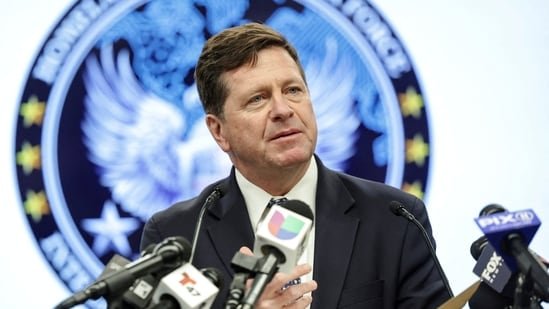
FILE PHOTO: Jay Clayton, U.S. Attorney for the Southern District of New York, speaks at a news conference in New York City (Reuters)
Trump nominated Jay Clayton (pictured) as U.S. Attorney for the Southern District of New York on June 11. Mr. Clayton is generally seen as a more level-headed choice than Mr. Pulte, and a Senate confirmation hearing is scheduled for June 17. But as is so often the case with Trump, the drama of the hirings and firings obscured a broader struggle over the scope of surveillance powers and the role of the director of national intelligence himself.
Over the decades, surveillance rules have been loosened and tightened to adapt to changing risks. In the 1970s, Richard Nixon’s spies roamed Washington, eavesdropping and stealing. The response was the Foreign Intelligence Surveillance Act of 1978 (FISA). Thereafter, spies must request a search warrant for each target from the Special Foreign Intelligence Surveillance Court. Congress changed the rules in 2008 as part of the war on terror. Under Section 702 of the revised law, agencies do not need separate search warrants but can instead obtain approval to monitor information on foreigners by providing broad grounds, such as counterterrorism.
The result is a torrent of wisdom. For example, by 2022, 59% of articles in the President’s Daily Briefing cited information reported using Section 702 by the National Security Agency (NSA), the U.S. signals intelligence agency. Civil liberties advocates dislike the law, both because of its broad scope and because some Americans have had their communications swept up by the FBI through so-called backdoor searches. Even Trump objected to it, albeit briefly during his first term, because he believed it was being used to spy on his campaign.
This year, the White House pushed to update the law but not reform it. Trump’s secretary of state, Marco Rubio, warned that letting it fail would be a “devastating blow to national security.” Section 702 also affects U.S. allies, particularly those in the Five Eyes treaty on intelligence sharing, which includes Australia, the United Kingdom, Canada and New Zealand. Not only do they benefit from intelligence, but they also have deeply entangled interception systems. However, the law expired at midnight on June 12 after opponents of Mr Pulte and campaigners for stronger privacy protections blocked the renewal. The fear now is that U.S. telecoms and technology companies will refuse to hand over certain data, fearing that doing so will no longer have legal protections.
Skeptics counter that this is too dramatic. The FISA court has approved broad search warrants that last through March, so there’s little risk of getting stuck overnight. Other parts of FISA also remain in place, allowing spies to seek search warrants on a case-by-case basis. Patrick Eddington of the Cato Institute, a think tank, noted: “Any truly urgent collection against a specific target can be conducted through an individualized court process under Title I, which is what the Fourth Amendment contemplates and what the reform coalition has been urging for years.”
By nominating Mr. Clayton, Mr. Trump now hopes to advance two important goals. The first was to update Section 702, but without the changes that privacy advocates were seeking. Democrat Ron Wyden and Republican Mike Lee support restrictions including search warrants seeking Americans’ data. But Mr. Clayton’s elevation could help the president win the votes necessary to overhaul Section 702.
The second goal is to have Mr. Clayton (assuming he is confirmed) oversee the continued reduction of his agency. The Office of the Director of National Intelligence (ODNI) was created in 2005 to promote sharing among intelligence agencies whose penchant for secrecy contributed to their failures before 9/11. However, the Office of the Director of National Intelligence has struggled to assert its authority over the agency that actually collects intelligence and controls its budget.
In fact, the personal qualities of the Director of National Intelligence are often more important than the office. John Ratcliffe, who served in the role during Trump’s first term, noted in 2022 that other “directors of national intelligence (DNIs) are the heads of the intelligence committees.” [intelligence community] A British intelligence official who works closely with the United States noted that Ratcliffe now leads the CIA. Avril Haines, Joe Biden’s director of national intelligence, is close to the president and then-CIA Director Bill Burns. “But I would say she’s the exception, not the rule.” He added, “If the bosses are not seen as invested in them, and if agencies see no value in performing well, then the NIA will take action.” He added, “If the bosses don’t feel invested in them, and if agencies see no value in performing well, then the NIA will find it hard to get attention.” “
Such was Ms. Gabbard’s fate. When she was conspicuously absent from key foreign policy debates — vacationing during the raid to capture Nicolas Maduro and opposing war against Iran — her authority was further undermined. But she and Trump have taken steps to weaken the Office of the Director of National Intelligence, with the goal of cutting its staff by more than 40%. On June 10, Trump said he wanted to make further “immediate necessary layoffs … to return staff to their respective agencies.” Republican Sen. Tom Cotton said he would be willing to “completely eliminate” the office.
That’s unlikely — it would require congressional approval. But few Democrats are eager to defend it. “The two parties have reached broad consensus, [ODNI] Mark Warner, the top Democrat on the Senate Intelligence Committee, acknowledged last year that “the nation’s intelligence agencies need thoughtful reform.” Chris Taylor, a former Australian official now at the Australian Strategic Policy Institute (ASPI), a think tank in Canberra, said the Office of the Director of National Intelligence was a useful contact point for allies on big issues that transcended individual agencies, but it “ended up looking like other bloated parts of the furniture”.
It’s no surprise that Trump seeks to shrink the intelligence community – MAGA is unhappy with the entire US intelligence community, seeing it as part of an entrenched deep state that obscures the origins of covid-19 and more. But in this case, another agency might benefit, with more power flowing to the CIA. Ratcliffe is one of the administration’s strongest voices on Russia policy and was reportedly the one who recommended Clayton to the president. Former CIA official Mark Polimeropoulos said he was “a huge winner in all of this.” For denizens of the deep state, this isn’t such a bad thing.