


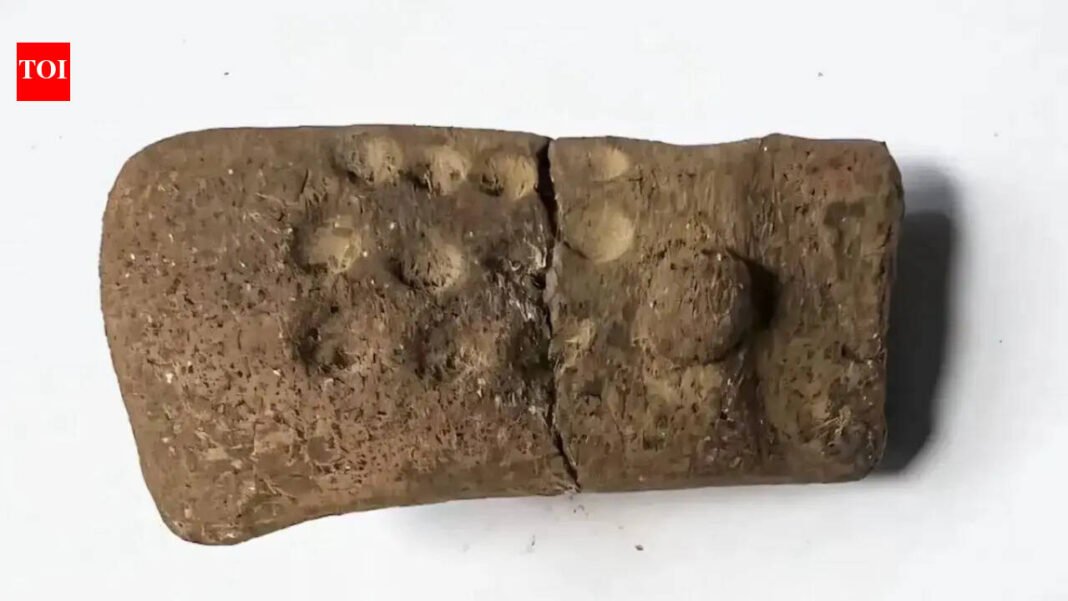
A shard of fired clay no larger than the palm of your hand has begun to draw attention away from the majestic stone monuments usually associated with ancient Mesoamerica. It was discovered decades ago from the remains of the La Blanca archaeological site, which was once stitched into a network of early towns on Guatemala’s Pacific coast. At first glance, the object doesn’t look like much: a broken statue, its upper half flat and its face never really forming any realistic shape. But there are eleven shallow indentations on it, each of which was pressed into the clay before it went into the fire. Quiet, deliberate mark, not quite decorative. The lingering question is whether they are calculating something, or simply echoing a way of thinking that has yet to shape writing as we recognize it.
La Blanca’s Tag Statue: And the Problem of Missing Facial Identity
Researchers Julia Guernsey, Stephanie M. Strauss and Michael Love published the study in Cambridge University Press titled “Numbers and bodies: potential early counting of Preclassic statues in La Blanca, Guatemala”, states that the object belongs to a group of so-called tag statues, common in La Blanca during the Middle Preclassic period. They tend to show the body without a proper face, as if the identity was expected to be added elsewhere, or perhaps not fixed on the facial features at all. This one follows that pattern. The “head” is more like a flat projection than a head in any naturalistic sense.Most striking are the clusters of dots on the upper surface. Eleven in total. It is not scraped later, nor painted after firing, but pressed into the clay while it is still soft. The layout is uneven but not careless: three on one side, four in the middle, four on the other side. It gives a feeling of being arranged rather than haphazardly scattered.La Blanca itself is not a fringe settlement. Between about 1000 BC and 650 BC it became a local center of gravity, with residential areas, structured neighborhoods and a steady production of small ceramic figures. Many of the statues were shattered before falling into the ground. Not all breakage looks accidental.
From household trash to history: everyday life in La Blanca, Guatemala
The dotted statues do not come from temple platforms or buried storehouses of offerings. It was discovered in a residential area just steps away from the site’s core buildings, surrounded by broken pottery, obsidian flakes and the remains of daily activities. Context is important because it pulls the object out of elitist display and into something closer to home life.Thousands of statue fragments have been discovered from La Blanca over the years, most of them from layers of garbage rather than carefully arranged sediments. Only a couple remained intact. The rest were scattered, broken, and reburied. It recommends repeated use, maybe even regular use, but not necessarily gentle use.The stratum in which the piece is found is generally dated to around 650 BC, although the statue itself may date slightly earlier than that time. This pushes the date back to around 750 BC, when many Mesoamerican societies were still figuring out how to fix symbols, numbers and identities into lasting forms.
The Strange Thing of the Eleven Marks
Eleven is not a decorative number that is often repeated in ancient design systems. That’s part of the reason the clip attracted attention. The impressions are asymmetrical and do not resolve neatly into purely decorative patterns. If someone wanted balance, they might choose ten or twelve, or mirrored spacing. Instead, the whole thing is a bit awkward, held together by placement rather than symmetry.According to Arkeonews, later Mesoamerican systems, especially the Maya and related cultures, used a dot and bar method, where a single dot represented a unit and the bar represented five. No formal structure is visible here. Just dots. There are no bars, no obvious grouping devices other than the arrangement itself.Still, the possibility remains that Eleven is Eleven. Not a symbol of something else, not a decorative flourish, but a count. Ambiguity is part of the difficulty. Dots can be numbers, beads, seeds, accent marks, or something more abstract.
Write before the numbers settle down
Across Mesoamerica, the emergence of counting systems and early writing was not a clean sequence. They seem to grow together, sometimes overlapping, sometimes drifting apart. Long before the emergence of fully formed inscriptions, there are scattered hints: grouped dots on carved objects, repeated marks on seals, drawn sequences that may or may not be numbers.The earliest widely accepted calendar symbols come from much later periods, including fragments from sites such as San Bartolo showing named dates in relation to a numbering system. Recently published research suggests that by then, numbers had become embedded in ritual calendars, tied to cycles of 13 and 20, shaping the structure of time itself.
Bodies, identities, and where numbers might be
The spot placement is hard to miss. Rather than being in random locations on the statue’s body, they are concentrated where a face or headdress would normally be expected. In later Mesoamerican art, this area of the body became a place where identity was declared. Symbols of name, title, rank or affiliation are often located near or above the head.There is also a broader thread running through Mesoamerican thought that the body is a counting device. The structures of fingers, toes, and limbs often provide information for digital systems. In some later languages of the region, the idea of a complete human being was conceptually linked to the number twenty (the total number of hands and feet). Whether this kind of thinking existed in a recognizable form early on cannot be confirmed, but a body-based counting logic was clearly available.
Fragments, fractures and unfinished meanings
Few of La Blanca’s statues survive intact. Most are in pieces, and the pattern of breakage is consistent enough that it feels intentional in some cases. Whether this means ritual destruction, daily discarding, or something in between remains open to interpretation.