


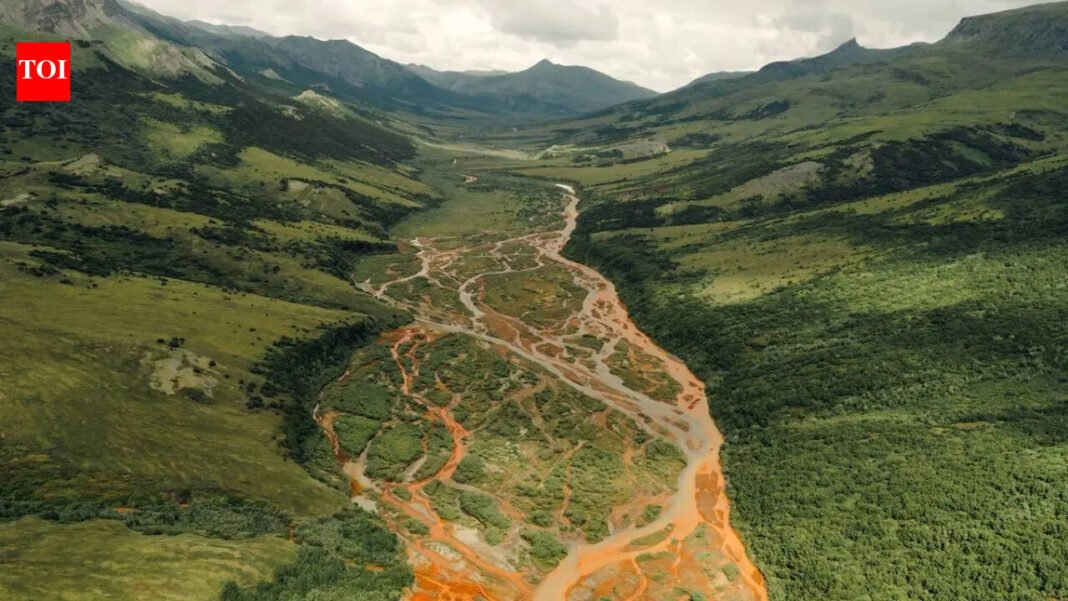
On a late-summer flight over the Brooks Range in northern Alaska, a river that had looked like glass suddenly turned the color of iron oxide. Viewed from above, they look like rust spreading through a cracked engine block. On the ground, the changes are even more disturbing: Clear tributaries turn opaque orange within a few bends, and fish habitat disappears under the influence of fine sediment and acidity changes.That’s the reality behind Alaska’s rivers turning a rusty orange color, a transformation that has nothing to do with spills or mining accidents and everything to do with the melting of permafrost that has been frozen for thousands of years. A study published in Communications Earth and Environment titled “Melting permafrost controls iron fluxes from wetlands and sulfide-bearing rocks to Arctic rivers and streams”, linking this phenomenon to iron release, sulfur chemistry, and microbial activity released as Arctic temperatures rise. What once served as a stable geological “freezer” is now actively rewriting the river chemistry of vast and remote watersheds.
Why Alaska’s rivers change color starting deep below the surface
Permafrost is often described as frozen soil, but this underestimates its role. It is more like a long-term repository of minerals, organic materials, and sulfide-rich rocks. While it remains frozen, these ingredients remain chemically quiet.In iron-rich areas of Alaska, thawing exposes minerals such as pyrite (iron sulfide, commonly known as fool’s gold) to oxygen and water, NRDC reports. Once this happens, a chain reaction begins. Pyrite oxidizes to produce iron, sulfate, and sulfuric acid. The chemical process is simple but powerful: Inert rocks become active and water becomes a transport system for dissolved metals.The misconception here is that discoloration always indicates contamination from industry. In fact, many watersheds are hundreds of miles from any industrial discharge point. The driver is climate warming interacting with geology that should never have been exposed under modern surface conditions.
The chemical ingredients behind rust color formation arctic rivers
At first glance, the discoloration looks like earth or glacial flour. But laboratory analysis showed something more specific: Both dissolved iron and particulate form of iron precipitate when they encounter oxygen-rich surface water.This is what causes the rust color, the iron oxidizes as it moves downstream. What makes the system more complex is that the process is not uniform. At higher altitudes, rock weathering dominates. In lowland areas, wetlands slow the supply of oxygen, diverting chemicals toward microbial pathways. Roman Dial, a researcher involved in the study, compared it to the opposite of breathing. Microorganisms in saturated soil begin to use iron as an electron acceptor instead of oxygen to drive metabolism. Microbial iron cycling produces soluble iron, which is then reoxidized when it reaches open water, amplifying the orange staining.
Why Alaska’s orange rivers are growing faster than expected
Satellite and field data from the Brooks Range region identified more than 200 orange water bodies. In some areas, the frequency of visible discoloration of rivers has almost doubled over the decade, from about one-third observed in the early 2000s to nearly three-quarters in the 2010s. Melting permafrost does not immediately release its chemical load. Instead, it operates with lag. Materials released one summer may not fully reach streams until the following year or later, depending on groundwater movement and seasonal freeze-thaw cycles.That’s why Alaska’s rivers turn rusty orange, better understood as moving fronts rather than stationary conditions. It gradually expands, influenced by temperature trends, soil composition and hydrology.
What this means for fish, food webs and downstream communities
The ecological impact is not superficial. Iron particles can travel long distances, covering riverbeds and clogging the gravel spaces that salmon rely on to spawn. Young fish are particularly sensitive because fine sediment can reduce the flow of oxygen through the nesting bed.More troublesome are the chemical shifts of the water itself. When sulfuric acid forms in localized areas, the pH can drop enough to stress aquatic insects and alter the microbial communities that form the basis of the food chain.