



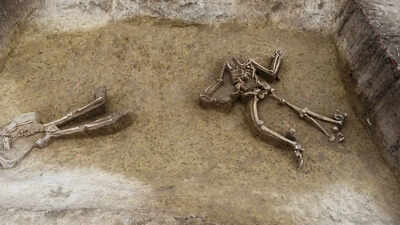
Archaeologists working in western Slovakia did not expect that the ditches surrounding an early agricultural settlement would become one of Europe’s most disturbing burial mysteries. But as layers of excavations were removed from the Neolithic site near modern Vrable, what emerged was not a typical burial ground. It’s a borderline feature filled with disjointed, headless human skeletons, at least 77 of them so far, clustered in a way that doesn’t fit traditional burial practices.The ditch belongs to a settlement occupied between approximately 5250 and 4950 BC and is part of a lineage of linear pottery cultural horizons that spread across central Europe. At first glance, the remains suggest that the decapitation and disposal were coordinated. However, details complicate this explanation. The cuts were in the upper cervical spine, not random areas of trauma. Missing jaw. In some cases, the bodies appear to have been carefully placed along ditches rather than dumped.
How about 77 headless skull Distributed in Neolithic ditches
The study was published in the Cambridge University Journal, titled “The Neolithic Bodies of Vrable – 7,000-year-old headless human skeleton from the closed settlement of LBK in southwestern Slovakia”, reveals that excavations at Flabler have been taking place since 2022 along an approximately 1.3 kilometer perimeter feature that once surrounded one of the settlement’s three Neolithic communities. Within this boundary system, archaeologists documented:
- One section of the ditch contains at least 77 headless skeletons
- Four pairs of burials, two bodies placed together
- One child’s skeleton retained its skull, while nearby adults did not
- Relic groups are arranged in spatial groups rather than randomly deposited
The bodies were not evenly distributed across the ditch. Instead, they occur in structured clusters, suggesting repeated behaviors governed by shared cultural rules rather than one-off violence. Radiocarbon dating dates this activity to the early Neolithic farming period, when Europe was undergoing major shifts in settlement structure, land use and social organization.
Forensic evidence suggests heads were removed after death
One of the most important technical findings came from osteological analysis of the cervical spine. The researchers found clear cutting marks consistent with a sharp tool, likely a stone knife typical of the period. However, there was no accompanying evidence of any disorganized trauma, such as defensive injuries or extensive perimortem fractures.In forensic archeology, execution sites and ritual deposition sites leave distinct signatures. Here, the lack of violent markings, combined with careful disjointing, suggests post-mortem manipulation rather than killing taking place in the ditch itself. In short, the head was most likely removed after death.
Why Neolithic societies focused on the head
The most striking feature of the Vrable remains is not only the absence of the head, but also its archaeological absence. No corresponding concentration of skulls has been found nearby, raising the possibility that they were transported, sorted or stored elsewhere.This pattern echoes other Neolithic sites where the skull was seen as distinct from the body. In some communities, skulls are plastered and painted. In other cases, they are processed repeatedly or displayed over time. What complicates Vrable’s case is the scale. Instead of a handful of carefully chosen skulls, the ditch contained dozens of systematically headless corpses. This suggests that practice should be practiced community-wide rather than selectively towards elite individuals.


