



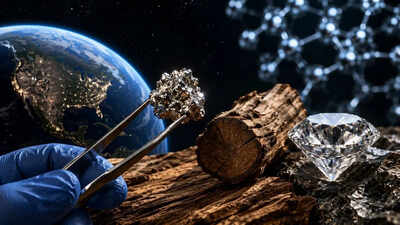
It doesn’t take much imagination for a spacecraft drifting past Neptune to imagine diamonds forming in its atmosphere. Deep within the ice giant, carbon compounds are squeezed under pressure, breaking molecular bonds and reorganizing atoms into crystalline structures. Scientists have been simulating this “diamond rain” for decades in laboratory experiments and planetary simulations, and missions such as NASA’s Voyager flybys have helped refine these in-house models. Meanwhile, telescopes studying interstellar clouds have found evidence of nanodiamonds, tiny carbon crystals suspended in dust between stars. It turns out that the universe is perfect for making diamonds.Wood is another story entirely. You don’t find it in planetary atmospheres or nebulae. You’ll find it in living systems, where it maintains metabolism, transports water, and builds structured polymers over time. This distinction is where the real disagreement begins.
The role of pressure, heat and time in creating cosmic diamonds
Carbon is one of the most flexible elements in chemistry. Under the right conditions, it rearranges into graphite, fullerene or diamond. In high-pressure environments like the interiors of Uranus and Neptune, methane is thought to break down, releasing carbon atoms that can crystallize into diamond structures as the carbon atoms sink deeper under gravity.This is not a biological process. No enzymes, no cells, no energy capture. This is thermodynamics at work.Even supernova remnants contribute. When a star runs out of fuel and collapses or explodes, the carbon-rich material can cool and condense into crystalline forms, including microscopic diamonds. Some of these particles survive long enough to become part of interstellar dust clouds and are later incorporated into new star systems or even meteorites that land on Earth.The key point is simple. Diamonds are a natural product of pressure, temperature and time. Life has no requirements.
Wood is organized by biological chemicals, not pressure
Wood does not form when compressed or heated. It is formed through metabolism.At its core is cellulose, a polymer made from glucose produced during photosynthesis. Trees absorb carbon dioxide, water and sunlight and then assemble long cellulose chains that form structures. Lignin is another complex polymer that fills gaps and adds rigidity, making wood both strong and flexible.This process depends on multiple systems working together: vascular transport that transfers water from the roots, enzymatic pathways that build polymers, and seasonal cycles that influence the growth rings. Each growth ring on a tree trunk is actually a record of environmental conditions, rainfall, temperature changes, and even stressful events such as drought.Without this biological mechanism, wood would not exist at all. Carbon alone is not enough.
Common misconceptions about “rareness” in the universe
Yemeni molecular biologist and science communicator Hashem Al-Ghaili said in a Facebook post that diamonds are “common” and wood is “rare,” but the comparison only works if both materials are assumed to be natural physical consequences of the universe. They are not. This is where popular science writing often oversimplifies things. The presence of complex carbon structures in space does not imply the presence of abundant biological materials. Even the detection of amino acids and organic molecules in meteorites, such as the Murchison meteorite that fell in Australia in 1969, does not indicate the presence of life. They show that chemical reactions can occur without it.Wood requires more than just chemistry. It requires a continuous history of energy flow, compartmentalization, reproduction, and evolution. So far, Earth is the only system where all of these have been confirmed to converge into forests.
What this comparison actually tells us about life in the universe
The real point isn’t that wood is “rare than diamonds.” We are comparing two fundamentally different classes of matter.A phenomenon occurs whenever physics allows atoms to form stable arrangements under pressure. Only when chemistry is organized into self-sustaining systems capable of growing and adapting will the other emerge.This distinction is important when we think about life beyond Earth. Finding diamonds elsewhere tells us almost nothing about biology. Finding structured, layered, growth-based carbon structures formed by metabolism like wood would mean something far more important. Currently, every growth ring on Earth is doing something the rest of the universe seems not to be doing: recording the time of life.