



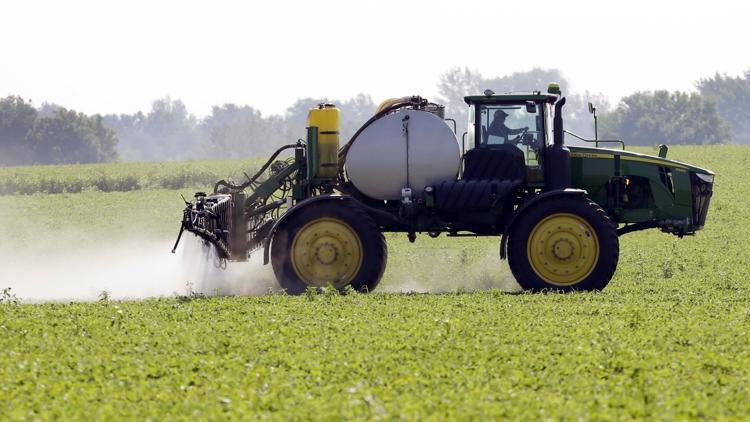
The Michael J. Fox Foundation hailed Vermont’s ban as a public health milestone.
WASHINGTON — Vermont this week became the first U.S. state to ban the use of the weedkiller paraquat dichloride after lawmakers pointed to research showing the chemical increases the risk of Parkinson’s disease.
Signed by Governor Phil Scott H. 79, “An Act Prohibiting the Use and Sale of the Herbicide Paraquat,” The ban on paraquat became law on Tuesday after both houses of the Vermont Legislature passed a bipartisan vote.
Leaders of the Michael J. Fox Foundation, a Parkinson’s disease nonprofit, called the law a “turning point in public health” and said people who use paraquat are twice as likely to develop the disease as those who use other herbicides and pesticides.
Michael J. Fox, the movie and television star who founded the nonprofit after his own Parkinson’s disease diagnosis, was among those who praised the law.
“I am grateful to the patients, advocates, legislators and scientists who are stepping up to protect Vermonters from paraquat,” Fox said earlier this month. “Now it’s time for other states and Washington to take the same action.”
The U.S. Environmental Protection Agency has said starting in 2021 that it will review the registration of paraquat as an approved pesticide. Although the federal government agency’s official website states that “no clear link has been found between exposure to paraquat from labeled uses” and diseases such as Parkinson’s disease and cancer.
Companies such as Syngenta, the main maker of paraquat products, have also denied the link.
The Swiss-based agricultural giant claimed: “While we have deep sympathy for those suffering the debilitating effects of Parkinson’s disease… the scientific evidence simply does not support a causal link.”
While some Parkinson’s disease is thought to be hereditary, the vast majority are caused by environmental factors or a combination of genetic and environmental factors. The National Institutes of Health, the main federal agency responsible for medical research, has widely cited pesticides as a risk factor for Parkinson’s disease. 2025 study released by NIH Paraquat has been linked to cancer and Parkinson’s disease.
Bills to ban paraquat or limit its use have also been introduced in 2026 in about a dozen state legislatures, including New York, Utah, Pennsylvania and Washington. As of Thursday, however, no votes on the measures had been held outside Vermont.
Other legislative bodies, including Congress, have sought to hold pesticide manufacturers civilly liable. In April, the U.S. House of Representatives approved the Farm, Food, and National Safety Act of 2026, which includes an amendment authorizing people to sue pesticide manufacturers if their products cause injury or illness.
Internationally, since its invention in 1962, paraquat has been effectively banned from the herbicide and pesticide markets by 74 countries.


