



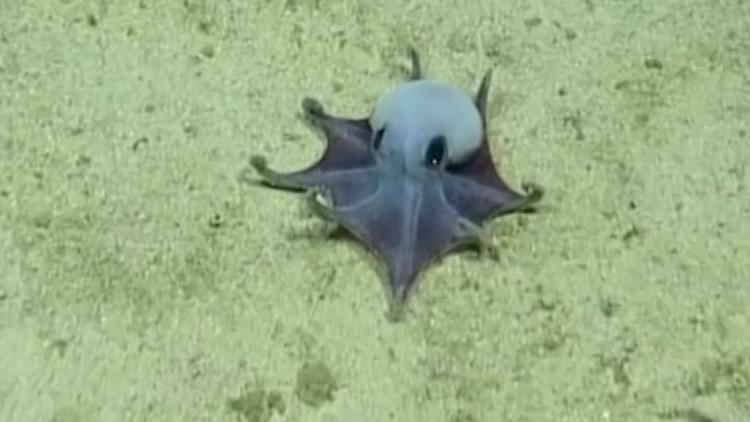
Ten years after scientists first spotted the golf ball-sized octopus during a deep-sea expedition, they have confirmed it is a new species.
CHICAGO — A deep-sea robot gliding along the ocean floor near the Galapagos Islands captured footage of something researchers had never seen before: a tiny, bright blue octopus no larger than a golf ball.
Now, a decade after the first sighting, scientists have discovered Officially confirmed It is a new species to science.
The octopus was first spotted in 2015 during an expedition conducted by the E/V Nautilus in partnership with the Charles Darwin Foundation and the Galapagos National Park Service. A remotely operated vehicle descended nearly 5,800 feet to explore the seafloor near Darwin Island on the northern edge of the archipelago.
Crews collected one sample and took video footage of two others. Back at the Charles Darwin Research Station, scientists cataloged dozens of specimens brought up during the dive. The little blue octopus immediately stood out.
Unsure which species it belonged to, the researchers contacted Janet Voight, curator emeritus of invertebrates at the Field Museum in Chicago.
“I knew right away that this was really special,” Voight said. “I’ve never seen anything like it.”
Voight is the lead author of a paper formally describing the new species, published in the journal Zootaxa. The challenge with such a rare specimen is examining it without destroying it, she said. Identifying a new octopus species requires examining its mouth, beak and teeth, which often means cutting the animal open. Since only one sample is available, this is not an option.
Instead, Voight worked with Stephanie Smith, manager of the Field Museum’s X-ray Computed Tomography Laboratory, to perform micro-CT scans of the animals. The technology stacks thousands of X-ray slices into detailed 3D models that reveal internal structures without any dissection.
“Because CT imaging is non-destructive, it is especially important for type specimens like this,” Smith said. “There’s nothing better than spending a day watching something no one else has ever seen.”
The scans showed the octopus’s internal organs in great detail, providing enough information to confirm it was a previously unknown species and place it among related octopuses.
The animal was named Microeledone Galapagensis. This is the first new octopus species that Walter has formally described in his 40-year career studying octopus evolution.
“These are tiny octopuses that live in the deep ocean and almost no one on Earth has ever seen them,” Voight said. “If you put all the land on Earth together, you wouldn’t cover the Pacific Ocean. The ocean is so big and there’s so much to explore.”
The discovery highlights how little is known about the deep ocean surrounding the Galapagos Islands, said marine scientist Salome Buglas, a co-author of the paper and a former fellow at the Charles Darwin Foundation.
“Each new species helps us better understand these hidden ecosystems and why it’s important to protect them,” she said.
Located off the coast of Ecuador, the Galapagos Islands are home to more than 1,000 plant and animal species found nowhere else on Earth.