



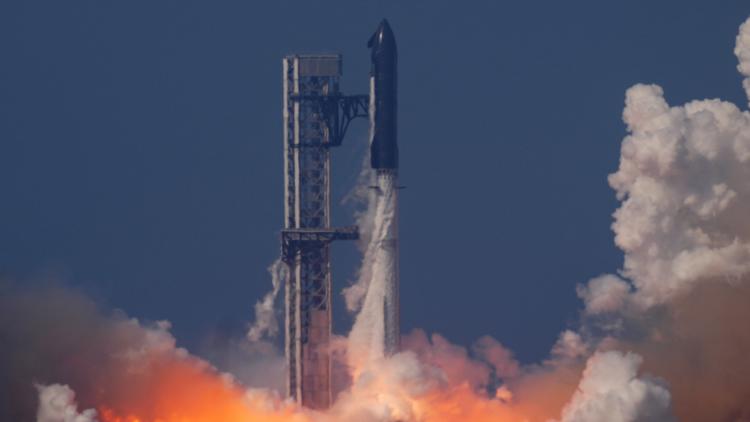
The rocket launched from the southern tip of Texas on Friday carrying 20 simulated Starlink satellites for a test flight.
SpaceX launched its largest and most powerful Starship yet on a test flight on Friday, an upgrade NASA is counting on Send astronauts to the moon.
SpaceX CEO Elon Musk announced that his redesigned giant rocket will debut in two days. take the company public. It launched from the southern tip of Texas carrying 20 simulated Starlink satellites, which were released midway through the hour-long flight halfway around the world.
It was the 12th test flight of the rocket Musk is building to one day send people to Mars. but first the moon NASA’s Artemis Program.
NASA Administrator Jared Isaacman flew in for the launch, eager to see the new starship fly.
this The last of the old space-plundering starships Take off in October. SpaceX’s third-generation Starship — an enhanced version called V3 — lifted off from a brand-new launch pad at Starbase near the Mexican border. Last-minute launch pad issues hampered Thursday night’s launch attempt.
SpaceX hopes to avoid fireworks Last year, it suffered mid-air explosions during successive launches, with debris raining down over the Atlantic Ocean. An earlier flight also ended due to fire.
This time there was no fireball until the very end. The spacecraft crashed into the Indian Ocean in a controlled manner as expected, then rolled over and caught fire. According to SpaceX, that last part isn’t surprising.
While liftoff itself went smoothly, not all engines fired as the booster attempted a controlled return. The spacecraft also had to use fewer engines but still continued eastward 120 miles (194 kilometers). A pair of modified, camera-equipped Starlink satellites ejected from Starship provided a brief view of the spacecraft as it aimed toward the Indian Ocean — a remarkable first.
At 407 feet (124 meters), the latest model is several feet (more than 1 meter) taller than the older Starship series and has more engine thrust.
The improved booster features fewer but larger, stronger grid fins to guide it back to Earth after liftoff, as well as larger, stronger fuel transfer lines to provide fuel for the 33 main engines. The size of the fuel tube is equivalent to that of a SpaceX Falcon 9 first-stage booster. The retro-looking stainless steel spacecraft also has more stuff — more cameras, more navigation and computer capabilities — and a docking cone for future rendezvous and lunar missions.
Starship is supposed to be fully reusable, with giant robotic arms on the launch pad to capture returning rocket stages. But during this latest trial run, nothing was restored. The Gulf of Mexico marks the end of the road for the redesigned first-stage booster, while the Indian Ocean marks the end of the demonstration of the spacecraft and its satellites.
NASA is paying SpaceX and Jeff Bezos’ Blue Origin billions of dollars to provide the lunar landers used to send Artemis astronauts to the moon.
Two companies are vying for first place.
While Starship has reached the edge of space on multiple flights lasting up to an hour, Bezos’ Blue Moon has yet to take off, although a prototype is ready for a lunar landing later this year.
Following the successful flight of four astronauts around the moon in April, NASA plans to conduct a docking test run in Earth orbit next year. During the Artemis 3 mission, astronauts will practice docking the Orion capsule with Starship, the Blue Moon, or both.
Two astronauts – Artemis 4 – will land on the moon as soon as 2028 using either Starship or Blue Moon, whichever is safer and the lander is ready first. This will be NASA’s first manned lunar landing since Apollo 17 in 1972. The goal this time is to establish a lunar base near the south pole of the moon, equipped with astronauts and robots.
SpaceX has started accepting reservations for Starship private flights to the moon and Mars.
The world’s first space tourist, California businessman Dennis Tito, and his wife signed up to fly around the moon 3 1/2 years ago. Time is uncertain.
This week, another wealthy space tourist — Chinese-born Bitcoin investor Wang Chun — announced he will fly to Mars on Starship’s first interstellar mission. Wang chartered a SpaceX polar flight in a Dragon capsule last year and, along with his handpicked crew, became the first to enter orbit over the North and South Poles.
No price tag or date for his trip to Mars has been revealed.
The Associated Press Health & Science Department receives support from the Howard Hughes Medical Institute’s Department of Science Education and the Robert Wood Johnson Foundation. The Associated Press is solely responsible for all content.