


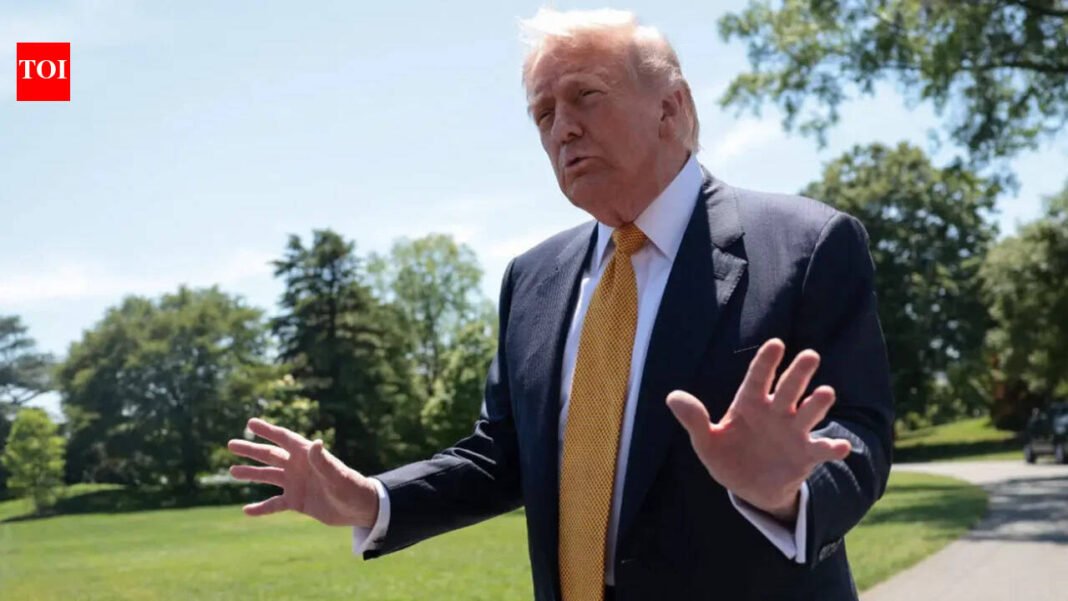

U.S. President Donald Trump has delayed plans to resume military strikes against Iran amid pressure from Gulf allies and ongoing diplomatic efforts. That was despite him saying the U.S. military was “ready to begin” the operation.Speaking at the White House on Tuesday, Trump said he decided to give Tehran “limited time” to reach an acceptable agreement before authorizing further attacks. “I mean two or three days, maybe Friday, Saturday, Sunday, etc., maybe early next week,” CNN quoted Trump as saying.The decision marks the latest shift in Trump’s approach toward Iran, after he suggested he was close to approving new military action. “They’re fully loaded,” Trump said of U.S. warships deployed in the region. “We’re ready to go.”According to reports, the US military has formulated a detailed plan for a new multi-stage air strike against Iran, including identified targets and operational stages. Trump reviewed military options with Vice President Vance, Secretary of State Marco Rubio, CIA Director John Ratcliffe and Special Envoy Steve Witkopf at a golf club in Virginia after returning from China over the weekend.According to CNN, a person familiar with the discussions said Trump considered striking more Iranian targets after becoming frustrated with the slow progress of negotiations.However, as the United States came closer to military action, Gulf leaders intervened. Qatar, Saudi Arabia and the United Arab Emirates each urged Washington to delay the strike and give diplomatic channels more time.Gulf states worry that a new conflict could trigger Iranian retaliation against critical energy infrastructure and further destabilize the region. Some countries have also warned that they may impose tighter restrictions on U.S. military access to bases and airspace if attacks occur again.Trump acknowledged that concerns about Iranian retaliation remained. “They still have a little bit of capability,” he said of Iran’s military capabilities. “Not much, but they have a little bit.”Saudi Arabia briefly restricted U.S. access to bases and airspace during earlier operations related to the Strait of Hormuz, then lifted the suspension after Trump suspended the mission.Gulf states also pointed to ongoing Pakistan-led mediation efforts and the importance of the hajj season as reasons to avoid escalation. A regional official said Gulf leaders presented a “united front” as they called for restraint.Trump said the calls ultimately influenced his decision. “I’ve made a decision. So they call, they hear I’ve made a decision, and then they say, ‘Sir, can you give us a few more days? Because we think they’re reasonable,'” he said.Despite the temporary suspension, military plans remain active. Commanders can initiate operations at short notice, and the campaign may be renamed from Operation Epic Fury to Operation Sledgehammer. The proposed name change could also have legal implications. Restarting the operation under a new name could reset the 60-day deadline under the War Powers Act that governs congressional approval of military operations.Defense Secretary Peter Hegseth said earlier that the ceasefire announced in April effectively suspended that timetable. “With the ceasefire, the clock stopped. If it were to start again, it would be the president’s decision,” he said. “The option is always there and Iran knows it.”Despite Trump’s repeated insistence that diplomacy is still possible, there have been few public signs that Tehran has softened its stance on key disputes, including uranium enrichment and retaining its stockpile of near-weapons-grade uranium.Vice President JD Vance acknowledged that negotiations remain uncertain. “You negotiate with people and sometimes you feel like you’re making progress and sometimes you feel like you’re not making progress,” he said. “I think the Iranians want a deal.”