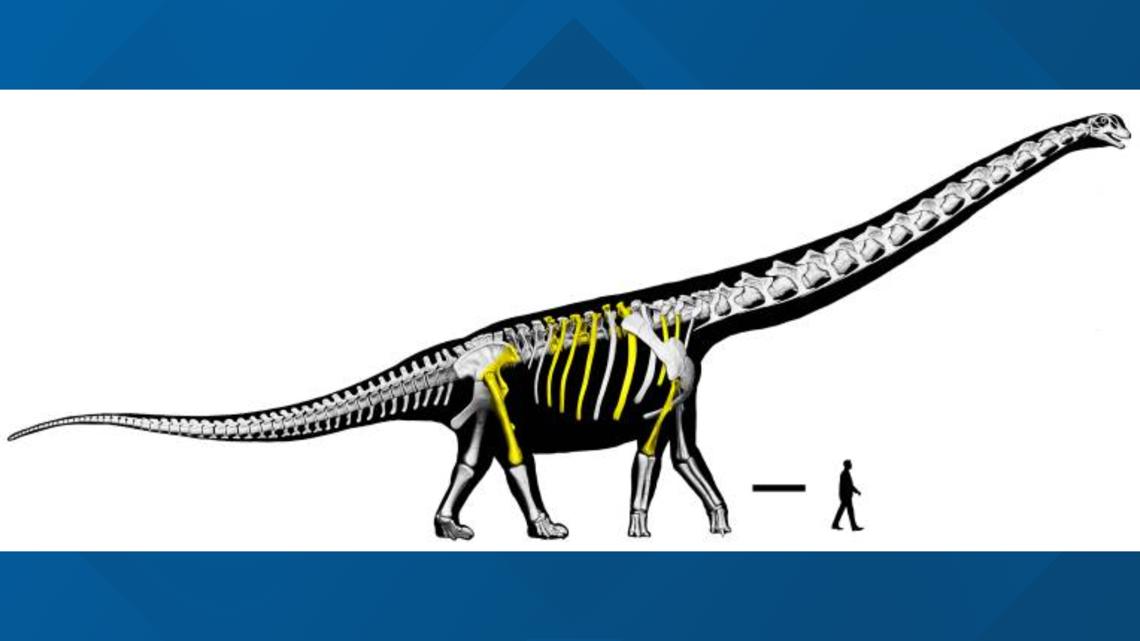



Researchers named it Nagatitan chaiyaphumensis, Thailand’s “last titan.” It is the largest yet discovered in Southeast Asia.
LONDON, United Kingdom — A new species of giant, long-necked dinosaur has been identified from fossils found near a pond in northeastern Thailand. The research was published in the journal Scientific Reports.
It is the largest yet discovered in Southeast Asia.
The newly named Nagatitan chaiyaphumensis was a giant herbivorous sauropod that weighed more than 59,000 pounds and lived more than 100 million years ago. To put this size into perspective, T. rex weighed approximately 15,000 pounds.
The bones were discovered in 2016 by a local man who described them as “strange-looking rocks on the shore of a public pond”.
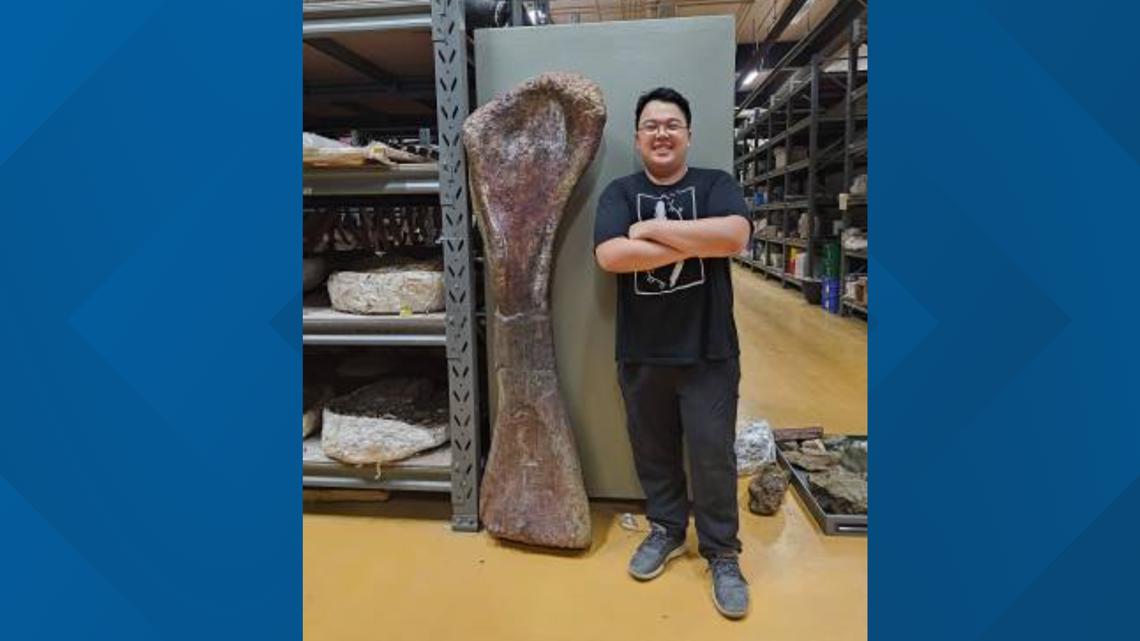
The bones found included several vertebrae and ribs, part of the pelvis and two leg bones, one of which was nearly 6 feet long. Based on the partial skeleton, the team estimated that the animal was 27 meters long, or about 88 feet, roughly the size of a blue whale.
The research was led by scientists from University College London, Mahasarakham University, Suronaree University of Technology and Sirindhorn Museum in Thailand. Lead author Thitiwoot Sethapanichsakul, a doctoral student at University College London, said that when he first saw the bone, “it was taller than me, which was very surprising.” The dinosaur was about twice the size of another known sauropod from Thailand, he said.
“Naga” refers to a legendary snake in Thai and Southeast Asian folklore; “Titan” recalls the giants from Greek mythology; “chaiyaphumensis” means “from Chaiyaphum,” the Thai province where the fossil was found. It is the 14th species of dinosaur officially named in Thailand.
Researchers call Nagatitan Thailand’s “last titan” for a geological reason: It was found in the country’s youngest dinosaurian rock formations. The area later became a shallow sea, meaning the younger rocks are less likely to contain dinosaur remains.
“So this is probably the last or most recent large sauropod we’ve found in Southeast Asia,” Setapani Thakur said.
Researchers say that throughout the animal’s life, it shared its environment with smaller herbivores, large carnivorous dinosaurs, freshwater sharks and crocodile relatives, as well as flying reptiles called pterosaurs.
The discovery provides insight into how ancient changes in climate and vegetation opened the door for the development of giant dinosaurs.
“This is the most complete sauropod specimen ever found in the Khok Kruat Formation,” said Pedro Mocho, a paleontologist at the University of Lisbon who was not involved in the study. “So far, Thailand’s large dinosaurs have been known only from fragmentary skeletons.”
The life-size reconstruction is currently on display at the Tylenol Museum in Asiatique, Bangkok.