



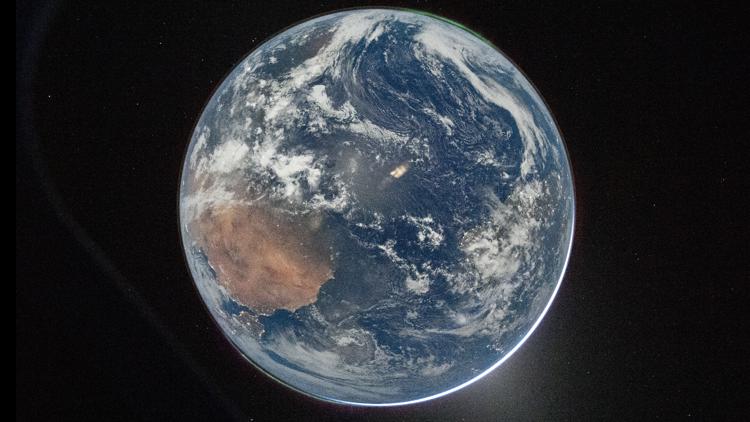
A bus-sized space rock first discovered days ago will pass by Earth at about a quarter of the distance of the moon.
WASHINGTON — A newly discovered asteroid will come closer to Earth than many orbiting satellites next Monday, giving scientists a rare opportunity to study a near-Earth object up close without launching a mission to reach it.
asteroid, designated 2026 Jinhui 2It will fly past Earth on May 18 at a distance of approximately 56,700 miles. This means that it is only 24% of the average distance of the Moon and well within the orbit of many communications satellites.
The asteroid was recently discovered by astronomers at the Mount Lemmon Survey Center in Arizona and the Far Point Observatory in Eskridge, Kansas. The first observation was on May 10th.
Despite the close proximity, scientists say there is no reason to panic. Current calculations show there is no evidence it would hit Earth.
Scientists estimate the asteroid to be between 50 and 115 feet in diameter, roughly the same object as the 2013 Chelyabinsk sky explosion over Russia, which produced a shock wave that shattered windows across large swaths of Siberia and injured more than 1,000 people, although the asteroid itself disintegrated in the atmosphere before reaching the ground.
NASA’s Jet Propulsion Laboratory classifies 2026 JH2 as an Apollo-class near-Earth object, meaning its orbit intersects Earth’s path around the sun.
For those who don’t have telescopes The Virtual Telescope Project will live stream the flyby Live online, starting at 21:45 UTC (5:45 PM ET) on May 18, just after the asteroid recently approached its peak brightness. The asteroid will not be visible to the naked eye.
The flyby comes three years before a more closely watched event: On April 13, 2029, near-Earth asteroid 99942 Apophis — a 1,230-foot-wide rock that had been feared as a potential impact risk — will pass just 20,000 miles from Earth. For at least a century, astronomers have ruled out the possibility of an Apophis collision.