



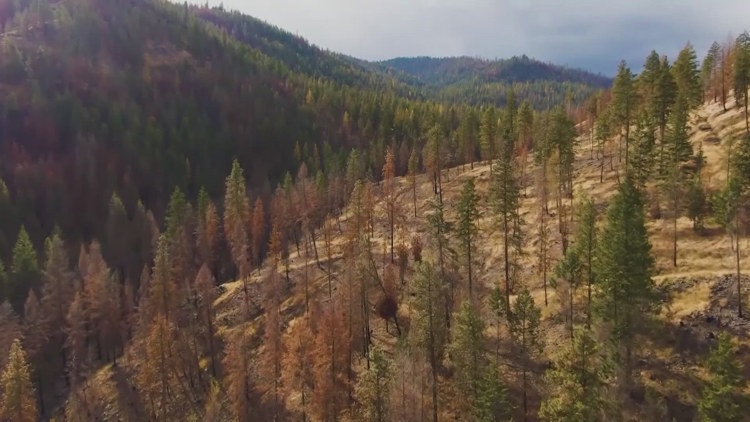
After record-low snowpack and a warm spring that melted snowpack, weather is drying out early, leading to the potential for a severe fire season.
Seattle —
Washington state enters summer fire season under worrisome conditions, with experts warning that historically low snowpack could exacerbate an active and potentially dangerous wildfire year.
Brian Harvey, a professor at the University of Washington and a forest and fire ecologist, said the April 1 snowpack survey, a key benchmark used to assess water reserves heading into summer, ranked in the 5th percentile, meaning 95 percent of years on record have seen more snowpack than last winter.
“One of the reasons snowpack is important relative to rainfall is that water is stored and then released throughout the spring and early summer,” Harvey said.
Unlike rainfall, which drains off quickly, snowpack acts as a slow-release reservoir, keeping soil and vegetation moist during the dry season. As this year’s reserves have melted rapidly in warm spring temperatures, the percentage of normal snowpack readings has dropped into the teens across much of the region, leaving the landscape increasingly fragile.
The link between winter snowpack and the following fire season is one of the most consistent patterns in the long-term fire record, Harvey said. Looking at national data over the past four decades, he noted that from the early 1980s to 2000, more than 6 million acres burned across the U.S. in just one year, with 15 years since 2000 crossing that threshold.
Seasonal fire outlook maps released in early May show high fire potential in eastern Washington state as early as June, with conditions spreading west of the Cascade Mountains in July, reaching high fire potential throughout the Pacific Northwest by August.
But Harvey warned against assuming the threat will happen just weeks away.
“Don’t get caught up in the feeling of ‘it’s only going to happen later in the summer,’ because these conditions can change quickly, like heat waves, which can dry things out very quickly,” he said. He cited the 2021 heat dome as an example of how quickly fire risks can escalate.
He added that wind remains a critical and unpredictable variable, especially on the west side of the Cascade Mountains, where late summer easterly winds can push already warm, dry air toward the coast, creating extremely difficult firefighting conditions, as seen during major fires in 2020.
While this summer’s fire risk is a reflection of last winter’s poor snowpack, forecasts for the upcoming winter are already out, with an El Niño trend for the season. Depending on the intensity, this pattern could lead to warmer and drier winters, but there’s no guarantee. The upcoming winter will impact the 2027 fire season, but may also provide fire mitigation in late summer and fall. If a fire breaks out, the return of wet weather can help naturally extinguish the fire.
While some have expressed concerns about potential El Niño events exacerbating conditions, Washington deputy state climatologist Karin Bombaco said its effects could be felt after this summer’s fire season ends. She noted that the region is currently in neutral conditions, which has no impact on current seasonal climate or fire prospects.
Bumbaco said there is about a 50 percent chance that the developing El Niño will be classified as strong or very strong by next fall or winter, with an equal chance that it will remain weak or moderate, with the situation expected to be clearer by July or August. She also noted that the term “super El Niño” is not a scientific label and clarified that stronger events do not necessarily mean more severe storms, just a greater likelihood of typical El Niño winter patterns in the region, which for Washington would mean warmer-than-normal winter temperatures and lower-than-normal snowfall heading into the spring of 2027.
Bumbaco added that forecasters are fairly confident that there will be no La Niña next winter, with only about a 1 in 10 chance of neutral conditions instead of El Niño.
Harvey emphasized that fires are a natural and expected part of the Pacific Northwest ecosystem, but he said the combination of early snowmelt, warmer temperatures and drying fuels means communities and land managers need to prepare earlier and more thoroughly than in a typical year.


