



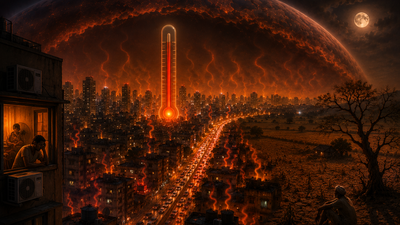
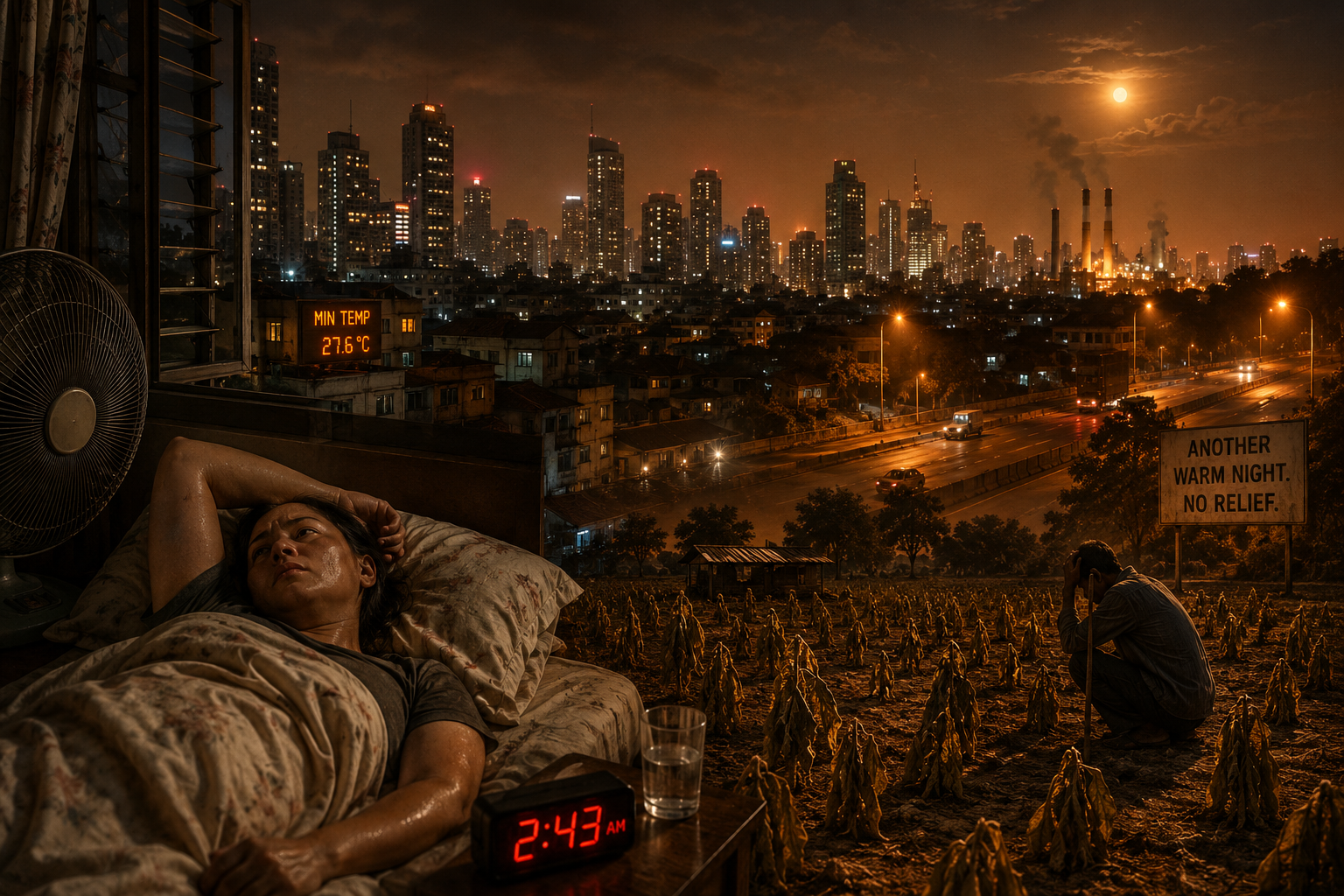
There was a time when nightfall meant relief. After the heat of a long summer, in the hours after sunset, a cool breeze blows in through the open windows and the temperature drops enough to pull back the thin blanket and fall asleep easily. For much of the world, that era is quietly disappearing.Across continents and climates, nights are getting warmer and warming faster than our days. While record daytime temperatures dominate the headlines and heat wave warnings flood our phones, a subtler and arguably more important shift is taking place in the darkness. Minimum temperature is the lowest point a thermometer reaches in a 24-hour period, almost always late at night, and in many parts of the world, minimum temperatures rise faster than daytime warming. Scientists have watched this asymmetry with growing uneasiness.The consequences are not abstract. Farmers rely on cooler nights to allow crops to recover from heat stress during the day. Ecosystems operate according to temperature rhythms calibrated over thousands of years.
AI generated images
The body uses the drop in nighttime temperatures as biological signals to repair cells, consolidate memories, regulate hormones and prepare for the next day. When this decline ceases to occur, everything from crop yields to heart health begins to suffer.The reasons behind nighttime warming are layered and multiple, including factors such as greenhouse gas accumulation, urban expansion, changing cloud patterns and the fact that the Earth absorbs more heat than it emits. Each factor affects each other in ways that researchers are still mapping.
Urban heat island effect: How cities capture daytime warmth
Walking out of any big city at midnight in July, you will feel a thick, lingering warmth that does not exist. The sun had set hours ago, but heat radiated from the streets as if the day wasn’t quite over yet. This is the urban heat island effect, one of the most important and most overlooked drivers of nighttime warming.The culprit is hiding in plain sight: the city itself.Concrete, asphalt, bricks and steel are the main building materials of modern urban life, and they are very efficient heat traps. Unlike soil or vegetation, which reflects sunlight and releases water through evaporation, these dense materials behave like thermal sponges. They actively absorb solar radiation throughout the day, storing it deep within their bodies, and then slowly exhale the stored heat during the night. A sunlit road or rooftop can remain warm well past midnight, effectively turning an entire city block into a low-level radiator.Compounding the problem is the city’s lack of trees. The green cover provides shade and prevents the surface from overheating in the first place, and through transpiration, the trees release moisture that cools the surrounding air, which is nature’s own air conditioner. As cities expand, green spaces are replaced by parking lots, towers and roads, stripping away this natural buffer and causing urban temperatures to rise unchecked.Then there’s the heat that cities actively generate. Every car engine idling in traffic, every air conditioning unit pumping warm exhaust fumes into the streets, and every industrial process humming at night adds heat energy directly to the city’s atmosphere. In densely populated metropolitan areas, this anthropogenic heat, that is, heat generated by human activities, can significantly increase local temperatures, especially after dark when natural cooling processes have been weakened by heat-saturated infrastructure.The result is that the city never really cools down, and increasingly never does for the millions of people who live in it.“Nighttime temperatures are rising most rapidly in already warm and densely populated areas such as South Asia, the Middle East, Africa and other rapidly urbanizing tropical regions. The World Meteorological Organization has confirmed that 2024 will be the hottest year on record, about 1.55°C above pre-industrial levels and the hottest year in the past decade. This global trend is evident in India, where CEEW’s analysis shows that more than 70% of regions have experienced at least five additional very warm nights per year over the past decade compared to the 1982-2011 baseline,” said Dr Vishwas Chitale, researcher at the Council on Energy, Environment and Water (CEEW).
Greenhouse gases and night blankets: Why the atmosphere no longer lets heat escape
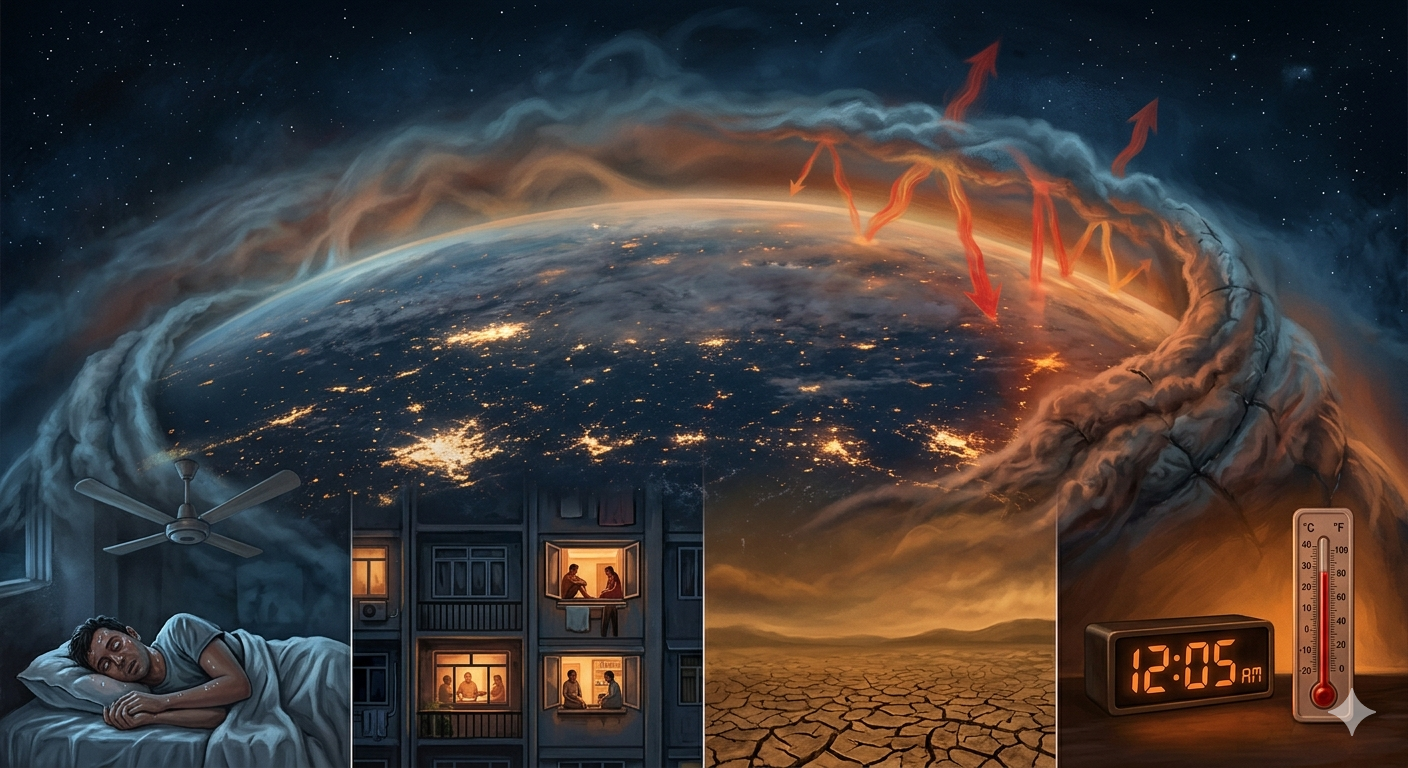
Think of the atmosphere as the blanket that wraps around the Earth. During the day, sunlight passes through it and warms the ground. At night, the Earth tries to release heat back into space, but the blanket grows thicker and emits less and less heat.
AI generated images
This thickened blanket is made up of greenhouse gases, primarily carbon dioxide, methane and water vapor. These gases absorb heat rising from the Earth’s surface and push it back down, warming the lower atmosphere instead of letting it escape into space. The more of these gases, the more heat is trapped and the warmer our nights become.Since the Industrial Revolution, atmospheric carbon dioxide levels have climbed from 280 parts per million to more than 400 parts per million, largely due to the burning of fossil fuels. Levels of methane and nitrous oxide have also risen sharply. Each additional molecule of these gases adds another layer to the blanket. This is most important at night. During the day, the sun will raise temperatures anyway. But after sunset, the Earth cools entirely by releasing heat into the atmosphere. When greenhouse gases are prevented from being released, nighttime temperatures remain high long after dark, and the natural coolness of the night never fully arrives.The numbers prove it. Over the past 50 years, global nighttime temperatures have risen about 40% faster than during the day. Across the world’s land surface, nighttime warming is nearly twice as intense as daytime warming. It’s a quiet but meaningful transformation. The same mechanism that heats our days also heats our nights, it only does its most destructive work in the dark, when the Earth has no sun to blame and nowhere to hide its heat.Dr Chitale said: “The heat is no longer just hotter in the afternoons, India is now very hot during the day, very warm at night and rising humidity, even in traditionally dry areas, making the heat more persistent, more humid and harder for people and infrastructure to cope with.”
Asymmetric warming: Why scientists are more worried about nighttime temperatures than daytime temperatures
When climate scientists talk about global warmingthe public tends to imagine hot afternoons and record-breaking summer days. But for researchers, it’s the night that deserves the most attention. Not because the heat of the day is harmless, it’s not, but because what happens after sunset tells a more honest story about the state of the planet.This concept is called asymmetric warming. Day and night do not heat up at the same rate. Nighttime minimum temperatures are rising faster than daytime maximum temperatures in much of the world. This distinction may seem technical, but for climate scientists, it has considerable implications.Minimum temperatures are more difficult to control. They are less affected by short-term weather events, urban activity or seasonal fluctuations. They reflect the baseline, the lower limit of the climate system, and when that lower limit continues to rise, it signals that some deep structure is changing.A hot day can be explained by a heat wave, a spell of drought, or a burst of summer sunshine. But one hot night, then another, then a decade – suggests the atmosphere has behaved fundamentally differently. The Earth loses less heat after dark. The sequestering effect of accumulated greenhouse gases isn’t a daytime story; it’s a 24/7 story, and nighttime is when it manifests itself most clearly.That’s why minimum temperature trends have become one of the key indicators most closely monitored by climate researchers. They function like vital signs, a pulse check on the Earth’s own cooling capabilities. And now, that pulse warms night after night, leaving less and less room for the natural world to recover before the next day begins.