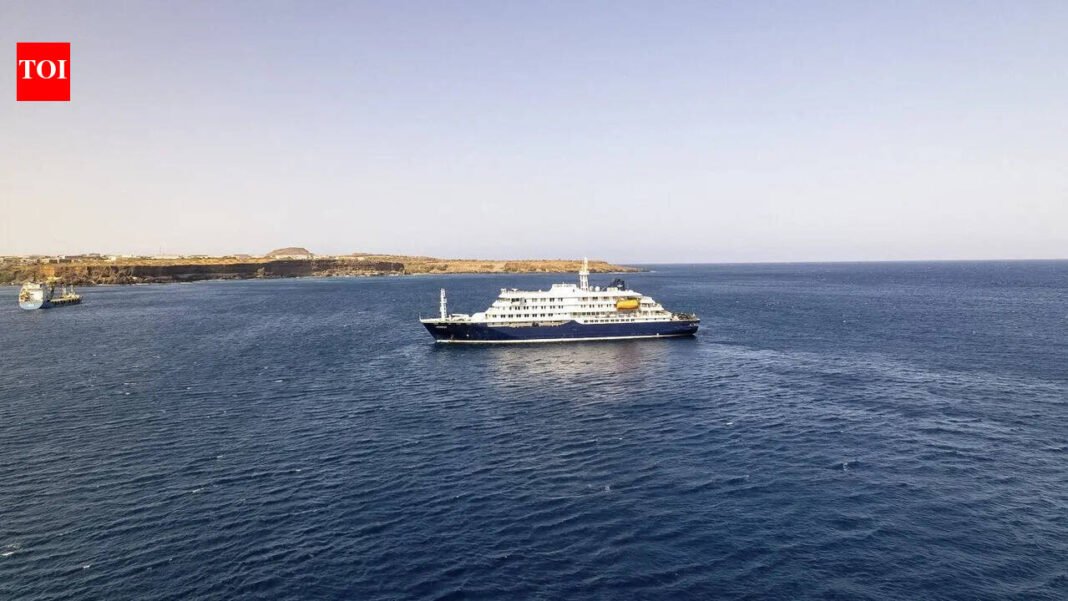



Passengers and crew members hunkered down in despair on a ship stranded off Cape Verde on Monday after local authorities banned it from docking due to a suspected hantavirus outbreak that killed three people.

The island nation has refused to disembark despite the World Health Organization’s European region saying the risk to the wider public remains low.
The MV Hondius was carrying 149 passengers from the UK, Spain and the US, and a crew of 23 nationalities from the Philippines.
Oceanwide Expeditions, the ship’s operator, said in a statement that people on board were subject to “strict precautions,” including quarantine, health protocols and medical monitoring.
The company has confirmed three deaths on board the cruise ship, which was traveling from Ushuaia, Argentina to Cape Verde on the West African coast.
Two people died on board and one died after disembarking.
The company said one passenger was in intensive care in Johannesburg and two others “required urgent medical attention”.
Jake Rosmarin, who posted regularly about the trip before the health crisis, was visibly shaken in his cabin and said people on board were desperate to leave.
“What’s happening right now is very real for all of us,” he said on Instagram.
“There’s a lot of uncertainty and that’s the hardest part. All we want right now is to feel safe, sane and go home.”
Hantavirus, a disease commonly transmitted from rodents to humans, has been confirmed in passengers in intensive care in Johannesburg, operators said.
However, it added that it had not yet been determined whether the virus caused the three deaths.
-“No contact”-
Earlier in the day, Cape Verde’s Ministry of Health said “the national health authorities have decided not to authorize the ship to dock in the port of Praia”.
Maria da Luz Lima, director of Cape Verde’s National Institute of Public Health, said in a television interview on Sunday night that the decision was to “protect the people of Cape Verde.”
“There will be no contact between passengers and the state,” she added.
The operator said it was currently considering landing in Spain’s Canary Islands, “where further medical examination and processing can be carried out.”
Cape Verdean authorities are awaiting approval from the Netherlands and the United Kingdom to provide an air ambulance at the request of some people on board the ship, the ministry said on Monday.
The operator said the first passengers to die were a Dutch couple. The husband died on the ship on April 11, and the wife died after disembarking on St. Helena on April 27 to accompany her husband’s body.
A German on board a cruise ship died on Saturday.
-“Emergency Action”-
Although Cape Verdean doctors went to assess the health of the two sick crew members, they were not allowed to evacuate them to shore.
Hans Kluge, the World Health Organization’s European director, said in a statement that despite concerns, “the risk to the general public remains low.”
“There is no need for panic or travel restrictions,” he said.
Hantavirus infections are “uncommon and usually associated with contact with infected rodents,” he added.
The World Health Organization said it was “taking urgent action to support the response to the hantavirus incident on a cruise ship in the Atlantic following a tragic loss of life”.
“WHO Europe is working with relevant countries to support medical treatment, evacuation, investigation and public health risk assessment.”
There are still two people on the ship who are symptomatic and require treatment, and have not yet been confirmed to be infected with hantavirus.
“The exact cause and any possible links are under investigation,” the vessel’s operator said.
On Sunday, the World Health Organization said it had confirmed one case of hantavirus and “five additional suspected cases.”
“Although rare, hantaviruses can spread from person to person and can cause severe respiratory illness,” the UN health agency said.
“This requires careful patient monitoring, support and response.”
Bulls-CBW-BFM/Gill
This article was generated from automated news agency feeds without modifications to the text.