



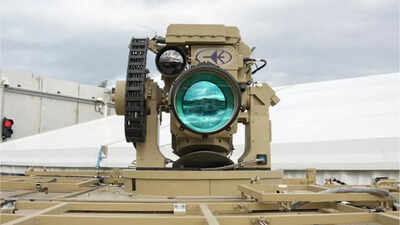
Israel has supplied the United Arab Emirates with an advanced laser air defense system known as Iron Beam as tensions continue to escalate in the US-Iran conflict. The system, designed to eliminate short-range rockets and drones, marks an important step in defense cooperation between the two countries and the deepening of the strategic partnership in West Asia.Israel has deployed a version of the Iron Beam system to help the UAE counter Iranian missile and drone attacks, the Financial Times reported. The laser system has previously been used by Israel against projectiles from Hezbollah in Lebanon and is capable of intercepting threats with high accuracy at short ranges.
Israel has also fielded an advanced surveillance system called Spectro, which can detect incoming drones up to 20 kilometers away. Reports show that some of the systems deployed are still in the prototype stage and have not yet been fully integrated into Israel’s own defense network, underscoring the urgency of the situation.One regional official said the move demonstrated “the value of being a friend of Israel.” Another source familiar with the deployment said Israel took the systems “off the bench and gave them to the Emiratis”, while a third said “we had them in our underwear”.According to reports, the UAE faces fierce attacks from more than 500 ballistic missiles and 2,000 drones from Iran. In response, a layered air defense system, including Israeli equipment, was activated, successfully intercepting most of the incoming threats. Israeli personnel were also deployed to assist with operations on the ground.
US approves $8.6 billion worth of arms deals for allies
According to Al Jazeera, the United States has approved arms sales worth more than $8.6 billion to major allies such as Israel, Qatar, Kuwait and the United Arab Emirates amid rising regional instability. The deals include the sale of $4 billion worth of Patriot missile systems to Qatar and nearly $1 billion in precision-guided weapons to Israel.The U.S. State Department said the agreements were designed to strengthen allies’ defense capabilities and support broader regional security objectives. Congress retains the power to review proposed sales.US President Donald Trump has defended military action against Iran, rejecting criticism of its effectiveness. “We have the radical left saying, ‘We didn’t win, we didn’t win.’ They don’t have any troops left. It’s unbelievable,” he said. “Actually, actually, I think it’s treason, okay. You want to know the truth, it’s treason.”Trump claimed that Iran’s military capabilities have been severely weakened. “Iran is getting hammered. They don’t have a navy. They don’t have an air force. They don’t have air defense equipment. They don’t have it.” They don’t have radar. They have no leaders; their leaders are gone,” he said.
Deepening Israel-UAE defense ties
The deployment underscores the growing military ties between Israel and the UAE in the wake of the U.S.-brokered Abraham Accords. These agreements formalize diplomatic relations and open the door to expanded defense and economic cooperation.Israel has previously supplied Barak and Spyder air defense systems to the UAE, but the current conflict marks the first major operational test of this partnership. One Western official noted that the United Arab Emirates became a key target of Iran in part because of its “enthusiastic” acceptance of the deals.The transfer of cutting-edge systems like Iron Beam reflects both the intensity of the conflict and the strategic importance of the Israeli-UAE alliance in countering regional threats.