



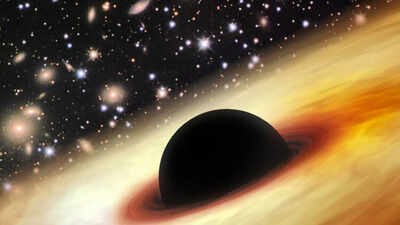
For years, astronomers have been witnessing a seemingly growing mystery about the early formation of the universe. According to recent discoveries, some supermassive black holes, a billion times more massive than our sun, were formed less than a billion years after the formation of the universe itself. This phenomenon is difficult to understand based on current scientific explanations of black hole evolution. Typically, black holes are created when a star collapses and gradually increases in size. This is because the entire process takes time. However, recent findings using the James Webb Space Telescope point in the opposite direction. There may be an unknown force behind their rapid formation, and dark matter may be the answer.
Scientists explore hidden effects Decaying dark matter
According to a report published by IOP Science titled “Direct collapse candidate black holes from decaying dark matter‘, the existence of dark matter refers to the concept of an invisible substance that makes up most of the matter in the universe. This dark matter neither reflects nor emits light, and has negligible interactions with other matter. However, its gravity affects galaxies. In recent research, scientists have taken another direction in exploring dark matter. Decay means releasing some energy into space. Initially, however, the process didn’t seem to have much of an impact on anything. The energy emitted by each particle is negligible. Still, scientists believe that minimal energy inputs could have had an impact on the universe’s initial state, since it was mostly composed of hydrogen.
Dark matter decay may directly trigger black hole formation
According to scientific research, under normal circumstances, gas clouds lose heat and eventually break up, forming stars. In other words, this is the normal path. However, according to current research, if a certain amount of energy is released in the gas cloud due to the decay of dark matter, then cooling will be hindered.Therefore, there will be no debris in the cloud. It will not fragment, but will directly collapse into a huge black hole. This phenomenon is called direct collapse, meaning no stars are created.Scientists speculate that this method may have helped form supermassive black holes soon after the universe began to exist. According to Space.com, it was found that this process may occur when the mass of the dark matter particle is between 24 and 27 electron volts.
Insights from the James Webb Space Telescope
In fact, the James Webb Space Telescope was crucial to asking these questions. The telescope’s discoveries include the identification of galaxies and black holes that appear to be further developed than expected given their ages. It challenges our current theories about the formation of the universe.Directly collapsing black holes has emerged as a plausible explanation, but seems to depend on special circumstances. For example, surrounding stars should emit intense radiation that affects the gas in the cloud surrounding the black hole in some way. However, proposed dark matter theories suggest that these anomalies may not be as rare as previously thought.
How tiny dark matter effects could have huge consequences
One of the most striking aspects of this research is the scale of energy involved. Each decaying dark matter particle releases a tiny amount of energy, far less than everyday energy sources. Nonetheless, cumulative effects over broad spatial regions may be meaningful.The gas clouds of the early universe were not stable systems. Their behavior depends on a delicate balance between heating and cooling. Even slight shifts in this balance can determine whether stars form, or black holes emerge directly. Researchers believe these early environments may have acted as natural detectors of dark matter activity. While the idea remains speculative, it offers a new way to link particle physics to the evolution of the universe.
New research adds another piece to supermassive black hole puzzle
The theory that dark matter decay leads to the development of supermassive black holes is still under investigation. This theory has not been proven and more research, both observational and theoretical, is needed. To be sure, there are still many unanswered questions about the early universe. The existence of massive black holes during this period contradicts existing theories.