


Snooker is a popular billiards game that is now played on all continents and is played at the highest professional level. Its history has its origins in the theater and television lights with which it is associated today, an environment almost incidental by comparison in the officers’ mess of a British Army Regiment stationed in Jabalpur, India, where Dating extensively to April 17, 1875To pass the time, a group of officers start tweaking a familiar game until it becomes something else entirely. 1875, in Devon 11th Sir Neville Chamberlain, who served in the Regiment, took the existing game of black billiards, which used a set of red balls and a black ball, and began experimenting with the introduction of additional colored balls and different orders of play, not with the intention of inventing a game that could be passed down from generation to generation, but simply to keep people around that night. The people around the table were more interesting, and when one of the young officers was confused by this new version, Chamberlain found the army slang “snooker” a term used to describe inexperienced cadets, and applied it to the players, and almost immediately to the game itself.For years, the moment was little more than an anecdote among players until Sir Neville Chamberlain himself formally acknowledged himself as the founder of the game when he wrote to The Field magazine in 1938. More than 60 years after the game was first played in this improvised form, it was taken seriously at the time and quickly gained prominence the following year when writer Compton Mackenzie quoted and championed it in The Billiard Player (1939), giving it a degree of contemporary recognition that helped resolve the question of snooker’s origins and shape the version of the story that has been followed ever since.

Snooker’s origin story was cemented after Neville Chamberlain’s 1938 letter to The Field and Compton Mackenzie’s support in The Billiard Players in 1939 / Picture: Snookerheritage.co.uk
How a colonial pastime returned to Britain
The game was not initially spread in any planned or structured way. Officials back from India simply brought the game back, introducing it to clubs and private rooms where billiards was already played, and over time it started to find its place without much formal push. One of the more important early encounters occurred in 1885, when John Roberts, the then British billiards champion, met Chamberlain during a visit to India, reportedly while dining with the Maharaja of Cooch Behar, and after learning the rules and seeing enough of the game, brought it back to England.
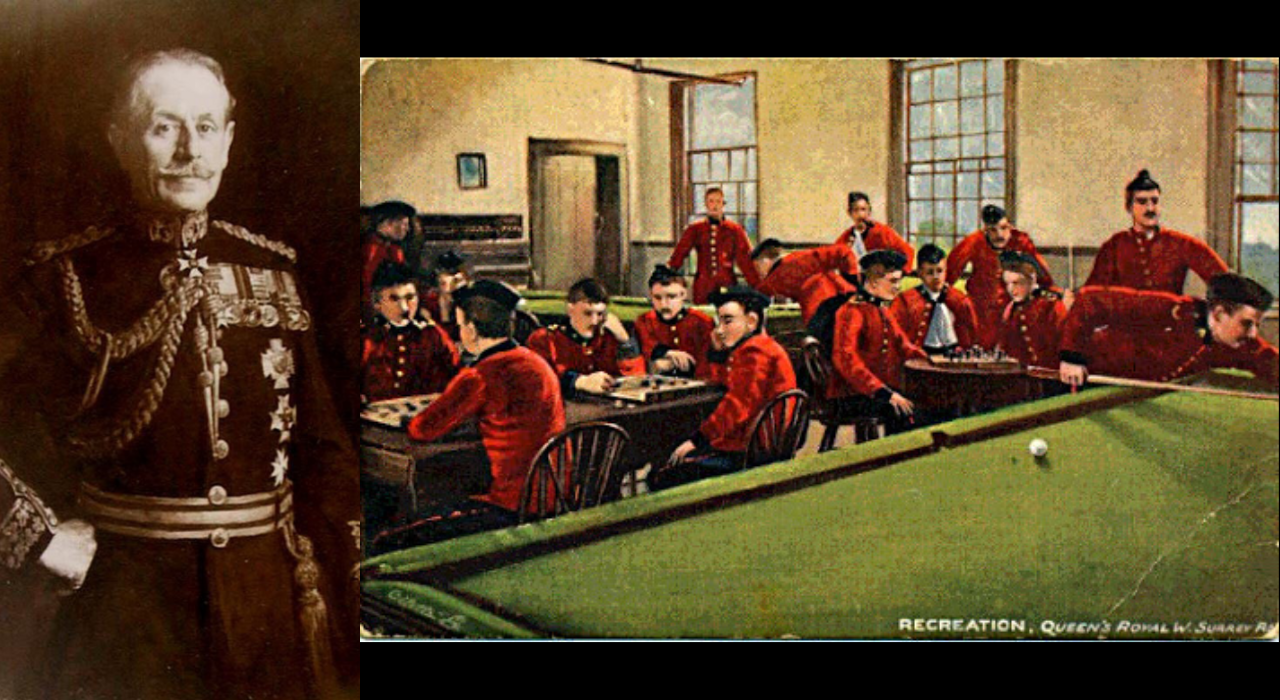
Snooker originated in India in 1875 and evolved from a pastime for British officers to an elite global sport / Photo: Wikipedia, thecueanddartslounge.co.uk
Even so, snooker didn’t spread overnight. For a while, it stayed mostly within circles with access to pool tables, usually in restricted-entry gentlemen’s clubs where those without memberships were not allowed in at all. However, this exclusivity creates its own pressures. As interest grew, smaller, more open clubs began to appear where the game could be played without the same barriers, and by the end of the 19th century billiards equipment manufacturers had begun to realize its commercial potential, producing tables and accessories specifically tailored for snooker.
From loose play to structured sport
For decades the game did not have a single, unified set of rules, but was shaped by local differences and customs, until 1919, when the Billiards Association and Controlling Clubs brought a degree of order to the game by establishing standardized rules that could be applied to various games. This body later became the World Professional Billiards and Snooker Association, providing the framework for taking snooker from a pastime to a profession. The first recognized amateur championship appeared in 1916, but it was not until the introduction of the Professional World Snooker Championship in 1927 that the sport was given a clear competitive structure, and it was here that Joe Davis became the first dominant figure, winning the title 15 times in a row and in doing so establishing a standard of excellence and a sense of continuity for a sport still searching for its identity.
The TV Era and the Players Who Shaped the Modern Game
The popularity of snooker has not been linear. After a quiet period in the 1950s, it found new audiences through television, particularly programs from the BBC Guohei The series, launched in 1969, introduced color play to make its visual rhythms more accessible to family audiences. The exposure coincided with a generation of players who gave the game an identifiable personality: Ray Reardon, Alex Higgins, Steve Davis Dennis Taylor’s 1985 final attracted millions of viewers and remains one of the most replayed moments in the history of the sport. From 1977 the World Championships found a permanent home at Sheffield’s Crucible Theatre, a venue that has since become the heart of the sport, its smaller, more intimate setting creating a pressure rarely replicated in larger arenas.
From British pastime to global sport
Over the past few decades, snooker’s influence has grown far beyond its British roots, with players from across Europe and Asia reshaping the competitive scene. Stephen Hendry, a seven-time world champion who redefined dominance in the modern era, and Ronnie O’Sullivan, whose longevity and style have kept him at the heart of the sport for more than three decades, have taken the sport into a different phase, one that balances tradition with a wider, more international influence. This shift is particularly evident in the rise of Chinese athletes, both in numbers and success, which has transformed not only who competes but where the sport’s future audiences may be.
The current moment is still tied to the first table
The 2026 World Snooker Championship will kick off at the Crucible on 18 April, taking place at the venue for the 50th consecutive year, with a venue that reflects both the history and direction of the sport. Defending champion Zhao Xintong returns after becoming the first Chinese champion in 2025, while 50-year-old O’Sullivan is competing for the 34th consecutive time and is still pursuing a record-breaking eighth world championship. The game brings together established names and emerging challengers, all played under a set of rules that somehow date back to the first attempts at reinventing the game in the Indian barracks.

In this photo released by Xinhua News Agency, England’s Ronnie O’Sullivan plays against Chinese player Xiao Guodong during the second round of the 2026 Snooker World Grand Prix in Hong Kong on February 5, 2026. (Xinhua News Agency/Lu Binghui)
Of course, there’s more to it than just history and prestige. The winner will receive £500,000, taking the total prize pool to over £2 million, which, like other items on the table, is a sign of how far the competition has come.In hindsight it is easy to see 1875 as a fixed point, a definite beginning, but at the time it simply did not feel that way. It’s just a change, an adjustment, a way to spend the night that happens to last.