



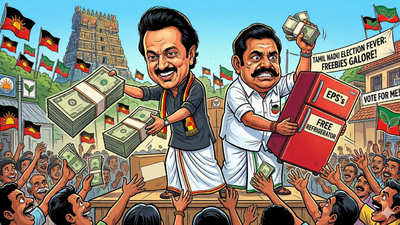
NEW DELHI: Election campaigns across India are increasingly defined by what political parties promise to deliver, and while “free culture” may be popular in other states, it is tamil nadu. Across the state, parties have renewed promises of cash transfers, subsidized services and household goods, each trying to outdo the other. ‘Tis the season of manifestos and high-decibel campaigning, with welfare language dominating every rally and roadshow.For many voters shaped by decades of Dravidian politics, such promises are not extraordinary giveaways but part of the normal grammar of governance.
Tamil Nadu is unique not only in the scale of its welfare but also in the depth of its political memory. From early interventions in food and education to more overt, consumption-oriented programs, successive governments have established the expectation that the state must play an active role in everyday life.It is not just the scale of benefits that is changing, but also its form, with earlier schemes focused on goods such as televisions, mixers and grinders now being replaced by direct cash transfers and other similar schemes.
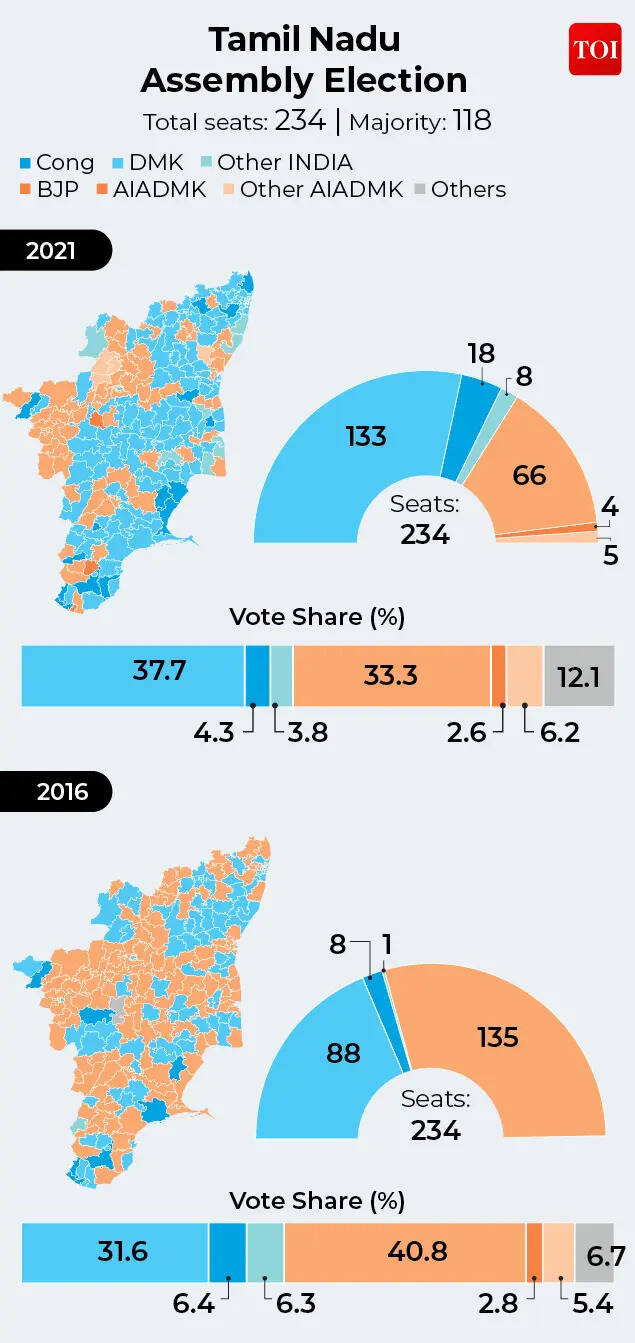
The contest thus reveals less about excess and more about continuity, showing how deeply entrenched this pattern is in Tamil Nadu’s political imaginary.Likewise, by 2026, what is unfolding is not just a contest of commitments, but a contest within limits that no major party is willing or able to redraw.
How welfare became the norm
The beginning of this story is not unnecessary, but intentional. Under MG Ramachandran, welfare was incorporated into governance as a legitimacy tool. His most lasting intervention was the expansion of the Nutritious Meal Programme, which ensured that cooked mid-day meals were provided to school children on a large scale, resulting in significant increases in enrollment and retention rates. At the same time, rice subsidies through the public distribution system were expanded, and programs such as free school uniforms and textbooks strengthened access to basic education. These are not discretionary benefits but fundamental responsibilities of the state, especially for poor families.
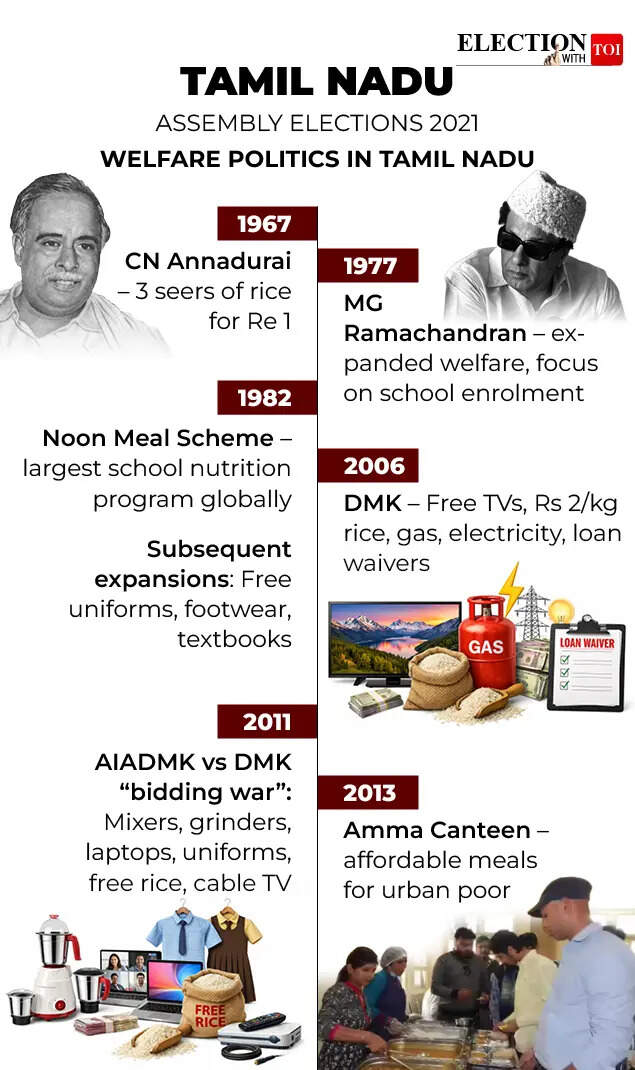
Under J Jayalalithaa, welfare gained a sharper political edge and a more visible form. Her government launched a series of consumer-oriented programs to make state support immediate and tangible: free color TVs for families, blenders, grinders and fans for female beneficiaries, and laptops for students aimed at bridging the digital divide. At the same time, the Ama brand’s subsidized services, including the famous Ama canteen providing low-price meals, as well as Ama salt, water and pharmacy, extend benefits to daily consumption. These initiatives not only provide material support; They reshaped voters’ experience of the country, turning benefits into something that could be seen, used and remembered.The next competition is not whether to provide benefits, but how much to provide and how effectively. alternation between DMK The AIADMK has not broken this pattern; it is entrenched. Each administration inherits and adds to the expectations set by the previous administration. By the time Stalin came to power, this pattern had evolved again. The focus shifted to more targeted programs and direct transfers, especially to women and students, improving rather than reversing the previous situation.Neither the DMK nor the AIADMK, led by Edappadi K. Palaniswami of the Opposition, can credibly carry out a campaign to reduce benefits. When criticism arises, it focuses on inefficiency or corruption rather than the principles themselves.
Can the model last?
Most political parties would say that Tamil Nadu’s welfare model remains fiscally sustainable, underpinned by a strong economy. The state has one of the strongest industrial bases in India, leading in electronics manufacturing and has grown steadily in recent years to exceed the national average. By standard measures, it is not in financial trouble. The debt-to-GDP ratio has fallen from its peak to around 26%, and the fiscal deficit is expected to return close to the 3% target. Strong own tax revenues and relatively low borrowing costs reinforce the outlook. Social outcomes bear this out: welfare programs improve education, especially for women, and strengthen labor force participation.
But caution remains. Tamil Nadu’s debt remains high in absolute terms and welfare spending continues to expand. Interest payments represent an increasing share of revenue, while the deficit remains high. Critics warn that the escalating commitments could lead to a tightening of fiscal space. Even within the government’s estimates, a massive cash program is likely to have significant recurring costs. Benefits themselves may not be unsustainable, but the accumulation of commitments is shrinking flexibility. The debate is not about the immediate crisis but how long this equilibrium can be maintained.
Competition without exit
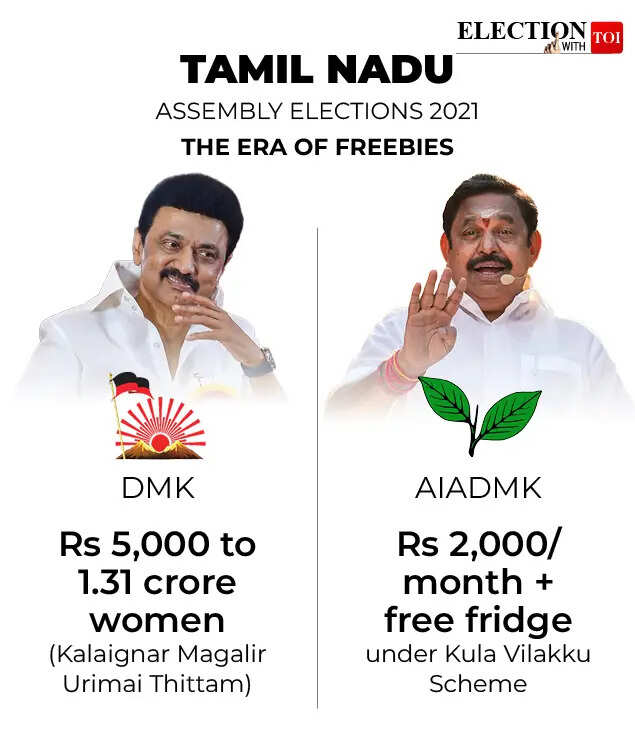
There is no major political party in Tamil Nadu now opposing welfare. Instead, the competition is about scale and delivery. The 2026 manifesto reflects this logic. The DMK proposed providing Rs 8,000 household voucher and extending financial support to women while continuing subsidies and services. The AIADMK responded with wide-ranging promises including direct cash transfers, free appliances (including refrigerators) and fuel support. Many of these echo earlier schemes, showing how deeply embedded the model is.
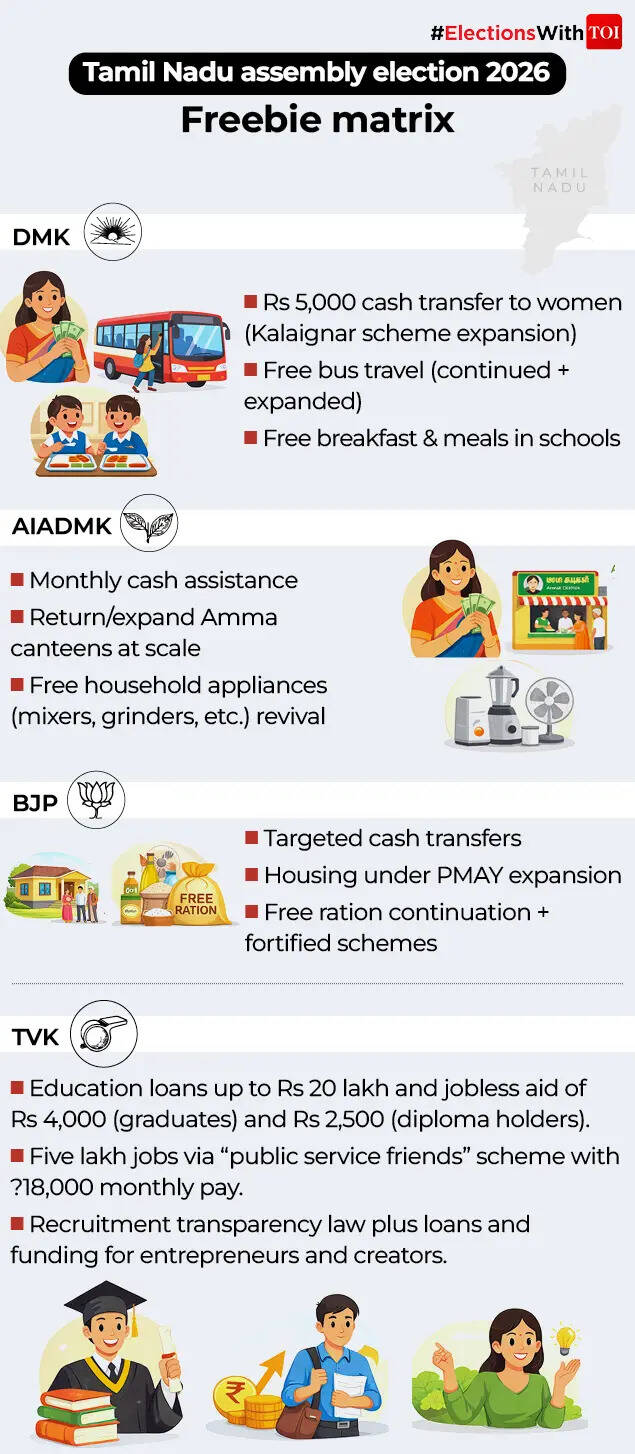
Political exchanges have entered a familiar cycle. Edappadi K. Palaniswami criticized Stalin’s proposals as inefficient while promising more direct cash support. The DMK, in turn, defended its approach as targeting welfare and development gains. Behind the rhetoric, both sides operate under the same constraints: extracting benefits carries political risks. The competition is no longer whether to provide benefits, but how to provide them visibly and effectively.
Voter Logic
Attempts to challenge this framework have had limited success. Seaman publicly rejected the language of freebies, arguing for dignity and self-reliance over state handouts. Yet his position remains outside the mainstream. even VijayInitially, his politics revolved around welfare rather than freebies, and he offered the same set of benefits as the established parties.This reflects a deeper reality. Tamil Nadu’s voters are not passive but the influence of decades of policies that have made welfare tangible and reliable. Programs are often targeted and tied to real outcomes, from education to nutrition. For many voters, these distinctions are more practical than ideological. Benefits are assessed based on reliability and accessibility, not intent. It often does not matter whether support is provided in the form of subsidies, services or direct transfers; what matters is whether it arrives on time and reaches the target households. This creates a feedback loop in which parties are judged not by delivering benefits but by effectively delivering benefits. In this sense, electoral competition reinforces the system even as it appears to work against it.
what is the way forward
The emergence of new players before 2026 increases the likelihood of such a shift. In different ways, Seeman and Vijay illustrate the politics of dignity and self-reliance. Their rhetoric hints at unease with the expanding welfare state, suggesting that dependence may come with its own costs.As a result, even potential disruptors face a dilemma. To oppose welfare outright is to risk marginalization; to accept it is to become part of the same competitive cycle. So far, the latter instinct has prevailed. The challenge they pose is therefore indirect, advancing the dialogue rather than overturning it.The real test is not whether parties can abandon benefits, but whether they can maintain them without closing off their own future options. For now, growth in Tamil Nadu maintains this balance, masking the trade-offs behind it. But the assumptions on which this balance relies may not always endure.Rather than falling into the free trap, Tamil Nadu built a system that worked until it didn’t. The uncertainty lies in what breaks first: the economy that sustains it, or the politics that requires it.


