



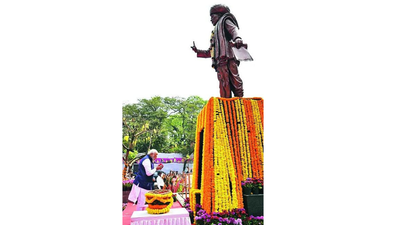
Today, April 11th, is a very special day for all of us. It is the birth anniversary of Mahatma Jyotirao Phule, one of India’s greatest social reformers and a guiding light for generations. This year, the occasion takes on even greater significance as it marks the start of celebrations marking the 200th anniversary of his birth. Mahatma Fuller was a great reformer. Beyond that, his life was marked by moral courage, tireless inquiry and an unwavering commitment to the social good. Mahatma Fowler is remembered for the institutions he founded and the movements he led. At the same time, his contribution to our civilizational journey lies in his continuing to inspire hope, instill confidence and ideological strength in hundreds of millions of people across the country. Mahatma Phule was born in the great state of Maharashtra in 1827 from humble beginnings. But the initial difficulties did not hinder his learning, courage or commitment to society. It was a trait he always retained: no matter what challenges he faced, he had to work hard to gain knowledge and mitigate those challenges, rather than sit idle. From his school days, young Joe Tilong was filled with intense curiosity and became a voracious reader, often reading books far beyond what a child of his age should be exposed to. Years later, he said, “The more questions we asked, the more knowledge we gained from it.” It was clear that the spirit of inquiry he had had since childhood remained a constant throughout his journey. Throughout his life, learning and education became central to Mahatma Phule’s mission. He saw with rare clarity that knowledge was not a privilege to be guarded, but a power to be shared. He opened pioneer schools for girls and those who did not receive formal education at a time when the joy of learning was not available to many. He once said: “Any progress a mother brings to her child is very valuable. Therefore, if schools are to be opened, they should be opened for girls first. ” He is committed to creating a new social imaginary in which the classroom becomes an instrument of justice and equality. His educational vision inspires us a lot. Over the past decade, we have been working towards making research and innovation a cornerstone for India’s youth. We are working hard to create an ecosystem that encourages young people to question, explore and innovate. By investing in knowledge, skills and opportunities, India is empowering its youth to become problem solvers and agents of national progress. Owing to his knowledge and wisdom, Mahatma Fuller had in-depth knowledge in areas such as agriculture, healthcare and rural development. He often said that injustice against farmers and workers weakens our society. He saw how social inequality manifested itself in everyday life, whether on the farm or in the village. He therefore worked to ensure the dignity of the poor, oppressed and marginalized groups. At the same time, he made every effort to maintain social harmony. Mahatma Phule believed that “true freedom can only be achieved when everyone in society is given equal rights.” To this end, he established institutions that translated this vision into action, contributing to the creation of a just society. The Satya Sodak social movement he founded is one of the most important social reform movements in modern India. It is at the forefront of social reform, community service and the advancement of human dignity. It became an effective voice for women, young people and rural residents. The movement reflected Mahatma Fowler’s intrinsic belief that society could be strengthened by placing at its core a spirit of justice, respect for each individual, and collective progress. His personal life was also filled with courage. Always working and living among people took a toll on his health. But even the most serious health challenges didn’t weaken his resolve. After suffering a debilitating stroke, he continued to work and realize his vision. Yes, his body was tested, but his commitment to society was not fulfilled. For millions of people today, especially those who drew courage from the struggle, this remains one of the most powerful dimensions of his life. The memory of Mahatma Fuller would not be complete without mentioning Savitribai Fuller, who herself was one of the supreme reformers of our country. As one of India’s pioneer women teachers, she played a decisive role in promoting education for girls, thereby providing them with the opportunity to pursue their dreams. After the death of Mahatma Phule, Savitribai inherited this torch and during the 1897 plague outbreak, she served the victims so zealously that she herself contracted the disease and lost her life. Our land has been blessed time and time again by great men and women who strengthened society through their thoughts, sacrifices and actions. They are not waiting for change to come from elsewhere. They became its source. For centuries, in our land, the clarion call for social progress has often come from within society, from those who can clearly see suffering and refuse to accept it as their fate. Mahatma Jyotirao Phule was one such voice. I fondly recall my visit to Pune in 2022, when I paid homage to Mahatma Phule at his magnificent statue in the city. As we commemorate the bicentenary of the birth of Mahatma Jyotirao Fuller, the most fitting tribute to Mahatma Jyotirao Fuller is about renewal. Reaffirm our commitment to subjects he cares about, such as education. We are resensitized to injustice. Renew our belief that society can improve itself from within. His life taught us that the power of community, when combined with moral clarity and public purpose, can work wonders in India. That’s why he still provides strength to millions. That’s why his words and work remain hopeful. That is why nearly two hundred years after Mahatma Jyotirang Fuller was born, he remains not a figure of the past but a guide to India’s future. (The author is the Prime Minister of India)