


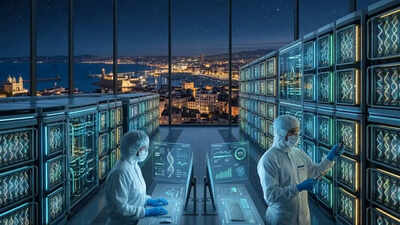
The combination of synthetic DNA and electronics is changing the approach to neuromorphic computing and is a new way to address the rising energy costs associated with current artificial intelligence. Combining molecularly engineered DNA sequences with quasi-two-dimensional perovskite semiconductor materials, researchers can create “memristors,” or memory resistors, based on the brain’s ability to create new memories through synaptic plasticity. DNA offers very high data density, storing 215 petabytes of information per gram; therefore, a device built using DNA hybridization and synthesized using ultra-low voltages of less than 0.1 volts has both processing power and memory on the same device. Using both processes and memory on the same device can dramatically reduce energy usage (i.e., by a factor of 100), creating a powerful, scalable model for the next generation of energy-efficient, high-capacity supercomputers.
DNA powers next-generation supercomputers
Standard calculations are approaching the “thermodynamic limit”, and synthetic DNA as a programmable nanomaterial will be the answer to this problem. According to a journal published by Wiley Online Library, when silver ions dope synthetic DNA and combine with perovskites, the resulting synthetic DNA, or DNA, creates stable conductive pathways for high-density storage. These devices are memristors, which retain memory (data) like neurons in biological systems without the need for constant power.
Why DNA is the key to sustainable computing
As artificial intelligence continues to expand, the energy required to move data on standard chips will become too great. Research funded by the National Science Foundation (NSF) shows that biological systems have advantages over contemporary chip architectures when it comes to parallel processing. Computing using DNA-enhanced processing (i.e., DNA-based computers) will enable multi-input processing and consume 90% less energy than traditional non-volatile memory.
The high-density advantage of DNA
One of the greatest advantages of DNA is its spatial efficiency. As cited in the NIH study, DNA stores data millions of times more densely than silicon. This will have a huge impact on future supercomputers, as the physical footprint of data centers will be reduced, while at the same time, the reliability of long (cold) data storage will increase through the chemical stability of the synthetic DNA strands.
Bioelectronics that can withstand extreme temperatures of 121 degrees Celsius
Bioelectronics face performance limitations due to fragility; however, research recently announced that composites of synthetic DNA and perovskites can withstand extreme temperatures of 121 degrees Celsius (250 degrees Fahrenheit), making it possible to design DNA-driven electronics that can withstand the thermal demands of high-performance supercomputers, potentially becoming an alternative to the current semiconductor industry.