

In the 19th century, Otto von Bismarck famously said that politics is “the art of the possible, the achievable—the art of the next best.” Few modern American politicians embody this sentiment as well as Vice President Vance. Over the past decade, Vance’s political journey has been filled with dramatic turns: from a strident critic to Donald Trump He once described him as the Republican Party’s “cultural heroin,” to one of the Trump movement’s most prominent supporters, and now to a vice president navigating the difficult terrain between populist isolationism and an administration willing to use military force abroad.This tension became particularly evident in the early days of the Iran War, when Washington’s attention turned to a curious question that began circulating in political circles and newsrooms: Where, exactly, is J.D. Vance?
what happened
The latest escalation between the United States and Iran began when the Trump administration authorized strikes against Iran’s military infrastructure and elements of its nuclear program. The White House has framed the operation as a limited effort to weaken Tehran’s capabilities and prevent it from acquiring nuclear weapons.The attack marked one of the most serious direct confrontations between Washington and Tehran in years. Senior officials soon appeared on television and at press conferences to defend the decision and explain the government’s strategy.But there was one absence that was conspicuous.According to the Financial Times, Vance “made no public comment on the military action in nearly 72 hours,” even as Republican lawmakers and cabinet officials rushed to the television studio to defend the attack. This silence is noteworthy because the vice president is traditionally one of the most visible political advocates in times of war.Instead, the government’s public defense of the movement was led by another figure.
Peter Heggs be the face of war
While the vice president has largely flown under the radar, Defense Secretary Pete Hegseth has emerged as the administration’s most visible supporter of the effort.The Sunday Times report said Hegseth “was tasked with selling the conflict to a skeptical US audience” while “J.D. Vance remained in the shadows”. These terms capture the unusual landscape surrounding early information about the war.
Hegseth, a former National Guard officer turned Fox News host, enthusiastically accepted the role. His rhetoric was blunt, combative, and deliberately artificial.“They are screwed and they know it,” he said, describing Iran’s military stance, before adding a line that quickly circulated in political commentary: “Death and destruction are falling from the sky. All day long. “In another speech defending the action, Heggs declared that “America is winning decisively, devastatingly, and without mercy.”This rhetoric is notable not just for its bravado but for what it reveals about the administration’s broader messaging strategy.Roger Stahl, a communications professor at the University of Georgia who studies war rhetoric, told The Sunday Times the rationale offered for the conflict sounded different from previous US interventions. “We were given zero moral justification,” Starr said. “It’s all about the power of America’s military, the beauty of our weapons and the idea that we’re going to win.“In fact, the administration portrayed the war as a show of American power rather than a moral crusade.This approach puts Hegseth at the center of government communications efforts.It also made the vice president’s absence all the more conspicuous.
vice president’s silence
The calm surrounding J.D. Vance in the early days of the conflict quickly became a topic of discussion among political observers.Historically, vice presidents have played a visible role in moments of military crisis. Dick Cheney was a prominent defender of the Bush administration’s Iraq strategy, while Joe Biden was a frequent diplomatic envoy and political advocate for Iraq. barack obamaforeign policy decisions.Vance’s low profile has prompted speculation about whether he is deliberately distancing himself from the war.Part of the reason may lie in his own political identity.Before becoming vice president, Vance had become one of the Republican Party’s most prominent critics of foreign interference. A Marine Corps veteran who served in Iraq, he has often warned that U.S. leaders have become too willing to deploy military force overseas.In an interview discussing the possibility of confrontation with Iran, he argued that the United States should avoid another protracted Middle East conflict. “We’re going to be in a war in the Middle East for years with no end in sight — that’s not going to happen,” he said while discussing potential escalation.That stance makes the Iran war politically awkward for a vice president whose rise is closely tied to populist criticism of U.S. foreign policy.
Not the first time
The Iran conflict is not the first time observers have questioned Vance’s visibility in a foreign policy crisis. Similar problems arose with U.S. actions against Venezuela’s leadership early in the administration. Journalist Benjamin Wallace Wells, writing in The New Yorker, noted that when the action was announced, “Vice President J.D. Vance was notably absent.“The report also noted that the Wall Street Journal’s detailed report on the plans behind the mission “did not once mention the vice president’s name.” White House officials disputed the suggestion that he was excluded, insisting that Vance was involved in behind-the-scenes activities. But the phenomenon reinforces a growing perception that the vice president plays a quieter role in foreign policy debates than some of his predecessors. The Iran war reinforced this view.
A political journey that took a turn for the worse
Even by the fluid standards of modern American politics, J.D. Vance’s political trajectory is unusually remarkable.In the early days of Donald Trump’s political rise, Vance publicly criticized the future president. In 2016, he described Trump as the Republican Party’s “cultural heroin,” arguing that Trump’s populist rhetoric provided emotional satisfaction without addressing deeper economic and political issues.Over time, however, Vance moved steadily closer to Trump’s political orbit. By the time he entered the Senate and later joined the administration as vice president, he had become one of the most prominent defenders of Trump’s worldview.
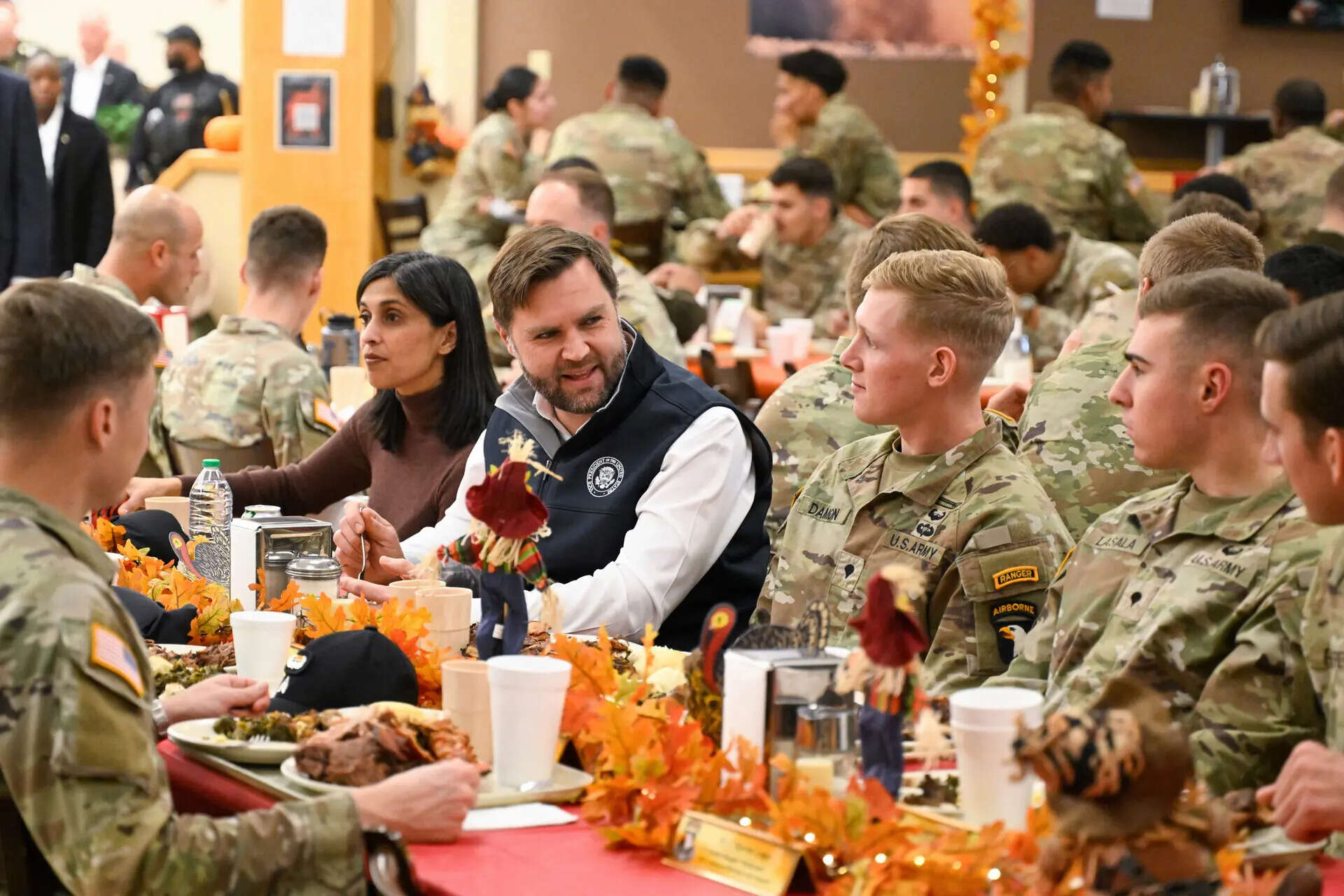
Vice President J.D. Vance and Second Lady Usha Vance (left) share a Thanksgiving meal with base soldiers during a visit to Fort Campbell (AP Photo)
The shift reflects a broader shift within the Republican Party, with populist nationalism gradually replacing the foreign policy doctrine that dominated conservative politics for decades.Today, Vance himself echoed the administration’s tough stance on Iran. In an interview discussing the conflict, he laid out this goal in stark terms: “The principle is very simple: Iran cannot have nuclear weapons.”The contrast between these two moments — from calling Trump “cultural heroin” to defending the Trump administration’s geopolitical doctrine — illustrates the scale of his political evolution.
Millennial Ambition
Forty-year-old J.D. Vance represents a generational shift in American politics. He is part of the first wave of millennials to reach the highest levels of government and is widely viewed by allies as a potential presidential candidate.If he ultimately achieves this ambition, he will become the first millennial to win the White House.This possibility determines how he carries out his duties as vice president. A politician with presidential aspirations must remain loyal to the government while retaining the political identity that helped fuel his rise.For Vance, this identity is closely tied to populist criticism of U.S. foreign policy.The war in Iran thus forces him to strike a delicate balance between defending government decisions and maintaining the credibility of a political movement deeply skeptical of foreign wars.
The bigger picture
The debate over J.D. Vance’s visibility during the Iran War reflects deeper tensions within contemporary American conservatism. One faction continues to emphasize the importance of America projecting military power abroad. Another increasingly advocates that the United States should avoid costly interventions and focus on domestic priorities. Vance has long subscribed to the latter view. As vice president, however, he now serves in an administration willing to use military force to reshape geopolitical realities. The result is an unusual political dynamic. Defense Secretary Pete Hegseth has become the public face explaining and defending the war, while the vice president played a quieter role in the early stages of the conflict. In Washington, the contrast has many observers asking the same question.Where the hell is J.D. Vance?