



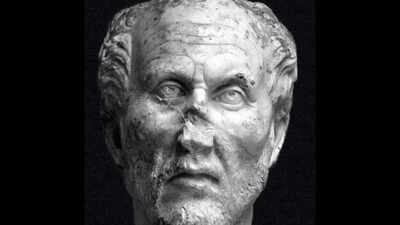
There once was a philosopher who refused to have his portrait painted. He won’t even tell people his birthday. The reason is strange and surprising. He was almost embarrassed to own a corpse and saw no need to celebrate the day it arrived. His name was Plotinus and he lived in the Roman world about 1800 years ago. He has been pursuing a concept throughout his life: the true self is not the body, but the soul. The quote above is one of his most famous lines. This sounds simple, but points to one of the boldest ideas in all of philosophy. This is what it really means.
Plotinus’ Quote of the Day
“The purification of the soul is to let it be alone, without the company of others, and it will be pure.”
who is Plotinus
Plotinus was born around 204 or 205 AD, most likely in Egypt, which was then part of the Roman Empire. Today he is considered the founder of the Neoplatonist school of thought. Simply put, this means that he took the ideas of the ancient Greek philosopher Plato from about 500 years ago and reconstructed them into something deeper and more spiritual.As a young man, he went to the large city of Alexandria to study. There he found a teacher named Ammonius Saccas and stayed with him for about 11 years. That long apprenticeship shaped everything that followed.Plotinus was also curious about the wider world. On one occasion, he joined a Roman military expedition heading east, in part because he wished to understand Persian and Indian philosophy. The battle failed and the emperor who led it was killed. Plotinus barely escaped with his life. Soon after, at around the age of 40, he settled in Rome and began teaching. He spent the rest of his life there.
The man who wants to leave the body behind
To understand this sentence, you need to understand what kind of person the person who wrote it is.Plotinus lived a very simple and disciplined life. He eats very little. He slept very little. He was a vegetarian, which was unusual at the time. Much of what we know about him comes from his devoted student Porphyry, who later wrote a brief account of his teacher’s life.According to Porphyry, Plotinus seemed ashamed of living in the flesh. That’s why he refused to sit down for a portrait. He felt that the body was only a temporary shell, an ephemeral image of a real person, not worth replicating in paint or marble.But here’s the surprising part. He is not a cold or selfish hermit. People trust him completely. Wealthy families in Rome asked him to care for their orphans and manage their money and property. They knew he was honest and would not deceive anyone. So this is a man with his head in the sky but his feet still planted in everyday life. He cares about real people while thinking about eternal things.
What does Plotinus actually mean?
Now about the offer itself. On first reading, this sounds like advice to avoid crowds and be alone. This is not exactly what Plotinus meant.For him, the soul is the true center of a person. But in daily life, he believed the soul became crowded and confusing. It is filled with noise, desires, worries, endless images and distractions pouring in from the outside world. All this, he felt, drew the soul away from itself.The full version of his lines makes this even clearer. He said that the soul is pure when it does not keep company with others, does not accept external thoughts, and no longer chases every passing image. In other words, purifying the mind is clearing away clutter. It means returning the soul to its original calm, simple and single-minded nature.Therefore, the “corporations” he warns about are not really other humans. This is a spiritual crowd. The constant chatter in my head. Endless cravings and reactions never allow the mind to calm down.
Why “alone” doesn’t mean alone
This is the part people often get wrong, so it’s worth slowing down.When Plotinus talks about solitude, he is not describing loneliness or sadness. He was describing an inner stillness, a state of soul integrity and inner peace. He believed that everything in existence came from a single source, which he simply called “The One.” According to him, the goal of human life is for the soul to find its way back to its source.He summed it up in one of the most beautiful phrases in philosophy. He described the spiritual journey as “the flight of the lonely to the lonely.” The lonely soul returns to the source of all loneliness. For Plotinus, solitude does not mean emptiness. This is the deepest connection.This is very different from how we usually think about loneliness. Most of us view loneliness as something to escape from. Plotinus saw it as something within reach.
How did this phrase survive?
It’s worth pausing to ask how on earth the words of a third-century man reached us.Plotinus did not write cleanly for the public. He wrote dense and difficult notes, often had poor eyesight, and was too lazy to revise. After his death in AD 270, his pupil Porphyry took on a difficult task. He collected all the scattered writings of his teachers and compiled them into a great work.Porphyry divides the material into six groups, each containing nine papers. The Greek word for nine is “ennea,” which is why the series is called Enneads. Without careful editing, these ideas may be lost forever. Instead, they continued to shape Christian thinkers, Islamic philosophers, and mystics for more than a thousand years.So the quote you read today only exists because of a devoted student who refused to let his teacher’s mind fade away.
Why this quote is still relevant today
You might think that 1800-year-old ideas about cleansing the soul have little relevance to modern life. In fact, it feels almost uncomfortable.Think about what a typical day feels like right now. The phone rings. Notifications piled up. There are messages to respond to, videos to scroll through, comments to respond to, and a hundred little worries competing for your attention. The mind rarely has quiet moments. This is exactly the kind of crowded soul Plotinus describes, only with the addition of a screen.His advice, stripped of the ancient language, is what a modern health coach might say. Take a step back. Turn off the noise. Stop feeding your brain with endless images and reactions. Give yourself a simple space and don’t be constantly disturbed.The difference is that Plotinus is not looking for relaxation or productivity. He believed that only by quieting the soul could true clarity and even a glimpse of the divine be achieved. Peace is not the end goal. It’s the doorway to bigger things.
What Plotinus can teach us about being alone in a noisy world
Plotinus always acted on his beliefs. In the last few years of his life, he became seriously ill, and one by one his friends and students drifted away from him. He spent his final days in the countryside, far from the busy life of Rome and very lonely.Porphyry recorded what were said to be his teacher’s last words. Plotinus told those around him that he was trying to give back his own sanctity to the sanctity of everything. Even at the end, his thoughts turned inward and upward, toward the single source he described throughout his life.It’s a quietly powerful image. A person slips away in solitude, not afraid of being alone, but finally calming down completely. That’s the whole point of his philosophy.This leaves a simple problem for the rest of us as we are surrounded by noise, screens and endless company. When was the last time you were truly alone with your thoughts? What would you hear if you ended up doing this?


