

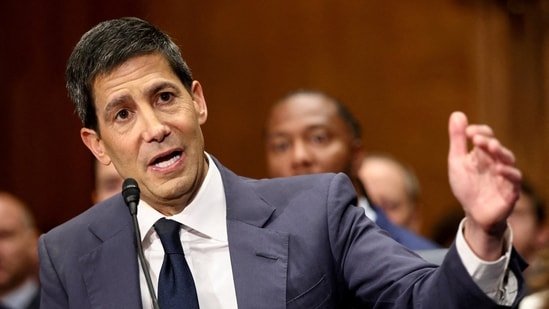
The Senate confirmed Kevin Warsh as the next Federal Reserve chair on Wednesday, handing President Donald Trump a key victory as the central bank faces growing political and economic pressure. Warsh was approved in a 54-45 vote and will officially take over on May 14, 2026, succeeding outgoing Fed Chairman Jerome Powell at the end of his term. He is expected to chair the first Federal Open Market Committee meeting on June 16-17.

The former Fed governor, once seen as a traditional inflation hawk, now takes on the role amid growing debate over interest rates, inflation and central bank independence.
The fight against inflation is urgent
Warsh inherits a difficult economic backdrop, with inflation remaining above the Fed’s long-term goal and new geopolitical tensions creating new uncertainty for the economy.
Consumer prices recently climbed to 3.8% year-over-year, in part due to rising oil prices as a result of the expanding conflict in Iran. Meanwhile, employment data remains mixed, with weak job growth masked by eviction policies and a decline in labor force participation due to an aging workforce.
The Fed now faces competing pressures: either keep interest rates high to curb inflation or lower them to support economic growth.
“Regime change” remarks raise concerns
Warsh has repeatedly criticized the Fed’s recent handling of inflation, particularly the sharp spike in 2021-22. He also called for sweeping institutional changes, arguing that the central bank’s communications strategy had become too politicized and too transparent.
He has previously said the Fed needs “system changes” and questioned whether tools such as quarterly interest rate forecasts make it harder for policymakers to quickly change course when economic conditions change.
His approach could mark a major shift from decades of increasing central bank openness.
Trump pressure expected to remain a major issue
Even before he officially takes office, analysts believe Warsh’s relationship with Trump could become one of the defining challenges of his term.
“Probably the biggest challenge for Warsh is dealing with President Trump,” David Wessel said, according to AFP.
“The president doesn’t respect the independence of the Fed and he wants interest rates lower.”
Trump has repeatedly attacked Powell over monetary policy decisions and has previously supported efforts to target Fed officials, including a Justice Department investigation into Powell related to cost overruns on the central bank’s renovations.
That investigation was later dropped as the administration moved forward with Warsh’s nomination.
Fed disagreements add another layer of uncertainty
Warsh also took office during a period of unusual division within the Fed.
At the central bank’s most recent meeting, several policymakers openly pushed for the possibility of future interest rate hikes — a rare disagreement that highlighted a growing divide over how aggressively to combat inflation.
“One of the challenges Warsh faces is that the Fed does appear to be divided — sometimes along partisan lines, unlike in the past,” Wessel added.
In addition to this unusual transition, Powell is expected to remain on the Fed’s Board of Governors even after resigning as chairman, making him the first Fed chair to step down in more than seven decades.
(Using AFP input)