


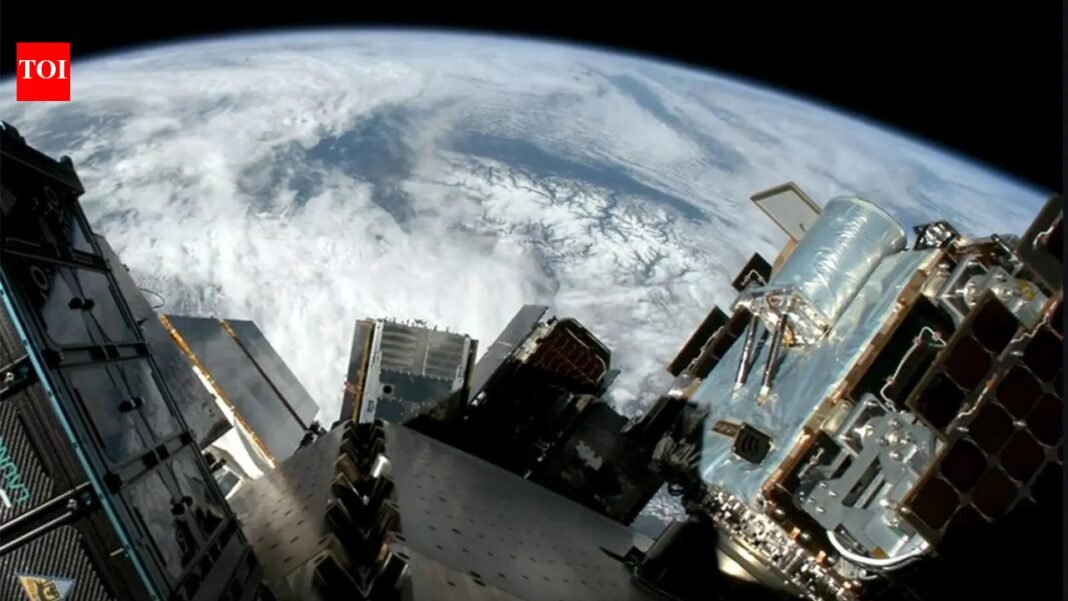
BENGALURU: When Bengaluru-based space startup GalaxEye on Sunday launched its first commercial satellite, Drishti, into orbit aboard a SpaceX Falcon-9 rocket, it was not just another launch for India’s private space sector. Considered India’s largest privately developed Earth observation satellite and the world’s first OptoSAR satellite, Drishti also adds a rare new feature to the country’s Earth observation fleet: a satellite that can “see” through clouds, darkness and severe weather, while also capturing traditional optical images. Suyash Singh, co-founder and CEO of GalaxEye, told TOI: “This will be the 16th remote sensing satellite available in India, making it among a small group of spacecraft. It also has capabilities considered useful for strategic and security applications, of which there are only a handful of satellites in orbit to date. “Drishti is the world’s first satellite to carry the “SyncFused OptoSAR” payload, which combines electro-optical imaging and synthetic aperture radar (SAR) on a single platform. Optical satellites provide traditional high-resolution images, but are affected by clouds and darkness. Radar satellites, on the other hand, can operate day and night and penetrate clouds, smoke and rain, although their images are more difficult to interpret.GalaxEye says that by synchronizing and combining the two data streams, the satellite can produce more consistent and usable imagery for ground users.The spacecraft is expected to support applications ranging from border surveillance and defense monitoring to disaster response, agriculture, infrastructure planning and insurance assessments. For example, during floods, tornadoes or landslides, radar imaging can continue to be useful even if cloud cover prevents optical satellites from capturing images.Lieutenant General AK Bhatt, Director General of the Indian Space Society (ISpA), said: “This marks a critical shift in India’s approach to Earth observation. It is a clear proof of concept for reforms in India’s private space sector and marks a shift from small-scale testing to sovereign, all-weather surveillance capabilities that are critical for national security and disaster response.”AI processing and first imageAnother key feature on board is artificial intelligence processing powered by Nvidia’s Jetson Orin computing platform. Some of the processing will take place directly in orbit, rather than transmitting large amounts of raw images back to Earth for analysis. The idea is to reduce the time required to convert satellite imagery into actionable information.GalaxEye said the satellite can provide imagery with a resolution of 1.5 meters and revisit global locations every seven to 10 days. The spacecraft is about the size of a compact refrigerator and also carries a deployable antenna that spans about three and a half meters.Following successful deployment and commissioning, preliminary images are expected to be delivered to customers in the coming weeks. “This satellite has generated significant interest from government and commercial stakeholders internationally who seek to obtain high-quality, high-frequency Earth observation data,” GalaxEye said after the launch.After Drishti launches, the startup plans to build a larger constellation of 8-12 satellites over the next four years, with future versions aiming to provide clearer images.Pawan Goenka, Chairman of India’s National Space Promotion and Authorization Center (IN-SPACe), the country’s space regulator, said: “The continuous efforts of India’s private space technology ecosystem over the past five to six years in trust building, capacity building and commercialization are now showing tangible results. Drishti is a good example of this – it is the world’s first OptoSAR satellite produced by the Indian private sector.“