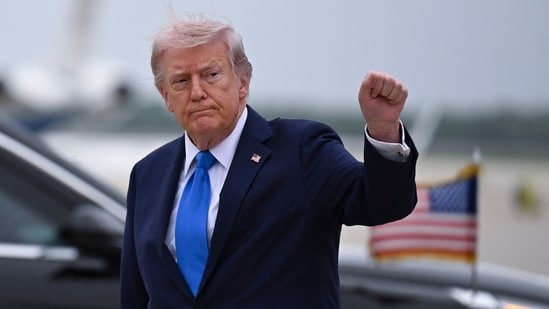




President Donald Trump’s ambitious golden-domed homeland missile defense plan faces growing doubts about funding, congressional support and technical feasibility, even as top Pentagon officials insist the project is moving forward, Politico reports.Top Pentagon officials gathered at Fort Story, Virginia, on Thursday to showcase progress on a plan to build a nationwide defense system against threats ranging from intercontinental ballistic missiles to drones. But behind the public optimism, the project faces serious financial and political obstacles.
According to Politico, the Golden Dome system is expected to cost between $185 billion and $3 trillion, while the Pentagon will seek $17 billion next year through budget coordination and only $400 million through the normal appropriations process.The strategy has already met resistance from congressional Republicans, who appear unwilling to rely on reconciliation ahead of crucial midterm elections.Ken Calvert, chairman of the House Appropriations Defense Subcommittee, told POLITICO: ” [reconciliation] The most efficient and effective way to spend your money? In my opinion, no. “The Golden Dome concept is designed to protect the United States from multiple threats by leveraging a network of existing and next-generation systems through artificial intelligence connections capable of sharing battlefield data in real time. Key components are expected to be operational by 2028, meeting Trump’s timeline.Gen. Mike Gatland, who is leading the Pentagon effort, defended the plan’s viability.“To the skeptics, let me say this,” Gatland said. “The Golden Dome is achievable. It is not a single point of failure.” He added that the purpose of the project is to “strengthen global stability by creating deep doubt in the minds of adversaries. They will not win.”Gaitland acknowledged, however, that much of the technology involved remains confidential and declined to provide a detailed breakdown of spending.“I can’t tell you exactly where the money is going,” he said, adding that the system would combine land, air and space-based assets. “We’re actually buying hardware. We’re not prototyping.”Politico reports that an early component is already being tested domestically. The Army’s long-range persistent surveillance system installed at Fort Story uses a 360-degree sensor array to detect cruise missiles, drones and aircraft.However, MPs expressed frustration at the government’s lack of detailed consultation.Rep. George Whitesides said communications have not yet “reached the level of a detailed spending plan.”“I can’t afford to put a lot of money into it without having a fairly consistent view of what should be done,” he said.Questions about affordability also arise. Gaitland recently warned lawmakers that the space-based interceptor considered the centerpiece of the shield could be abandoned if the cost becomes too high.“We are very concerned about affordability,” Gaitland told the House Military Strategic Forces Subcommittee. “If we couldn’t afford it, we wouldn’t go into production.”Golden Summit received about $23 billion last year through a summer settlement program, but Politico said those funds were delayed, frustrating defense contractors seeking contracts.Jeff Hanke, president of space systems at L3Harris Technologies, said the industry had hoped the process would be accelerated.“We just have to continue to work with them, share with them and help them move forward as quickly as possible.”According to Politico, the White House plans to incorporate the Golden Dome into the basic federal budget after 2027 through a dedicated “American Golden Dome Fund”. The allocation is expected to increase to $14.7 billion in 2028, $15 billion in 2029, $16 billion in 2030, and $15.8 billion in 2031.For now, the future of Trump’s signature defense program depends largely on a Republican-controlled Congress that remains wary of another reconciliation battle. Acting Pentagon Comptroller Jules Hurst said other options are already being considered.“If the White House and Congress decide that reconciliation is not the right approach, we will return to the White House and work with Congress to develop a new strategy [path],” Hurst said.