


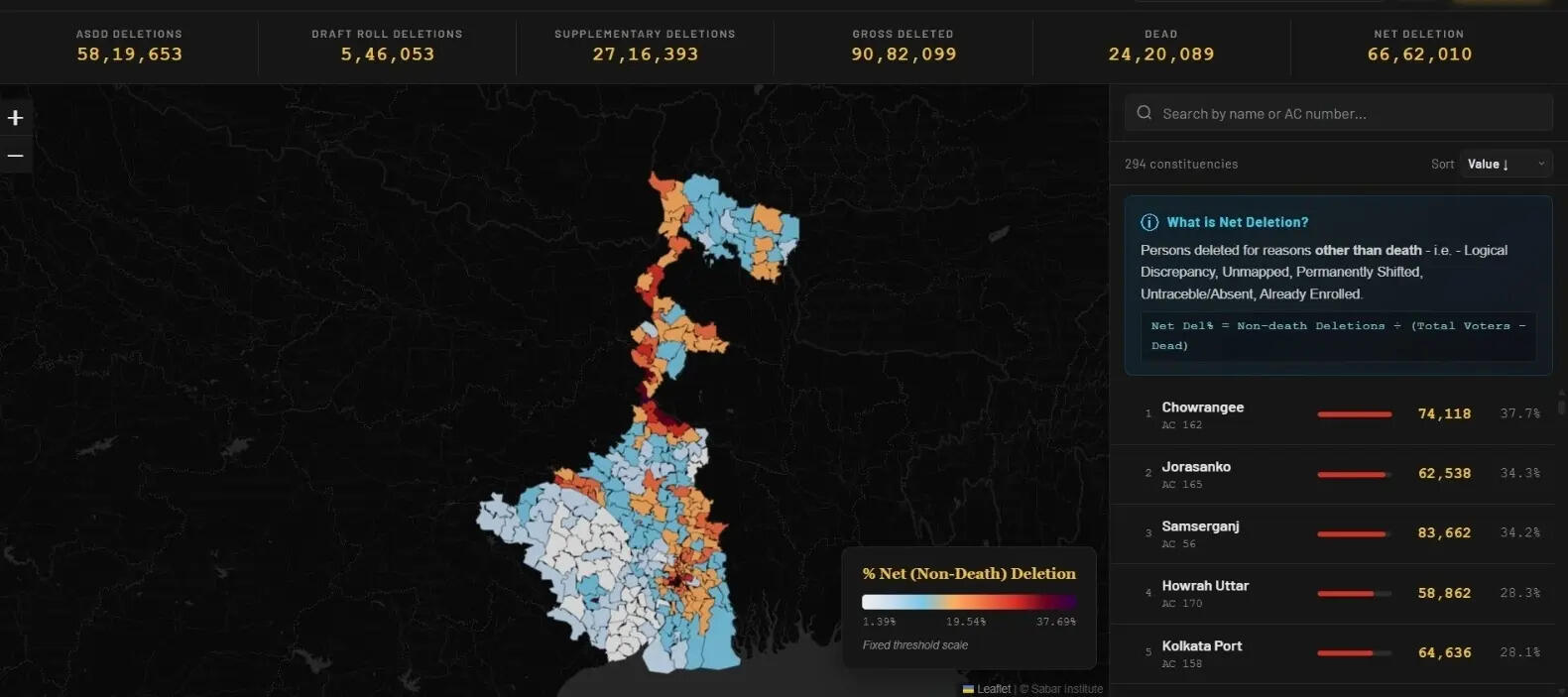
“My grandfather chose India over Pakistan and ensured that Murshidabad remained in the country and then they removed my name,” Syed Reza Ali Mirza, a direct descendant of Mir Jafar, told TOI in Murshidabad, where Chhote Nawab was visibly upset. A few hundred meters away, a Hazaduari tour guide and a Tongala turner expressed the same regret. Although they claim to hold documents dating back more than 300 years, their names have been redacted from the SIR proceedings. They still have deep faith in the constitution and the electoral process, and believe their names will eventually be restored. But the feeling of disappointment, of being suddenly left out and leaving a mark in your own backyard, is hard to ignore. Versions of this sentiment can be found across several districts in south Bengal, from Chowringhee in Kolkata to Howrah Uttar and Howrah Madhya, and from Bhangar in South 24 Parganas to Deganga in North 24 Parganas, with many residents claiming that despite possessing valid documents, they bore the brunt of the cleanup drive.That anger is now spreading against the changing electoral backdrop. After the verdict, 27,16,393 out of 60,06,675 voters who were scrutinized were deleted. Along with this, the number of voters in Form 6 has also increased and the number of voters has reached 6,82,51,008. However, even after adding these figures, the total is still 83,86,521 lower than the previous figure of the SIR, which is why the sense of hurt in the affected communities remains deep-rooted.In Howrah’s Tikiypara, 85-year-old rickshaw puller Hafeez asked Chief Election Commissioner Gyanesh Kumar to check his documents and said he could compare them with those of the Central Election Commission. Skepticism is brewing among several minority groups. Many residents believe the deletions were not routine censorship but deliberate exclusions. A significant number directly linked this to their loyalty to the ruling Trinamool Congress party. “Didik Harat Chaiya EC“The Election Commission wants to defeat Didi,” was a recurring refrain. In Howrah, local Trinamool workers believe the move could backfire as Muslims whose names remain on the list may now feel more compelled to vote for the party. Former minister and Kamalhati candidate Madan Mitra put it bluntly: Even if only one vote counts, that vote will go to the Trinamool.
Many Muslim voters said Mamata Banerjee ensured that the community lived in relative peace, did not openly discriminate against any religion, and kept welfare schemes running smoothly. In this scenario, voting for Trinamool is no longer out of enthusiasm but out of responsibility and protection. This feeling seems strongest where the party is seen as the only viable force capable of keeping the BJP out.However, this consensus is not uniform. In places like Bangal, Muslim ISF supporters complained of discrimination in housing benefits by the TMC government. In Baharampur, Adil Chaudhry accused the ruling party of orchestrating the 2024 riots. Sabir Ahmed, director of the Sabal Institute, believes that the impact of the SIR across geographies is likely to solidify minority support behind the ruling party. In his interpretation, the overt anti-incumbency sentiment among minorities on issues like OBC reservation and the Waqf Bill has now receded, replaced by more immediate fears of documentation, exclusion and vulnerability. He opined that for many people, where the elections become a matter of survival, they may choose the TMC, which has been strongly opposed to the SIR compared to other parties such as the Left, Congress and ISF.Ahamed’s interpretation of the data is that clearing patterns change between ASDD stages (absent, displaced, dead, or duplicate) and underadjudicated stages. According to him, Muslim-dominated seats initially showed relatively high numbers of mapped populations, while the Matua region appeared to be unmapped.
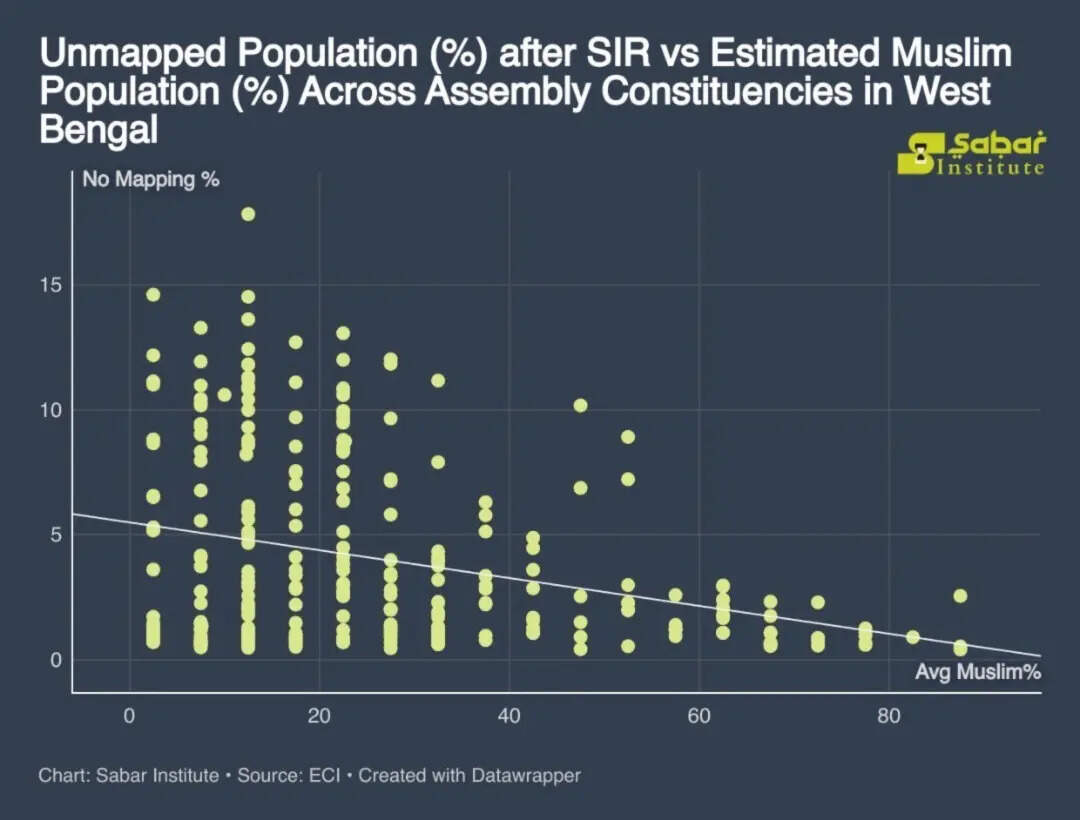
But once the underadjudicated data are compared to the Muslim population, the pattern changes. He said there was a clear positive correlation between the rate of non-trials and the Muslim population. His analysis is that the final volume has a similar trend.
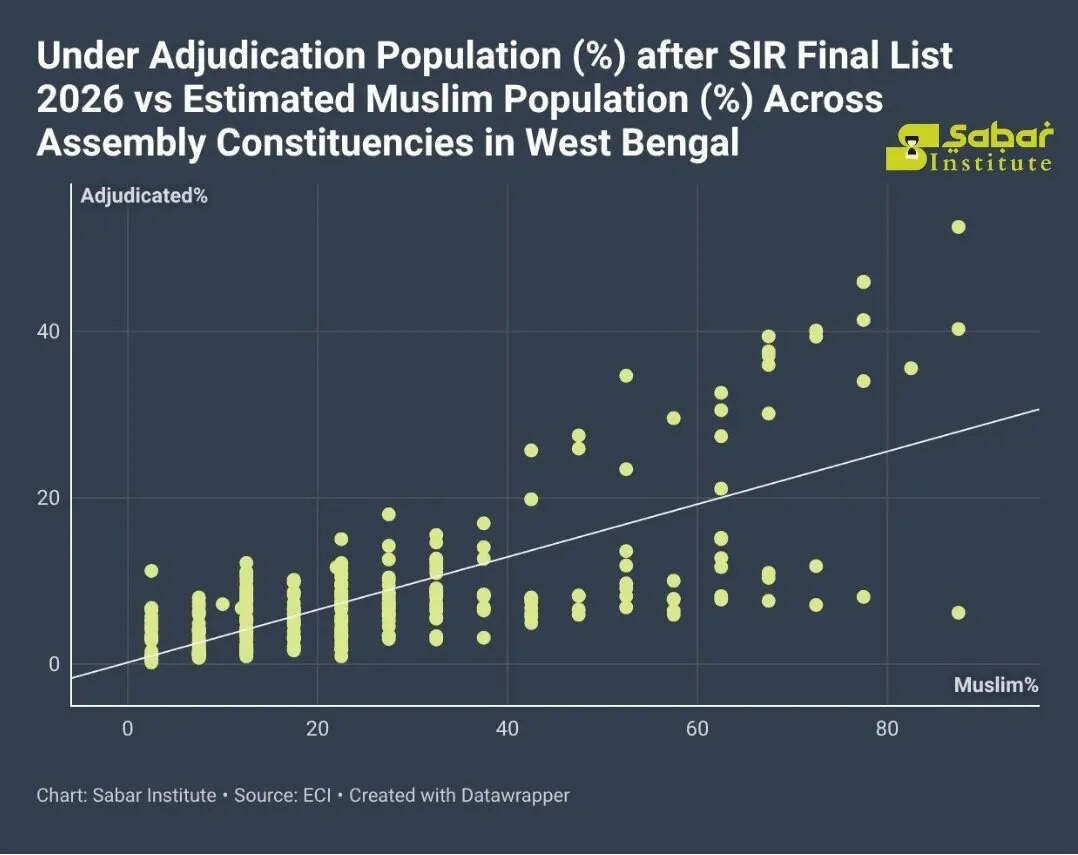
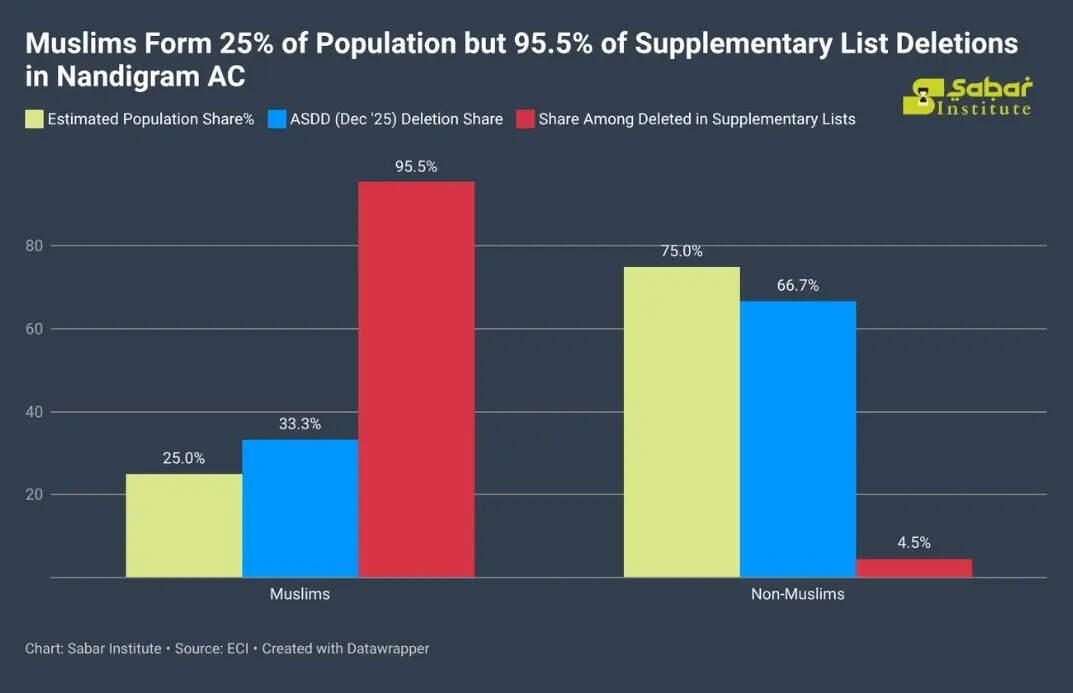
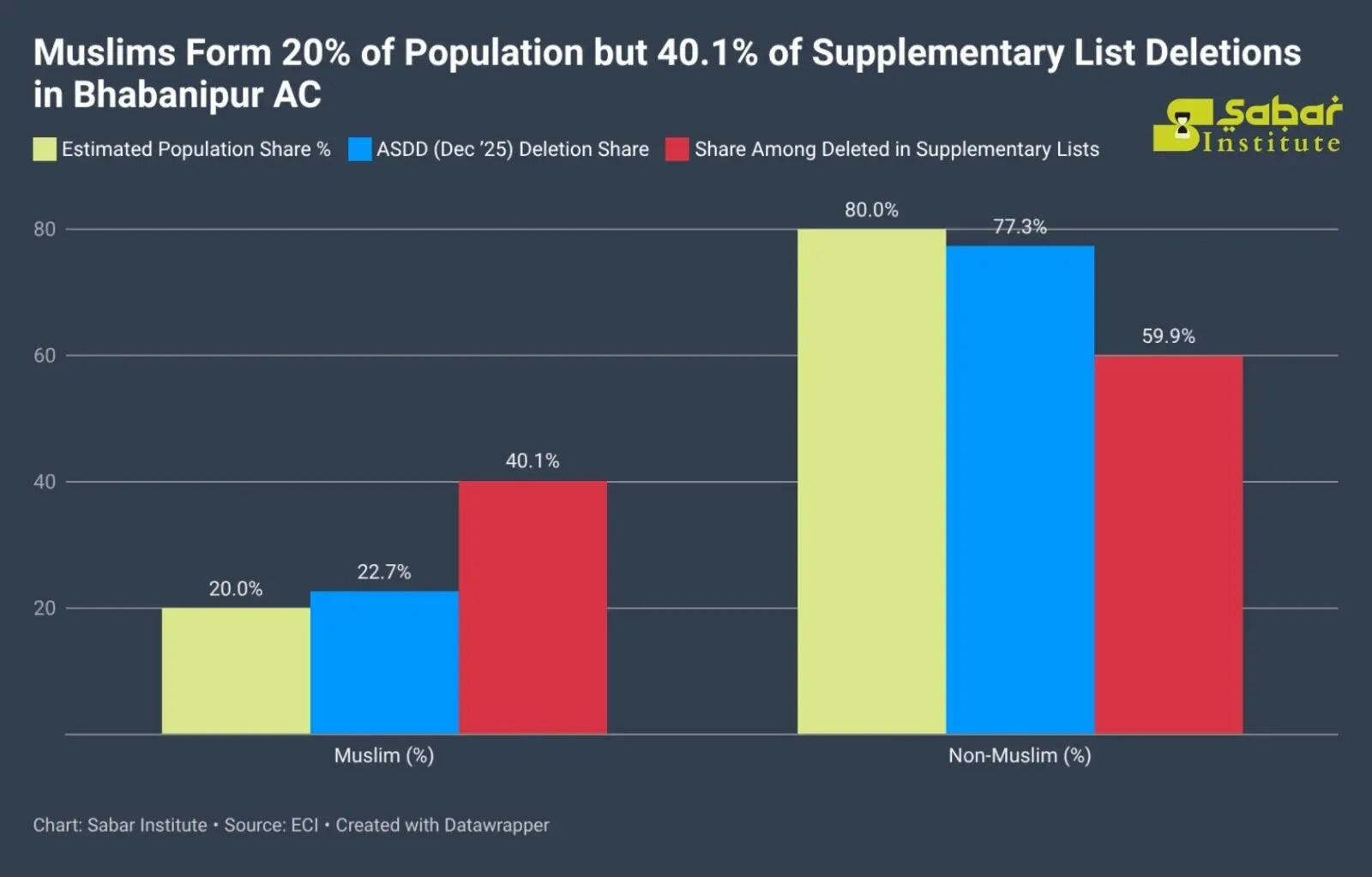
He pointed out constituencies such as Shamsherganj, Lalgola, Bhagabangola, Metiabruz, Farakka and Motabari as examples of places where a large number of deletions occurred after scrutiny. Wider constituency data also shows that constituency deletion was particularly severe in Murshidabad, while significant losses were also seen in Malda, North Dinajpur, South 24 Parganas, Birbhum and the Matua-dominated areas of North 24 Parganas and Nadia. Places like Domkar and Farakka, which are more than 90 percent mapped, now face widespread deletion, Ahmed said. The researchers conducted a micro-level analysis of Bhowanipore and Nandigram, the most popular constituencies in these polls, and found that Muslim deletion rates were unusually high. Ahmed believes all of this points to a biased approach to removal.
At the same time, not everyone agrees that this will automatically translate into clear electoral dividends for the Trinamool. Political commentator Suhamoy Maitra said there was no clear evidence that voters in Muslim-dominated areas such as Malda, Murshidabad and North Dinajpur would switch en masse to the ruling party as a result of the mass deletion. Instead, he argued, those dissatisfied with the government may still trust the Congress and the Left. Referring to the 2024 election results, he noted that the Third Front’s vote share improved compared to 2021 and still retained a meaningful base. On the wider clean-up, he said removing some 5.82 million ASDD names from draft lists could hurt the ruling party, which has long prided itself on its organizational strength, but warned against drawing any direct conclusions.The Congress party launched an aggressive campaign in Malda and Murshidabad, with Rahul Gandhi spearheading it in Shamsherganj. The party has many opportunities in places like Sujapur, Maratipur, Ratua and Chanchal in Malda and Jalanji, Lalgola, Baharampur, Sagardij and Farakka in Murshidabad. Likewise, the Left is also hoping to get a chance in seats like Hagram, Kandi, Domkar and Murshidabad. Proper three- or four-person tournaments are expected to be held at Chopra, Karandijpur and Chakuliya in North Dinajpur, and Kumarganj in South Dinajpur. In such competition, even slight shifts in loyalties can tip the balance of power. With stopping the BJP remaining the main goal, minority communities are likely to weigh their options carefully.It is no secret that Muslim voters have been steadily shifting towards the Trinamool since 2011. Muslims make up about 27% of Bangladesh’s population, and they often hold the distinction between the victors and the vanquished. In Malda and Murshidabad, two Muslim-majority districts, Trinamul’s vote share rose by nearly 10 percentage points between 2011 and 2021. During the same period, Muslim representation in Congress and on the Left fell sharply, while the Trinamul vote share rose sharply. However, 2024 also shows that the ruling party is not unshakable in these zones. It slipped at Murshidabad and fell behind in all 12 assembly sections at Malda. This is why the Congress and the Left remain relevant, even if they lack alliances, and the presence of groups like Humayun Kabir’s AJUP complicates the situation.Mamata Banerjee’s inclusive politics are seen by many as winning over minorities. Others think she just sees them as a captive vote bank. Regardless, minority support remains one of the main pillars of the Trinamool’s electoral strength. The anger among ethnic minority voters following the SIR is undeniable. The question is whether the funding will be enough to solidify support behind Didi, helping her secure a fourth term and avoid overt signs of anti-incumbency. We’ll find out in a few days.