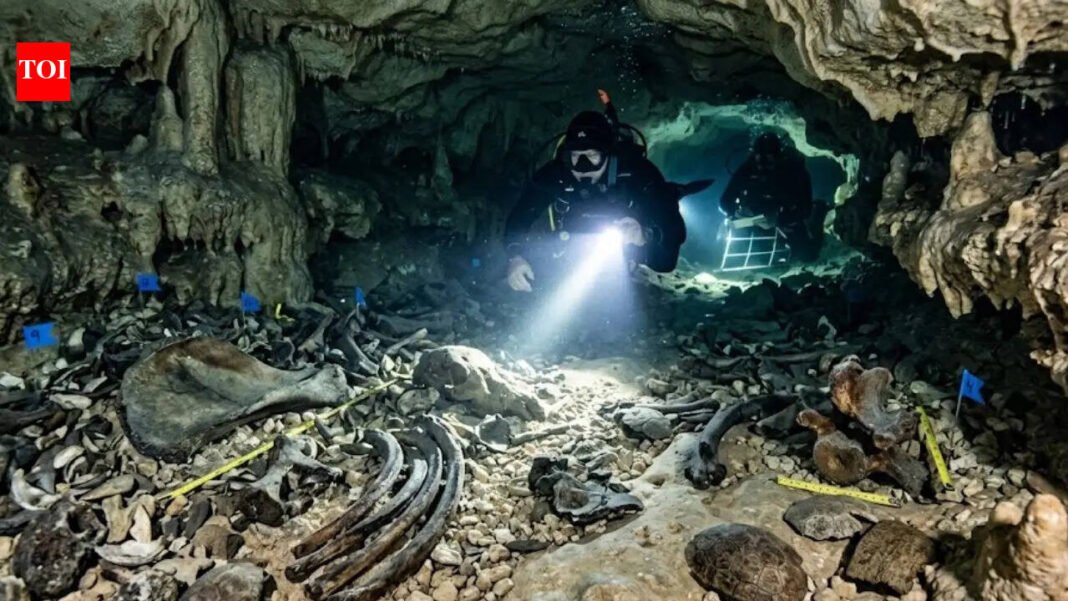
An active underground stream was recently discovered deep in the rolling hills of the Edwards Plateau, a remarkable discovery. While on a snorkeling excursion in the low ceilings and dark passages of Bend Cave in Comal County, Texas, researchers discovered a vast “lag assemblage” of Pleistocene megafauna. It is also of unique importance because it contains fossils from previously unrecorded species in the area (giant tortoises and the lion-sized pampasus (Holmesina septentrionalis)). The findings are forcing paleontologists to rethink their view of central Texas’ ancient climate, as the data suggests the climate was warmer and wetter during a period previously thought to have been dominated by cool, dry grasslands.
Rare fossil discovered in Bend, Texas cave
Collections of macrofaunal fossils from active riverbed locations provide the basis for this work. Bones of the largest animals that lived during the Ice Age, mammoths, mastodons, saber-toothed cats and giant ground sloths, have been found, according to research published by Cambridge University Press. These fossils are mineralized and have a calcite coating due to long-term exposure to carbonate-saturated groundwater. This mineralization and overburden preserve the fossils in a “lag assemblage” at the cave floor.
From lion-sized armadillos to giant tortoises: Rare finds on the Edwards Plateau
As noted by the findings from the Jackson School of Geosciences and the University of Texas at Austin, the most striking scientific discoveries were the bones of the giant tortoise (Hesperotestudo) and pampasa (Holmesina septentrionalis). About the size of a lion, pampasus were a close relative of the modern armadillo, but neither species had ever been found on the Edwards Plateau before. Their presence represents an extreme anomaly because both species require a warm, moist, frost-free climate, an attribute that differs significantly from the accepted cooler, moist model of the late Pleistocene on the Edwards Plateau.
How cluster analysis reveals warm climate 100,000 years ago
Researchers at the University of Texas faced challenges in determining the precise age of the bones. The first preliminary radiocarbon analysis of bioapatite suggested an age of approximately 17,000 years, but this date was determined to be an inaccurate date due to carbonate contamination within the cave environment; therefore, cluster analysis of fossils found at different sites within Texas water caves determined that the fossils were in fact from a warm climate in the fifth phase of marine isotopes dating back more than 100,000 years ago.
How researchers navigate underwater cave passages
The survey of the water cave system is one of the first formal surveys of a water-filled cave system within Texas. Researchers are required to use snorkeling gear/wetsuits with additional underwater lighting to help them gain a better view through the lower ceilings of the riverbed/cave passages compared to most excavation sites located within dry cave systems. Using this technology and approach, the scientists were able to sample 21 different areas along the riverbed. Furthermore, the results of this survey indicate that underwater cave systems are excellent places to preserve paleontological records of the past.