
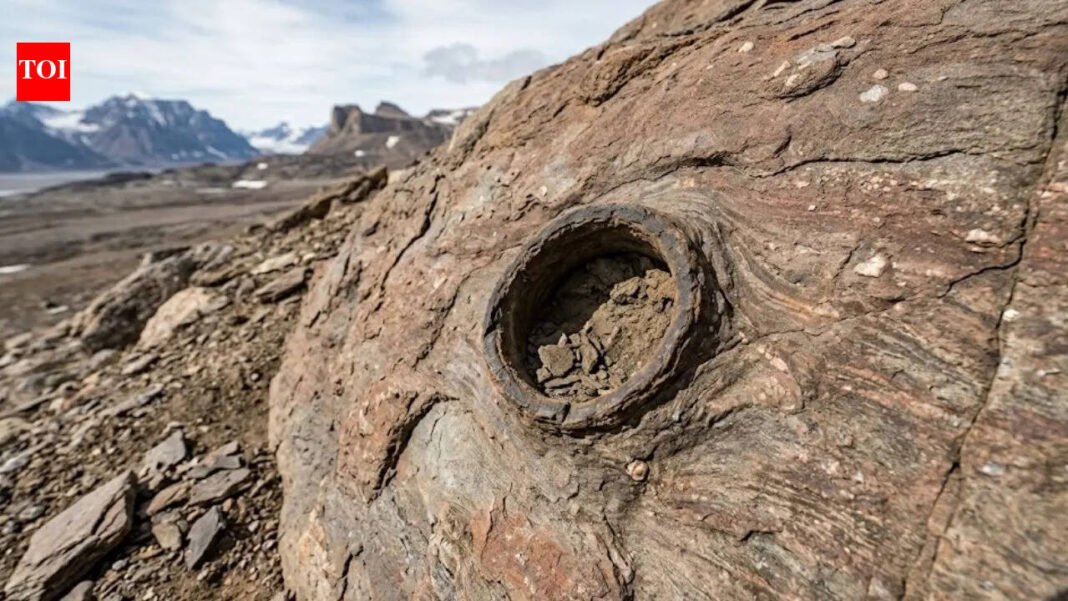
The recently discovered 210-million-year-old Lungfish Cave in East Greenland’s Fleming Fjord Formation provides valuable insights into the variability of Late Triassic climate across ancient Greenland. These cave fossils suggest that lungfish had a strategy of burrowing into the dirt during the seasonal droughts of Greenland during the Late Triassic, through a biological process called aestivation, to survive until the environment became habitable again.The study, published in ResearchGate, increases our understanding (or lack thereof) of the Norian-Raetian transition, showing that environmental pressures, rather than lush ecosystems, defined these ecosystems during the Late Triassic. Geologists and paleontologists are reconstructing the ancient world from these “holes” in the rock, where animals retreated to survive below the surface.
Greenland cave reveals how lungfish lived 210 million years ago
Researchers discovered “trace fossils” of lungfish (cylindrical structures) formed in layers of sediment deposited into the ancient lake basin during the geological processes that formed Fleming Fjord. Unlike corpse fossils, which record the form and appearance of an organism, these caves record the actual behavior of the organism, specifically the behavior of burrowing into the substrate to escape dehydration some 210 million years ago.
The 210-million-year-old secret of Greenland’s fish
The discovery of these caves provides evidence that Triassic-era lungfish were able to enter a dormant stage, called aestivation, as a way of coping with environmental conditions. This physiological response allows the lungfish to survive in intermittent lakes. In other words, these fish could survive in lakes whose water sources were dried up by Pangea’s giant monsoon cycle.
Mudstone caves reveal Greenland’s continental drift
According to the Bulletin of the Geological Survey of Denmark and Greenland (GEUS), the strata of these caves are composed of mudstone and siltstone; they have retained the shape of their cavities as the mud was deposited and hardened. These types of formations are critical for researchers to continue to understand how Pangea moved from place to place and where Greenland was on Earth during this time period.
How a small hole in Greenland is reshaping Triassic climate models
Additionally, these “holes” can serve as climate indicators, indicating large fluctuations in precipitation. An NCBI study published data showing that temperature increases at high latitudes during the Triassic were significantly higher than previously predicted by models. Also, they are much drier than current models indicate. This indicates significant differences at high latitudes from what existing models suggest about past atmospheric and climate conditions.