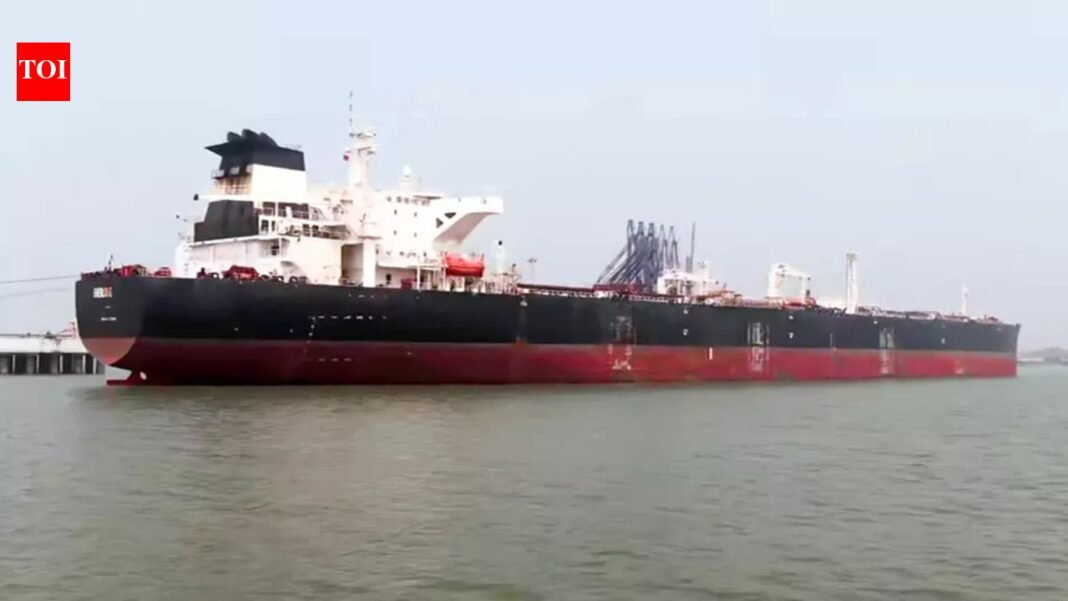
New Delhi: A US-sanctioned oil tanker carrying iranian crude oil Mid-way diversion from India to China, payment-related issues appear to be the main reason for change of declared destination.The Aframax tanker Hirsch, built in 2002 and subject to US sanctions in 2025, had previously targeted Vadinar in Gujarat. If the cargo arrives in India, it would mark the country’s first purchase of Iranian crude in nearly seven years.
According to ship tracking company Kpler, the ship is now signaling Dongying, China, rather than Vadinar.There is no way to confirm that the destination shown on the ship’s Automatic Identification System (AIS) transponder is the final destination and may still change during transit.“An Iranian crude oil tanker, the ‘Ping Shun’, which has been en route to Vadinar in India for the past three days, has made India its announced destination of imminent arrival and is now sending a signal to China,” said Sumit Ritolia, principal research analyst for refining and modeling at commodity market analysis firm Kpler.According to Ritolia, the change of course appears to be related to tightening payment terms.“The shift in flat destinations appears to be related to payments, with sellers tightening terms and moving away from earlier 30-60 day credit windows towards prepayments or near-term settlements.”It is unclear who the actual sellers and buyers of the crude oil are.The development comes as Indian refiners have been exploring opportunities to buy small quantities of Iranian oil from the sea, after the United States last month waived sanctions on such purchases for 30 days.This exemption window expires on April 19.While the waiver allows countries to buy Iranian offshore oil, the main challenge remains payment.Iran remains outside SWIFT (Society for Worldwide Interbank Financial Telecommunication), the global banking messaging system used by financial institutions to securely send and receive transaction information.Early purchases from Iran were made in euros through a Turkish bank, but that option no longer exists.In March 2012, Iran was cut off from the SWIFT system after the European Union imposed sanctions over its nuclear program. In 2018, the United States caused further disruption by reimposing sanctions that severely restricted Tehran’s ability to receive oil payments, conduct international trade, and acquire foreign exchange reserves.The Ping Shun is estimated to be carrying about 600,000 barrels of crude oil, which was loaded from Kharg Island around March 4, according to Kpler. According to Kpler, its announced ETA for arrival in Vadinar is April 4.Vadinar is home to the Rosneft-backed Nayara Energia’s 20 million tonnes per year refinery.If delivered, the cargo would be the first shipment of Iranian crude to India since 2019.India used to be a major buyer of Iranian oil, importing large quantities of Iranian light and Iranian heavy oil due to strong refinery compatibility and favorable business conditions.But after sanctions were tightened in 2018, imports stopped in May 2019 and were replaced by crude oil from the Middle East, the United States and other sources.At its peak, Iranian crude oil accounted for 11.5% of India’s total oil imports.In 2018, India imported approximately 518,000 barrels of Iranian oil per day. Indian imports fell to 268,000 barrels per day between January and May 2019, when the United States offered exemptions to some buyers. It has not been imported since.India’s oil ministry has so far insisted that any decision to resume purchases of Iranian crude would be subject to technical-commercial feasibility.It is estimated that there are approximately 95 million barrels of Iranian oil currently on ships at sea. Of these, about 51 million barrels could be sold to India, with the remainder considered more suitable for buyers in China and Southeast Asia.Ritorlia said the latest rerouting showed how financial terms were at the heart of flows of Iranian crude.“While such changes in the intermediate destination of Iranian crude are not unprecedented, they highlight the increasing sensitivity of trade flows to financial terms and counterparty risks,” he said.“If payment issues are resolved, cargoes may still be shipped to Indian refineries. However, this incident highlights that commercial terms are as important as logistics when determining the flow of Iranian crude to countries other than China.”